English हिन्दी
Connect with us

India News

Gujarat High Court says Hindu marriage requires rituals, registration alone not enough

The Gujarat High Court has ruled that registration alone cannot validate a Hindu marriage unless essential customary ceremonies such as saptapadi are performed, while setting aside a family court order in a marriage dispute.

Published

on

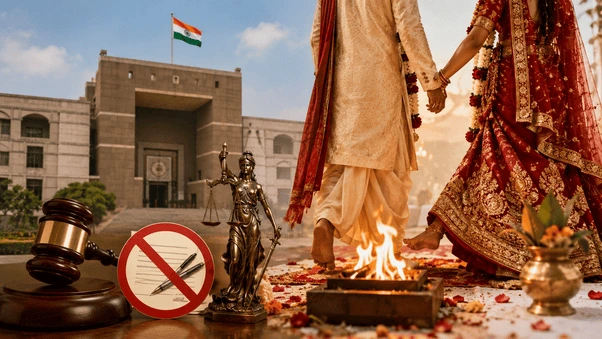
The Gujarat High Court has ruled that registering a marriage alone does not make a Hindu marriage legally valid if the essential customary rites and ceremonies prescribed under Hindu law have not been performed. The court observed that rituals such as saptapadi form the foundation of a valid Hindu marriage and cannot be replaced merely by documentation or registration.

The observation came while deciding an appeal filed by a UK-based man who challenged a family court’s refusal to declare an alleged marriage as void.

Court stresses importance of customary ceremonies

In its order dated June 23, a division bench comprising Justices Ilesh Vora and R.T. Vachhani said Hindu marriage is regarded as a sacrament (samskara) and must be solemnised through the customary rites and ceremonies recognised under the Hindu Marriage Act.

The bench noted that saptapadi—the ritual in which the bride and groom take seven steps together before the sacred fire—is one of the essential ceremonies that gives a Hindu marriage its spiritual, social and legal character.

According to the court, although marriage customs may vary across regions and communities, these ceremonies hold significant religious and cultural value and are believed to spiritually transform the individuals entering the marital union.

Appeal arose from marriage dispute

The appellant, Kaushal Sonar, who resides in the United Kingdom, approached the High Court after a family court dismissed his petition seeking to declare the alleged marriage null and void.

He claimed he became aware of the alleged marriage only after the woman visited his parents and produced a marriage certificate stating that she was his legally wedded wife.

The appellant maintained that no marriage ceremony had ever taken place between them, no Hindu rituals were performed, and the two had never lived together as husband and wife. He further alleged that his signatures on the marriage-related documents had been obtained fraudulently without his free consent.

Family court order set aside

The High Court observed that the woman had admitted before the family court that no marriage rites or ceremonies were performed and that the parties never shared a marital relationship.

In view of this admission, the High Court held that the family court had erred in rejecting the appellant’s plea.

Referring to Section 7 of the Hindu Marriage Act, the bench said a Hindu marriage must be solemnised in accordance with customary rites and ceremonies. Since no such ceremonies had taken place in the present case, the essential legal requirement for a valid Hindu marriage was absent.

Marriage is a sacred institution, says court

The court also made broader observations on the significance of marriage under Hindu law, stating that a wife is regarded as an equal partner and ardhangini while retaining her own independent identity.

It emphasised that marriage is not merely an occasion for celebrations, entertainment or commercial arrangements but a solemn institution that establishes a lifelong, dignified and consensual relationship between two individuals for building a family.

The bench urged young men and women to carefully understand the sanctity and responsibilities associated with marriage before entering into it.

According to the court, customary marriage ceremonies, despite regional and cultural differences, play an important role in giving Hindu marriage its recognised legal, social and spiritual status.

India News

Mamata Banerjee’s niece Bristy Mukherjee found dead in Birbhum

Mamata Banerjee’s 28-year-old niece Bristy Mukherjee was found dead at her residence in Birbhum’s Kusumba village. Police have launched an investigation.

Published

on

Mamata Banerjee

Bristy Mukherjee, the 28-year-old niece of Trinamool Congress chief and former West Bengal Chief Minister Mamata Banerjee, was found dead at her residence in Birbhum district on Tuesday, police said.

Mukherjee was found on the second floor of her family home in Kusumba village in the Rampurhat area. The police have launched an investigation into the circumstances surrounding her death.

Bristy Mukherjee was Mamata Banerjee’s distant cousin’s daughter

Bristy Mukherjee was the daughter of Nihar Mukherjee, who is Mamata Banerjee’s maternal cousin and a regional Trinamool Congress leader.

According to the report, Mukherjee had earlier worked as a non-teaching staff member at Bolpur Upper Primary School. She was among those who lost their jobs following the court proceedings related to the West Bengal school recruitment case.

The appointments of nearly 26,000 teaching and non-teaching staff in state government-aided schools were struck down by the Calcutta High Court, with the Supreme Court later upholding the order.

Police investigation underway

Police said Mukherjee’s body has been sent for an autopsy. An investigation into her death is underway, with authorities expected to establish the circumstances after the post-mortem and other procedural inquiries.

Sources close to the family told that Mukherjee had been undergoing treatment for depression for the past few years.

At this stage, the circumstances and exact cause of her death have not been officially established by the police. Further details are awaited as the investigation progresses.

Continue Reading

India News

Chirag Paswan receives death threat in anonymous letter, hardcore terrorists mentioned

Union Minister Chirag Paswan has received a death threat through an anonymous letter mentioning “hardcore terrorists”. The matter has been conveyed to the Union Home Ministry, CRPF and Bihar government.

Published

on

Chirag Paswan

Union Minister Chirag Paswan has received a death threat through an anonymous letter that warned he would be killed by “hardcore terrorists”.

Mr Paswan, who heads the Lok Janshakti Party and is the Union Minister for Food Processing Industries, has Z-plus security.

The matter has been conveyed to the Union Home Ministry, and Home Minister Amit Shah has also been informed. The threat has additionally been brought to the attention of the Central Reserve Police Force (CRPF) and the Bihar government.

Letter seeks urgent investigation

According to a letter sent to the Home Ministry by Chirag Paswan’s secretary, an unsigned communication containing two mobile phone numbers was received by the ministry.

The letter described the communication as containing a direct threat to the life of the Union Minister for Food Processing Industries.

The message reportedly stated: “You will be killed shortly by hardcore terrorists.”

The letter described the direct nature of the threat and its reference to “hardcore terrorists” as a matter of grave concern, raising concerns about the minister’s safety and security.

It requested that the matter be taken up urgently for investigation and that the minister’s security arrangements be reviewed and scaled up if necessary.

Earlier threats to political leaders

The development comes after other instances of death threats involving prominent political leaders.

In August, a man was arrested in Jharkhand for issuing death threats to Prime Minister Narendra Modi and Union Home Minister Amit Shah.

The man, identified as Alim Ansari, had posted objectionable videos on social media in which he used abusive language against Prime Minister Modi, Uttar Pradesh Chief Minister Yogi Adityanath and Amit Shah, besides issuing death threats.

In 2023, the Delhi Police reported receiving two phone calls from a man threatening to kill Prime Minister Modi, Amit Shah and then Bihar Chief Minister Nitish Kumar.

Continue Reading

India News

PM Modi urges Indians to avoid foreign travel, weddings abroad

Prime Minister Narendra Modi praised India’s 7.8% GDP growth and urged citizens to promote Swadeshi by avoiding non-essential foreign travel and weddings abroad.

Published

on

PM Modi

Prime Minister Narendra Modi on Tuesday congratulated Indians after the country recorded 7.8% economic growth in the April-June quarter of the financial year 2026-27, while urging citizens to support the domestic economy by limiting non-essential spending abroad.

In a video message, Modi called for greater emphasis on the principles of Swadeshi, Vocal for Local and Made in India. He appealed to Indians to avoid travelling abroad for leisure and to choose India instead for destination weddings.

The Prime Minister also urged citizens to buy gold only when necessary, linking the appeal to his broader call for self-reliance.

PM Modi praises 7.8% GDP growth

Modi said the 7.8% GDP growth reflected the collective efforts and resolve of Indians. The growth came despite global challenges, including wars, instability and disruptions to supply chains.

The government’s latest figures show that India’s economy expanded 7.8% in the first quarter of FY2026-27. The growth was stronger than expectations, although it was lower than the 8.6% expansion recorded in the previous quarter.

Modi said the strong economic numbers reflected growing confidence in India’s economic trajectory.

PM Modi calls for ‘Swadeshi’ and ‘Vocal for Local’

The Prime Minister said Indians should embrace Swadeshi and promote locally made products as part of efforts to strengthen self-reliance.

He urged citizens to avoid foreign travel for leisure and asked them not to organise destination weddings abroad. Instead, he promoted the idea of “Wed in India”, encouraging people to spend on travel, hospitality and celebrations within the country.

Modi also appealed to people to avoid buying gold unless it was necessary.

The message comes as the government seeks to encourage domestic consumption and reinforce the broader objective of an Atmanirbhar Bharat.

Modi links local choices to Viksit Bharat

Modi expressed confidence that greater emphasis on Swadeshi and self-reliance would help India move towards the goal of a developed nation.

He said that stronger participation by citizens in supporting domestic products and services would contribute to India’s long-term development and help create a stronger future for the country’s youth.

The Prime Minister’s message was delivered while he was in Bishkek, Kyrgyzstan, for the Shanghai Cooperation Organisation (SCO) Summit.

Continue Reading

Trending

© Copyright 2022 APNLIVE.com