English हिन्दी
Connect with us

India News

Gulbarg massacre: Gujarat HC rejects plea by Zakia Jafri seeking inclusion of PM Modi as accused

Published

on

Gulbarg massacre: Gujarat HC rejects plea by Zakia Jafri seeking inclusion of PM Modi as accused
[vc_row][vc_column][vc_column_text]Court upholds SIT clean chit to the then chief minister of Gujarat and senior bureaucrats but says petitioner can move the SC

The Gujarat High Court, on Thursday (October 5), refused to accede to a petition which had asked for the inclusion of Prime Minister Narendra Modi and 59 others, including senior police officers and bureaucrats, as accused for being party to a “conspiracy” that led to the 2002 post-Godhra riots and killings.

The high court’s Justice Sonia Gokani, however, allowed the petition to be moved before the Supreme Court.

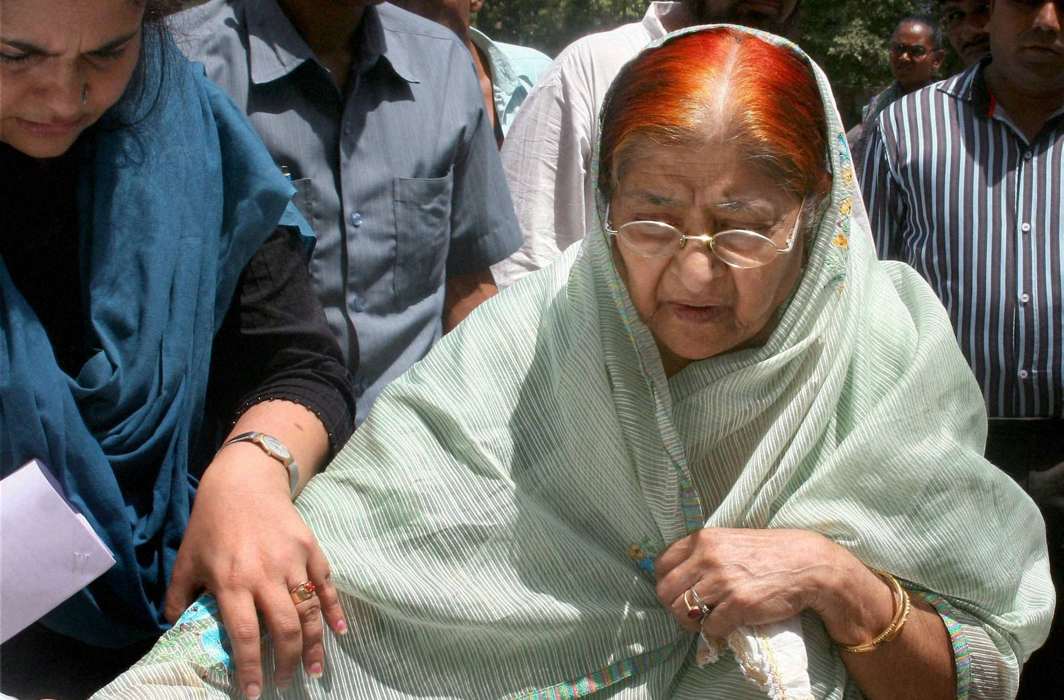
The petition was placed by Zakia Jafri, widow of slain ex-MP Ehsan Jafri. Zakia’s petition pertains to the massacre that happened in Ahmedabad’s Gulbarg society during the 2002 post-Godhra riots. Ehsan Jafri, a former Congress MP, was hacked to death by the Hindu rioters along with 67 others– all Muslims – at the Gulbrag Society on February 28, 2002.

Zakia has maintained that the brutal murder of her husband and others at the society was done at the behest of the then Gujarat chief minister, Narendra Modi. She and her family members have earlier said that numerous calls made by Ehsan Jafri to the chief minister’s office seeking security for the society hours before the rioters reached there had gone unheeded.

Thursday’s verdict of the high court was against a criminal review petition filed by NGO Citizen for Justice and Peace’s (led by activist Teesta Setalvad) which had challenged a magistrate’s order that upheld the SIT clean chit to Modi and others. The allegations refuted by the magistrate were of a “larger criminal conspiracy” behind the riots.

The SIT’s deposition before the high court said that its probe was monitored by the Supreme Court and that its report was generally accepted by all. The court decided that there was no need for further investigation, especially regarding the “conspiracy” angle.

Zakia Jafri’s counsel Mihir Desai had pointed out to the court that the magistrate never considered rejecting the report or ordering a fresh probe, neither did it consider signed statements of witnesses. He also pointed out that submissions of key witnesses such as (former IPS officers) Sanjiv Bhatt, R.B. Sreekumar and Rahul Sharma were not even considered, neither was Tehelka magazine’s sting operation result.[/vc_column_text][/vc_column][/vc_row]

Entertainment

Kriti Sanon’s Raksha Bandhan ad draws criticism over modern festive look

Kriti Sanon’s Raksha Bandhan advertisement has sparked an online debate, with some social media users questioning her contemporary festive outfit and the campaign’s concept.

Published

on

Kriti Sanon’s latest festive appearance has triggered a debate on social media after the actor featured in a Raksha Bandhan advertisement wearing a contemporary outfit.

In the advertisement, Kriti Sanon is seen in an off-white bralette-style blouse paired with a cape and a draped skirt. While the actor has previously experimented with contemporary interpretations of traditional fashion, some social media users criticised her look in the festive campaign.

The criticism was directed particularly at the choice of outfit for a Raksha Bandhan-themed advertisement, with several users questioning whether the look was appropriate for the occasion.

Advertisement’s pet dog sequence also draws reactions

The concept of the advertisement also became a point of discussion online. In the campaign, Kriti is seen tying a traditional rakhi on a dog after the pet barks at her.

The advertisement presents the ritual as a way of including the pet in the family’s Raksha Bandhan celebrations. However, several social media users questioned the decision to include the dog in the festive ritual.

Some commenters accused the brand of making a mockery of Indian festivals, while others said they disagreed with the overall concept of the advertisement.

Social media users criticise Kriti Sanon’s festive look

Kriti Sanon’s outfit became one of the main talking points among those criticising the advertisement. Some users described the outfit as inappropriate for a Raksha Bandhan campaign.

One social media user wrote that Kriti was tying rakhi in a “bra kinda attire” and questioned the use of such an outfit during the festival.

Another commenter compared the treatment of Raksha Bandhan with other festivals and criticised the advertisement’s presentation of the celebration.

Other reactions focused on traditional elements associated with Raksha Bandhan. One user questioned the absence of a puja thali and tilak while also criticising Kriti’s outfit.

A separate comment objected to the inclusion of the dog, arguing that the campaign was not representative of the traditional spirit of Raksha Bandhan.

These comments reflect the views of individual social media users and do not establish a broader consensus about the advertisement.

Kriti Sanon yet to respond to criticism

The Raksha Bandhan advertisement continues to receive mixed reactions on social media. While some users have criticised the actor’s outfit and the campaign’s concept, Kriti Sanon is yet to respond to the criticism.

The debate comes as brands increasingly use contemporary interpretations of traditional festivals in advertising, with the campaign’s presentation becoming a subject of discussion among social media users.

Continue Reading

India News

Rahul Gandhi’s T-shirt style gets a colourful twist for Gen Z outreach

Rahul Gandhi has adopted colourful shirts during his nationwide “Chhatron Ki Goonj” programme as the Congress steps up its outreach to Gen Z.

Published

on

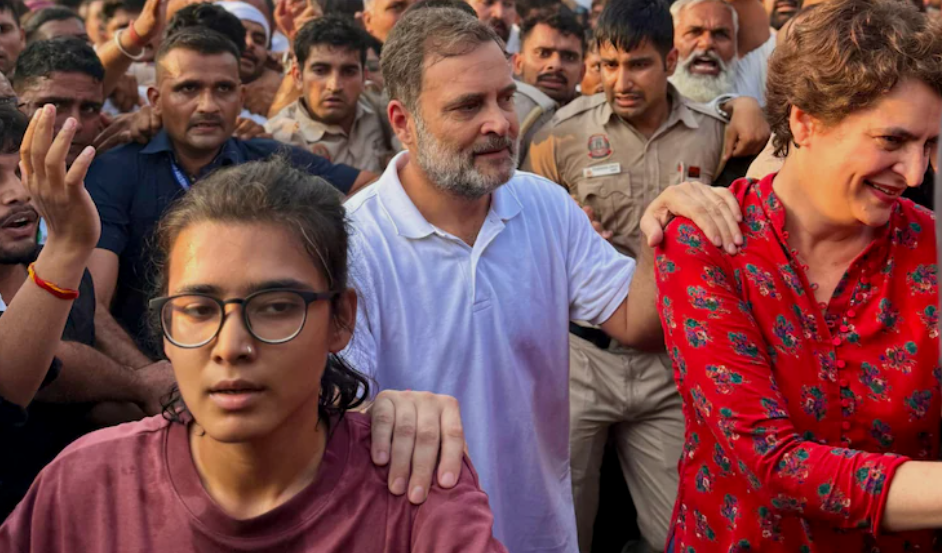
Congress leader Rahul Gandhi has added a new twist to his public image as he steps up outreach to Gen Z through the nationwide “Chhatron Ki Goonj” programme.

The Leader of the Opposition in the Lok Sabha, who became known for wearing T-shirts during the 2022 Bharat Jodo Yatra, has recently been seen in brightly coloured shirts at several student-focused events.

The change marks a departure from the white T-shirts that became closely associated with his appearance during the Bharat Jodo Yatra, when he walked from Kanyakumari to Kashmir.

From white T-shirts to colourful shirts

Rahul Gandhi wore white T-shirts during the Bharat Jodo Yatra, including during its winter leg. He subsequently continued to appear in T-shirts at party programmes and political events.

The style also became a subject of political criticism, with the BJP repeatedly targeting Gandhi over his choice of attire and describing him as “non-serious”.

Gandhi, however, continued with the T-shirt look and it was also adopted by some Congress leaders who had traditionally appeared in kurta-pyjamas.

His latest appearances have brought a more colourful wardrobe into focus.

Rahul Gandhi’s colourful appearances

Gandhi wore a blue shirt at the first “Chhatron Ki Goonj” event in Kota, where he addressed the issue of paper leaks.

In Dehradun, he was seen wearing a shirt instead of his usual T-shirt. At an event in Allahabad, he wore a pink shirt while interacting with students, drawing discussion on social media.

He later appeared in a yellow shirt at an event in Pune.

The Pune programme focused specifically on female students and working women, with Gandhi addressing issues related to women’s safety, freedom and rights.

Congress steps up Gen Z outreach

The “Chhatron Ki Goonj” programme is part of Rahul Gandhi’s outreach to young people, with paper leaks and issues affecting students among the subjects being highlighted.

The Congress is also seeking to engage young women through programmes and interactions focused on issues concerning them.

Youth and women remain important voter groups in elections, and the Congress is increasingly focusing its outreach on Gen Z as it seeks to strengthen its connection with younger voters.

Gandhi’s colourful shirts have consequently become an additional talking point during his latest student and youth engagements.

Continue Reading

India News

MK Stalin announces major DMK organisational Changes in Tamil Nadu

MK Stalin has announced a major DMK organisational overhaul, introducing age and term limits and expanding party districts from 77 to 110.

Published

on

DMK chief MK Stalin has announced a major overhaul of the party’s organisational structure, months after the party lost the Tamil Nadu assembly election.

Acknowledging the defeat, Stalin said the party must openly recognise its mistakes. He also pointed to the functioning of party office-bearers as one of the factors behind the electoral loss.

“Although there are several reasons for our defeat, the functioning of our party office-bearers is also one of them,” Stalin said, stressing that the party must acknowledge its shortcomings and ensure better performance at every level.

Stalin also described the DMK as a “specialist” in making comebacks and said the party would return stronger.

Age and term limits for party posts

Among the major changes announced by Stalin are age and tenure limits for party positions.

Stalin said the changes would involve a significant restructuring of the DMK’s administrative system, with priority being given to new faces. He said the measures were intended to make the party sustainable for the next 100 years and help restore the trust of young people and women.

Under the new rules, branch secretaries must be aged 45 or below and can hold the position for a maximum of two terms.

District secretaries, meanwhile, must be below 70 years of age and can serve for a maximum of three terms.

DMK to increase party districts from 77 to 110

The DMK executive committee has approved increasing the number of party districts from 77 to 110.

The expansion will be implemented as part of the party’s 16th organisational elections. Revenue districts will generally be reorganised so that each party district covers two assembly constituencies.

Where only one constituency remains after the reorganisation, it will be attached to another suitable party district within the same revenue district as a third constituency.

Stalin has been authorised to determine and announce the constituencies that will form the 110 party districts.

New branch structure planned in urban areas

The DMK will also introduce a new branch-level structure in urban areas, along with the post of branch secretary.

The new system will initially be implemented in Chennai, Coimbatore, Madurai, Tiruchirappalli and Salem. It may subsequently be extended to other corporations.

Once the new party districts are announced, district executive committees will have to meet and establish the union, city, area, town, ward and branch-level units within 15 days.

The organisational changes come as the DMK seeks to restructure its party machinery and prepare for its political comeback following its assembly election defeat.

Continue Reading

Trending

© Copyright 2022 APNLIVE.com