English हिन्दी
Connect with us

India News

Hasty GST implementation, noteban to adversely affect GDP: Manmohan

Published

on

Manmohan Singh

[vc_row][vc_column][vc_column_text]Former Prime Minister’s earlier prediction of demonetisation bringing GDP growth down by 2 per cent had recently come true

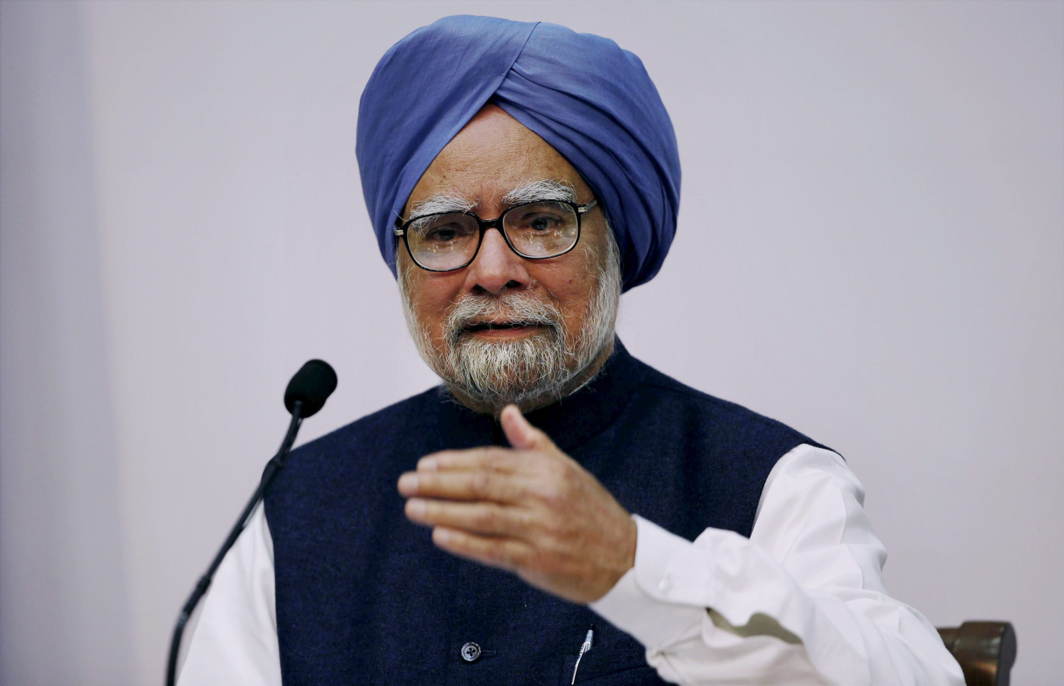
With his prediction of demonetisation pulling down India’s GDP growth rate by two per cent having recently come true, former Prime Minister Dr Manmohan Singh has once again warned against the adverse impact of noteban coupled with effects of the hasty implementation of the Goods and Services (GST) regime on the country’s economy in the near future.

Singh, an economist of international repute, has warned that the hasty implementation of the GST regime that was rolled out in July along with the continuing effect of demonetisation will hit the country’s massive informal and small scale sectors which collectively account for nearly 90 per cent of India’s job creation.

Speaking to CNBC TV18, on Monday, the former Prime Minister said: “Both demonetisation and the GST have had some impact (on the GDP growth)… Both will affect the informal sector and the small-scale sector. These sectors are today responsible for 40 per cent of GDP.”

Singh added that “because the GST has been put into practice in haste, there are many glitches now coming up. This is bound to affect GDP growth.”

The senior Congress leader’s comments come in the wake of recent government data that showed the GDP growth slipping to a three-month low at 5.7 per cent for the April-June quarter – a decline that has been blamed on effects of demonetisation and the GST by a large section of economists and business leaders across the country.

Although the ruling government has been singing praises for Prime Minister Narendra Modi’s decision of October last year to declare the Rs 500 and Rs 1000 currency notes as no longer legal tender – a sudden announcement that flushed out 86 per cent of India’s currency from the market – the slump in the GDP had forced even Union finance minister Arun Jaitley to admit that the new tax regime had impacted the country’s manufacturing sector.

As businesses destocked inventories ahead of the GST kick-off from July 1, gross value added (GVA) in manufacturing declined to a low of 1.2 per cent, from 10.7 per cent, year on year. Gross Domestic Product (GDP) growth in the first quarter of 2017-18 was lower than 6.1 per cent of the preceding one and 7.9 per cent in the same period last fiscal.

Jaitley had said that the fall in GDP growth was a “matter of concern”, although he expressed hope that the economy will bounce back to a 7 per cent growth once effects of GST implementation on de-stocking ease in the current quarter.

Singh, however, doesn’t share Jaitley and the Modi government’s optimism. Shortly after demonetisation was implemented, the former Prime Minister had, while speaking in the Rajya Sabha, called the move an “organised loot and legalised plunder”. In the aftermath of the GST rollout too, Singh had told a meeting of the Congress Working Committee – the apex decision making body of the principal Opposition party that the economy was “running on just one engine of public spending”.

While his prediction of a 2 per cent fall in GDP growth rate due to demonetisation has been proven true, much to the chagrin of the Modi government, it remains to be seen whether the Centre will pay heed to the former PM’s advice now.[/vc_column_text][/vc_column][/vc_row]

India News

BJP’s Punjab outreach faces fresh challenge as farmers return to Shambhu border

The BJP’s push to shift Punjab’s political focus towards development has encountered a fresh challenge as farmers resume protests at the Shambhu border over concerns surrounding the proposed India-US trade agreement.

Published

on

Prime Minister Narendra Modi’s recent visit to Punjab had signalled what many viewed as a fresh political outreach by the Bharatiya Janata Party (BJP) in a state where it has struggled to recover from the fallout of the 2020-21 farm laws protest. However, the return of farmers to the Shambhu border over concerns surrounding the proposed India-US trade agreement has once again brought agrarian issues to the forefront.

Thousands of farmers gathered at the Punjab-Haryana border, while Haryana Police stopped them from marching towards Delhi. The scenes have drawn comparisons with both the 2020-21 farm laws protest and the farmers’ agitation witnessed in 2024.

BJP’s development narrative faces disruption

During his recent Punjab visit, Prime Minister Modi focused on development, infrastructure and investment, signalling the BJP’s intention to shift political discussions away from the farm laws controversy ahead of the Assembly elections, which are expected in about six months.

His decision to wear a green turban, a colour closely associated with Punjab’s farming community, was widely viewed as a symbolic gesture aimed at reaching out to rural voters.

However, the ongoing protest over the proposed India-US trade agreement has interrupted that narrative, with farmers once again mobilising at the Shambhu border.

Concerns over proposed India-US trade agreement

Farmer organisations have expressed concern that lower import duties under the proposed India-US trade agreement could allow heavily subsidised American agricultural and dairy products to enter the Indian market. They argue this could reduce domestic prices and negatively impact farmers’ incomes.

The groups have also maintained that waiting until the agreement is finalised would leave little opportunity to safeguard farmers’ interests.

Punjab BJP president Kewal Singh Dhillon has appealed to farmers not to draw conclusions before the agreement is finalised. He said no final pact has been signed and asserted there would be “no compromise on the interests of farmers and livestock rearers”. He also said Prime Minister Modi has assured that Punjab’s farmers would not be adversely affected.

Opposition steps up attack

The issue has quickly become a political flashpoint in Punjab.

The Congress has launched a campaign against the proposed trade agreement, alleging it could adversely affect the state’s agriculture and dairy sectors.

The Aam Aadmi Party has described the proposed pact as the “biggest betrayal of farmers” and has demanded that the Centre make the draft agreement public.

The Shiromani Akali Dal has also extended support to the agitation, accusing the Centre of ignoring the concerns of Punjab’s farming community.

Political implications ahead of Punjab polls

The BJP has been attempting to broaden its support beyond its traditional urban voter base by expanding its presence in rural Punjab ahead of the Assembly elections.

Political observers had viewed Prime Minister Modi’s recent visit as the beginning of that outreach. However, the renewed farmers’ mobilisation risks reviving memories of the 2020-21 farm laws agitation, which had significantly affected the BJP’s standing among many farmers in the state.

Unlike the earlier movement, which centred on domestic agricultural reforms, the current agitation focuses on a proposed international trade agreement. If the movement gathers further momentum, it could become India’s first large-scale farmers’ protest against a foreign trade pact, bringing renewed attention to how political parties balance international trade objectives with the interests of domestic agriculture.

With Assembly elections approaching, the renewed agitation has the potential to once again make farmers’ concerns a central issue in Punjab’s political discourse.

Continue Reading

India News

CJP warns of fresh protest if cases against students not withdrawn by Tuesday

The Cockroach Janta Party has threatened to resume protests if cases against students are not withdrawn, alleging the Centre violated assurances made during recent talks.

Published

on

The Cockroach Janta Party (CJP) has warned that it will resume protests from Tuesday if the Centre does not withdraw cases filed against demonstrators and stop further police action against students involved in the nationwide agitation.

The Abhijeet Dipke-led movement, which began as a satirical campaign and later evolved into a nationwide protest over alleged examination irregularities, had ended its 37-day sit-in at Delhi’s Jantar Mantar over the weekend following discussions with the government.

According to the organisation, the protest was withdrawn in “good faith” after Education Minister Dharmendra Pradhan resigned, one of the group’s key demands.

CJP alleges breach of assurances

CJP spokesperson Ashutosh Ranka alleged that authorities had failed to honour assurances made during negotiations by continuing police action against protesters.

In a post on X, he claimed that hundreds of students had been arrested in Bihar and West Bengal, while volunteers and protesters in Delhi and other states were facing surveillance and harassment.

Ranka urged senior ministers JP Nadda and Jitendra Singh, who represented the government during the talks, to ensure that all FIRs registered against protesters are withdrawn and that no fresh cases are filed by Delhi Police, central investigative agencies or police forces in BJP-allied states.

He also sought a written copy of the understanding reached during the negotiations regarding legal action against protesters.

Demands raised after talks with Centre

Following the third round of discussions held at the Constitution Club on Saturday, the CJP had said the Centre agreed to provide suitable compensation to the families of NEET aspirants who died by suicide and assured that FIRs lodged against protesters across the country would be withdrawn.

The organisation had submitted a five-point charter of demands to the government and said another round of talks would be held after four weeks.

One of the group’s major demands was the withdrawal of FIRs registered after the July 20 ‘Chalo Sansad’ march and a commitment that no further legal action would be initiated against protesters.

Police action and Parliament debate

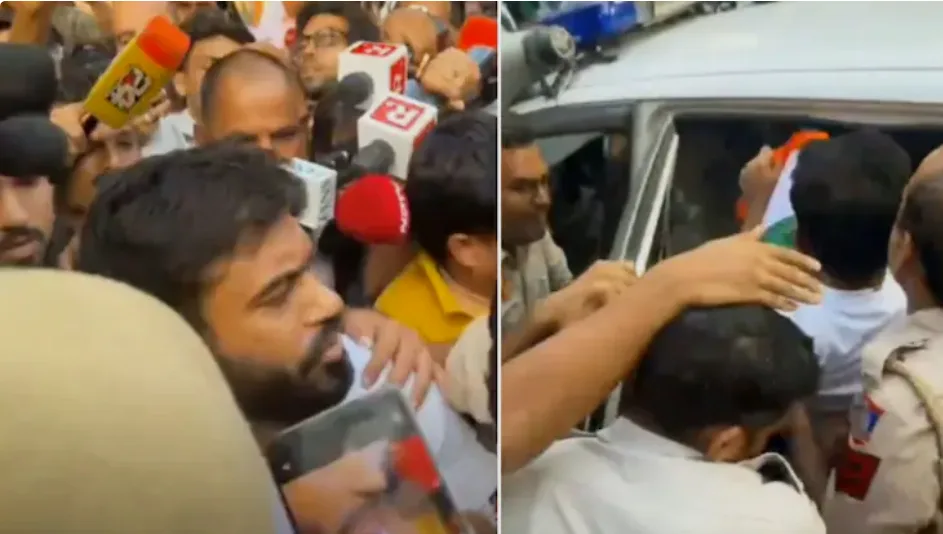
Several FIRs were filed following clashes during the July 20 protest near Parliament after demonstrators attempted to march from Jantar Mantar towards Parliament.

Police used tear gas and batons to disperse the crowd, leading to clashes and multiple detentions.

On Monday, the issue echoed in Parliament as Opposition members repeatedly demanded a government response over the police crackdown on protesters.

Meanwhile, despite disruptions in the House, the government introduced a Bill in the Lok Sabha proposing stricter penalties for examination paper leaks.

Continue Reading

India News

India summons Ukrainian envoy after ships with Indian crew attacked in Black Sea

Published

on

India has summoned the Ukrainian Ambassador after two merchant vessels carrying Indian crew were attacked in the Black Sea, raising concerns over the safety of Indians working in the conflict zone.

The Ministry of External Affairs (MEA) described the incidents as a matter of serious concerns and conveyed India’s position directly to the Ukrainian envoy.

According to the MEA, the attacks took place amid the ongoing Russia-Ukrainian war, where commercial shipping has increasingly come under threat due to military operations. Although no deaths have been reported, several Indian seafarers were on board the affected vessels, prompting the government to seek immediate clarification from Ukraine and stress the need to ensure their safety.

During the meeting, the MEA reiterated that merchant ships engaged in commercial trade and civilian crew members must not become targets during armed conflict. India urged Ukraine to take all possible steps to prevent such incidents and to uphold international maritime law, which protects civilian shipping operating in international waters.

The ministry said it is in constant contact with Indian missions abroad, shipping companies, and maritime authorities to monitor the condition of Indian crew members. Officials have assured that diplomatic and consular assistance for the crew.

The attack have once again highlighted the dangers faced by thousands of Indian seafarers employed on international cargo vessels operating in conflict-affected regions. The continuing war has disrupted shipping routes in the Black Sea, creating risks for commercial trade and the safety of multinational crews.

The latest diplomatic move reflects India’s consistent position on the Russia-Ukraine conflict. While maintaining relations with both countries, India has repeatedly called for dialogue, a peaceful resolution to the conflict, and the protection of civilians and commercial vessels under international law.

Continue Reading

Trending

© Copyright 2022 APNLIVE.com