English हिन्दी
Connect with us

India News

Chatgpt aadhaar card misuse: Here’s how you can identify fake Aadhaar cards with step-by-step verification

ChatGPT-generated Aadhaar cards raise new concerns over ID fraud. Here’s a detailed guide on spotting fake IDs and verifying real ones using UIDAI’s official portal.

Published

on

fake adhaar

Artificial Intelligence (AI) has opened doors to countless innovations, but it also brings along serious concerns—especially when it comes to identity security. A recent LinkedIn post revealed that ChatGPT was able to generate what appeared to be an Aadhaar card, triggering fears over the ease with which fake government IDs can now be created using AI.

Amid rising dependency on Aadhaar for everything from banking to phone verification, the emergence of fake, AI-generated Aadhaar cards has raised red flags.

How AI is being used to mimic Aadhaar

A LinkedIn user recently experimented with ChatGPT to test whether an Aadhaar card could be generated—and the outcome was alarming. Despite AI’s inability to access UIDAI’s official databases or create authentic records, its capability to produce convincing visual fakes has sparked major security concerns. Fraudsters could exploit such tools to mislead individuals or institutions by generating Aadhaar-like cards with altered details and design.

Why this matters: Aadhaar’s significance in India

Aadhaar is a 12-digit unique identity number issued to every Indian citizen, including children and infants. Managed by the Unique Identification Authority of India (UIDAI), it serves as a crucial document for identity and address verification and is often mandatory for bank accounts, mobile numbers, PAN cards, and financial transactions.

Spotting fake Aadhaar: Key differences to look for

To help citizens differentiate between real and AI-generated Aadhaar cards, here are five critical checks:

Photograph mismatch: AI-generated Aadhaar cards often show discrepancies between the uploaded photo and the one that appears on the final card.

Font inconsistencies: Compare the fonts used in English and Hindi on the card—AI models may struggle to replicate official typography accurately.

Syntax and formatting errors: Look out for misplaced colons, slashes, or commas in personal details and layout.

Incorrect logos: Closely examine the Aadhaar and Government of India logos. Fake versions may appear blurry or improperly scaled.

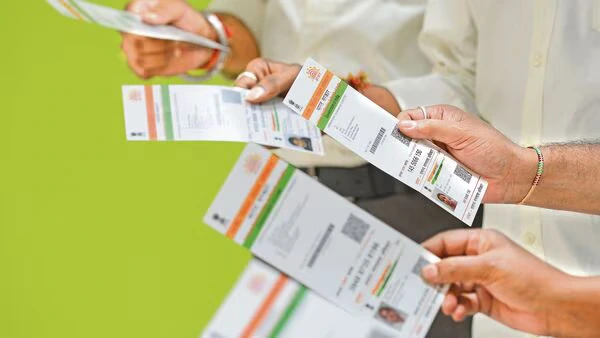
QR code check: A genuine Aadhaar card contains a scannable QR code. If it’s present, scan it to verify its authenticity

How to verify Aadhaar online: UIDAI step-by-step guide

To confirm whether an Aadhaar number is valid:

Step 1: Visit https://myaadhaar.uidai.gov.in/verifyAadhaar

Step 2: Click on “Check Aadhaar Validity”

Step 3: Enter the 12-digit Aadhaar number and captcha code

If the number is invalid, the system will not proceed. If it’s valid, you’ll receive a confirmation message stating:

“Aadhaar Verification Completed” and “[Entered Aadhaar number] Exists”

Virtual ID (VID): A secure alternative

To enhance privacy, users can generate a Virtual ID (VID)—a temporary 16-digit number linked to their Aadhaar. This can be used for authentication and e-KYC without revealing the actual Aadhaar number. Importantly, only the Aadhaar holder can generate this VID, and it is sent via SMS to the registered mobile number.

Continue Reading

India News

Over 5,000 tribals join BJP in Assam’s Goalpara ahead of elections

More than 5,000 tribals, largely from the Garo community, joined the BJP in Assam’s Goalpara district during a large-scale ST Morcha programme ahead of elections.

Published

on

Hemanta Sharma

More than 5,000 members of tribal communities formally joined the Bharatiya Janata Party (BJP) at a large-scale event held in Assam’s Goalpara district on February 25, weeks before key elections.

The joining programme was organised by the BJP ST Morcha, Assam Pradesh, at the Agia School playground. The event was conducted under the leadership of Riya Sangma, State Secretary of BJP ST Morcha and in-charge of the Goalpara ST Morcha.

Party leaders said the programme witnessed strong participation, particularly from the Garo community, describing it as a significant political development in the district.

The chief guest at the event was Samir Oran, National President of BJP ST Morcha and outgoing Member of Parliament (Rajya Sabha). Among those present were Bijuli Kalita Medhi, MP from the Guwahati Lok Sabha constituency, Ravindra Raju, Horen Singh Bey, who serves as State President of BJP ST Morcha, and other party leaders.

Goalpara district has traditionally seen strong influence from opposition parties, especially the Congress. Tribal voters in the region have largely remained divided, making the large-scale induction ahead of elections politically significant.

Addressing the media, Samir Oran said the BJP has brought a new phase of recognition and opportunity for tribal communities across the Northeast. He stated that the joining programme reflected growing trust among tribal populations in the party.

Riya Sangma said many tribal communities, particularly members of the Garo community, had earlier felt deprived of adequate respect and development benefits. She added that the participation of over 5,000 people demonstrated confidence in the BJP’s leadership.

Dipankar Nath, BJP Goalpara District President, termed the development a “game-changer” for the constituency. He said the party remains committed to the welfare, development and dignity of tribal communities.

Party leaders expressed confidence that the induction drive would strengthen the BJP’s organisational base in Goalpara and nearby areas ahead of the upcoming polls.

Continue Reading

India News

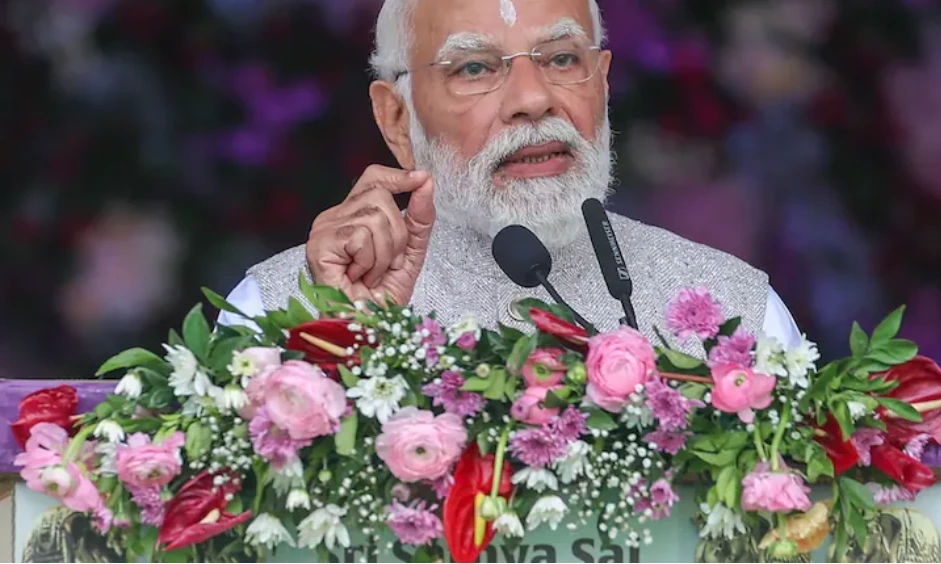
PM Modi crosses 100 million followers on Instagram, first world leader to achieve milestone

Prime Minister Narendra Modi has crossed 100 million followers on Instagram, becoming the first world leader to achieve the milestone and widening the gap with global counterparts.

Published

on

pm modi followers

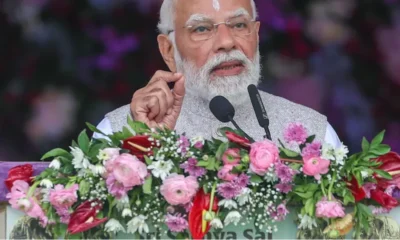
Prime Minister Narendra Modi has become the first world leader and politician to cross 100 million followers on Instagram, marking a significant moment in global political communication.

Having joined the platform in 2014, the Prime Minister has steadily built one of the most followed political profiles worldwide. Over the past decade, his Instagram account has featured updates on official engagements, international visits, public outreach programmes, cultural highlights and personal moments, helping him connect with a broad and diverse audience.

With 100 million followers, PM Modi now ranks first among world leaders on Instagram. His follower count is more than double that of US President Donald Trump, who stands at 43.2 million followers.

Other prominent leaders remain considerably behind in comparison. Indonesian President Prabowo Subianto has around 15 million followers, Brazilian President Luiz Inacio Lula da Silva has 14.4 million, Turkish President Recep Tayyip Erdogan has 11.6 million, and Argentine President Javier Milei has 6.4 million followers.

Notably, the combined follower count of the next five major global leaders remains lower than PM Modi’s individual tally, highlighting the scale of his digital outreach. Observers note that his presence on Instagram resonates strongly with younger users in India and abroad, reflecting the growing importance of visual and interactive platforms in political engagement.

Wide gap within India’s political space

The Prime Minister also maintains a substantial lead over other Indian political figures on Instagram. Uttar Pradesh Chief Minister Yogi Adityanath has around 16.1 million followers, while Congress leader Rahul Gandhi has approximately 12.6 million followers.

The gap underlines PM Modi’s dominant position on social media among domestic political leaders.

The milestone reflects a broader global trend of political leaders increasingly using platforms like Instagram to communicate directly with citizens, share governance updates, and expand public engagement beyond traditional media channels.

Continue Reading

India News

MK Stalin predicts frequent PM Modi visits to Tamil Nadu before assembly election

MK Stalin has said Prime Minister Narendra Modi will visit Tamil Nadu more often ahead of the Assembly election, calling the tours politically motivated and questioning the Centre’s support to the state.

Published

on

MK Stalin

Tamil Nadu Chief Minister M. K. Stalin has predicted that Prime Minister Narendra Modi will increase his visits to the state as the Assembly election, expected in April or May, draws closer.

Speaking ahead of the polls, the DMK president said the Prime Minister has already begun touring Tamil Nadu and is likely to visit frequently in the coming months. He claimed that such visits could create discomfort within the BJP-led National Democratic Alliance (NDA), as alliance partners may fear the political impact of repeated appearances.

Stalin calls visit politically motivated

The Chief Minister described the Prime Minister’s scheduled programmes in the state as “politically motivated”. PM Modi is set to attend various events in Madurai in southern Tamil Nadu, including the inauguration of the first phase of the AIIMS hospital project. He is also expected to visit the Thiruparankundram Temple amid the Karthigai Deepam-related controversy and participate in a public meeting organised by the NDA.

Stalin said he has been working for all sections of the population, including those who did not vote for his party. In contrast, he remarked that some leaders are visible in the state only during election time and increase their visits as polls approach.

Criticism over Union Budget allocations

The DMK leader also criticised the BJP-led central government, accusing it of neglecting Tamil Nadu. He pointed out that while approval was recently granted for the Gujarat Metro project, there were no major announcements or allocations for Tamil Nadu in the Union Budget.

Stalin asserted that voters would remember the lack of significant measures for the state. He framed the upcoming election as a contest between Tamil Nadu and the NDA, stating that the state should be governed from Fort St George in Chennai rather than from Delhi.

The ruling DMK is currently allied with several smaller parties and, at present, the Congress, as it seeks a third consecutive term in office. Its principal rival, the AIADMK, is aligned with the BJP as part of the NDA.

Continue Reading

Trending

© Copyright 2022 APNLIVE.com