English हिन्दी
Connect with us

India News

India on track to become global consumption capital, reveals new report

India is on the path to becoming the world’s leading consumption economy, as household growth, tax reforms, and a booming Gen Z population fuel discretionary spending.


Published

on

India is projected to emerge as the consumption capital of the world, driven by strong economic trends, rising per capita income, and a booming Gen Z population, according to a recent report by a media citing analysis from Angel One and Iconic Asset.

Household growth outpaces population rise

The report highlights that household formation in India is accelerating due to the increasing trend of nuclear families. This surge is outpacing overall population growth, emerging as a pivotal factor fueling higher consumption across sectors.

Currently, consumption constitutes 56% of India’s GDP, making it the most rapidly growing segment of the economy. Projections indicate that India’s consumption is expected to double by 2034, placing the country ahead of major global economies.

Future savings to unlock consumption potential

India’s economic landscape is set for a dramatic transformation with its total savings over the next 25 years projected at USD 103 trillion—a tenfold increase from USD 12 trillion between FY1997 and 2023. These savings are anticipated to unleash massive potential for incremental consumption.

Moreover, recent tax reductions in the Union Budget are expected to unlock ₹1 lakh crore, leading to an additional consumption boost of ₹3.3 lakh crore. This move alone could potentially add 1% to the national GDP, the report states.

A trajectory similar to the US and China

The report draws parallels with historical patterns seen in the US and China, where periods of rising per capita income triggered significant increases in discretionary spending. India is expected to follow a similar trajectory, with notable growth in categories such as consumer electronics, apparel, jewellery, and the experience economy.

Gen Z and modern retail: the next frontier

With 92% of retail trade still dominated by Kirana stores, the report underlines the untapped potential for modern retail to expand and gain market share. Furthermore, India’s Gen Z population already surpasses the total population of the US, and by 2035, every second rupee spent will come from a Gen Zer, adding a demographic edge to India’s consumption story.

India News

Supreme Court allows green crackers in Delhi-NCR for Diwali, sets time limits

The Supreme Court has allowed certified green crackers in Delhi-NCR for two days ahead of and on Diwali. The complete ban on firecrackers will return from November 9.

Published

on

Supreme Court

The Supreme Court on Monday permitted the use of certified green firecrackers across Delhi-NCR for two days ahead of and on Diwali, offering a temporary relaxation of the existing restrictions on fireworks.

Under the court’s directions, green firecrackers can be burst on November 7 and 8, between 6 am and 7 am and again from 8 pm to 10 pm. The complete ban on firecrackers will be restored from November 9, the court said.

The decision comes ahead of Diwali, which falls on November 8 this year. The relaxation is subject to several conditions governing the manufacture, sale and use of firecrackers.

The court also noted that it had not been provided with adequate data to determine whether a complete ban was the most effective solution to Delhi-NCR’s annual air pollution problem. It observed that there had been no significant improvement in Air Quality Index (AQI) readings despite the firecracker ban imposed in 2024.

Supreme Court sets restrictions on firecracker use

The Supreme Court has prohibited the bursting of firecrackers within a 300-metre radius of hospitals, nursing homes, primary and district health centres, old-age homes and notified silence zones.

Educational institutions will also fall under this restriction.

These locations will be designated as ‘No-Cracker Zones’, with authorities directed to mark their boundaries on the ground and publicise the restrictions.

The court has also directed authorities to ensure that the permitted time slots are followed during the two days.

Strict conditions for green cracker sales

The Supreme Court has laid down specific conditions for manufacturers and traders to prevent conventional firecrackers from being sold in the name of green crackers.

Only manufacturers holding valid certifications from the Council of Scientific and Industrial Research-National Environmental Engineering Research Institute (CSIR-NEERI) and the Petroleum and Explosives Safety Organisation (PESO) will be permitted to manufacture approved green crackers during the specified period.

The manufacture and sale of firecrackers joined in series, commonly known as ‘ladis’ and garlands, have been prohibited.

Firecrackers containing barium and those not approved by CSIR-NEERI as green crackers will also not be permitted.

The court has further directed that green crackers must be sold in sealed boxes to prevent conventional or unauthorised firecrackers from being mixed with approved products.

Each box must carry a product-specific QR code linked to the particular product and batch. Scanning the code should provide details of the manufacturer, NEERI registration, PESO or District Magistrate licence, formulation and test certificate.

Online sale prohibited, designated locations identified

The Supreme Court has directed District Collectors and Commissioners across the National Capital Region to identify designated locations for the sale of green firecrackers in consultation with the respective Superintendents of Police.

The sale of firecrackers at any other location, including through online platforms, has been prohibited.

Authorities have also been directed to display banners at designated shops and sale locations explaining how consumers can identify CSIR-NEERI-approved green crackers.

The court has asked authorities to check vehicles entering Delhi-NCR to prevent the transportation of illegal and conventional firecrackers.

It has also directed police and district administration officials to conduct inspections, verify QR codes and confiscate unauthorised firecrackers.

What are green crackers?

Green crackers are developed by CSIR-NEERI and are designed to produce around 30 per cent less pollution than conventional firecrackers.

They contain reduced quantities of certain chemicals, including barium and aluminium, and incorporate additives intended to suppress dust and smoke emissions.

These crackers are also designed to produce less noise, burn for shorter durations and release controlled flames.

Complete firecracker ban to return on November 9

The Supreme Court has clarified that the relaxation is temporary and that the complete ban on firecrackers in Delhi-NCR will be restored from November 9.

The court has also directed manufacturers and traders to furnish monetary security. The security deposit will be forfeited in case of violations of its directions.

The measures are aimed at regulating the use and sale of firecrackers during Diwali while addressing concerns over air pollution in the National Capital Region.

Continue Reading

India News

5 Killed in Manipur as recovery Of 2 bodies triggers protests in Kangpokpi

Five Kuki men were killed in two separate incidents in Manipur’s Kangpokpi and Noney districts. The recovery of two missing men’s bodies triggered protests, clashes with security forces and a shutdown in Kangpokpi.
Published

on

Manipur

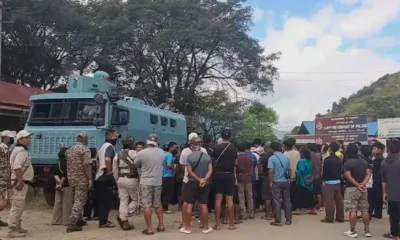
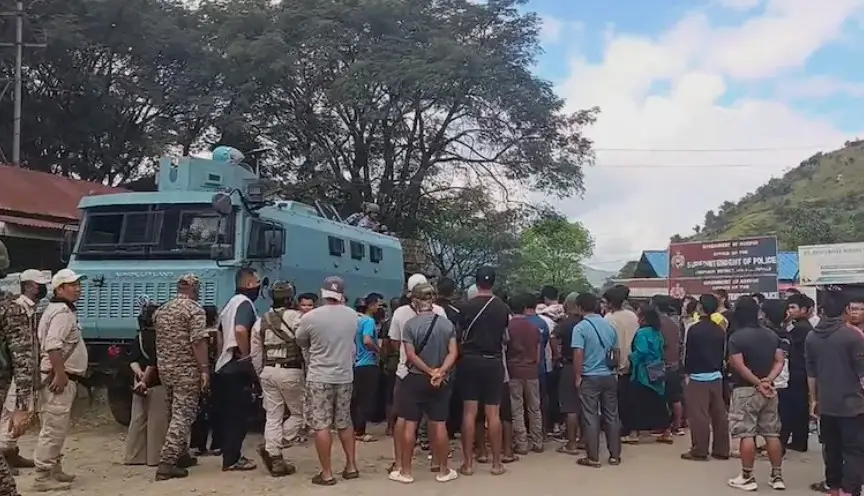
Fresh violence has erupted in Manipur after five Kuki men were killed in two separate incidents in Kangpokpi and Noney districts. The recovery of two missing men’s bodies in Kangpokpi on Sunday triggered protests and clashes between demonstrators and security forces, further escalating tensions in the region.

The two incidents took place on Saturday and Sunday. While three men were killed in a reported exchange of gunfire between two unidentified armed groups in Noney district on Saturday, the bodies of two missing men were recovered during a joint security operation in Kangpokpi on Sunday.

Two missing Kuki men found dead in Kangpokpi

The two deceased men were identified as Paoginlal Hangsing and Tinginlun Chongloi, both aged 20. They had gone missing from Taphou Kuki village on October 28.

Their disappearance had prompted the Committee on Tribal Unity (CoTU), Sadar Hills, to announce a shutdown across Kangpokpi district.

According to the Manipur Police Control Room, multiple search operations were launched after the two men went missing.

On Sunday, a joint team comprising Manipur Police, the Commando Battalion for Resolute Action (CoBRA), the Central Reserve Police Force (CRPF), Assam Rifles and the Rapid Action Force (RAF) conducted an extensive search operation in the area east of National Highway-2 along the SP Road.

The operation resulted in the recovery of two bodies. Official sources subsequently confirmed that they belonged to the missing men.

The bodies were initially taken to Kangpokpi District Hospital, where large crowds gathered after their deaths were confirmed.

Protests and clashes erupt in Kangpokpi

The recovery of the bodies triggered protests and clashes in Kangpokpi, prompting security forces to step up efforts to control the situation.

As tensions escalated, police shifted the bodies to the Superintendent of Police’s office in Kangpokpi. Demonstrators continued their protest, following which security personnel fired several rounds of tear gas shells to disperse the crowds.

Protesters also blocked National Highway-2, while shops, business establishments and private institutions across the district remained closed as part of the shutdown called by CoTU.

The organisation subsequently announced that it would not claim the bodies of the two men until the government fulfilled its demands, including the immediate removal of Deputy Chief Minister Losii Dikho.

CoTU spokesperson Ng Lun Kipgen said the shutdown had been extended by another 24 hours on Saturday in the hope that Dikho would intervene with people in Senapati district to secure the safe release of the two missing Kuki-Zo youths.

However, the two men were later found dead.

Three Kuki men killed in separate Noney incident

In a separate incident on Saturday, three Kuki men were killed in a reported exchange of gunfire between two unidentified armed groups at Kekru Naga village in Manipur’s Noney district.

The village falls under Nungba Police Station and is located approximately eight kilometres from the police station.

The deceased were identified as Thanglensang Singson, Thangkhosei Haokip and Lamminsang Kipgen.

Thanglensang Singson originally belonged to Maojang village and was residing at Tuinom in Thanlon subdivision of Churachandpur district.

Thangkhosei Haokip was a resident of Thinghibung village in Henglep subdivision of Churachandpur district, while Lamminsang Kipgen hailed from Phaibong village in the same subdivision.

Local sources said tensions had been building in the surrounding areas for several days before the fatal incident. However, the specific circumstances that led to the exchange of gunfire remain unclear.

Kuki tribal body alleges involvement of armed groups

Kuki Inpi Manipur (KIM), the apex body of the Kuki tribes, condemned the killings and alleged that cadres of the NSCN-IM and ZUF(K) were responsible.

The organisation also alleged that the bodies of the deceased had been desecrated. It accused the authorities of failing to provide adequate security to vulnerable Kuki-Zo settlements in Noney district and demanded accountability and immediate measures to protect civilians.

However, the allegations against NSCN-IM and ZUF(K) have not been independently verified. Police have not identified those responsible for the killings.

Police said necessary legal formalities and other procedures were underway. Search and combing operations would continue to identify and apprehend those responsible.

The circumstances surrounding the deaths of the two missing men in Kangpokpi and the three killings in Noney remain under investigation.

Continue Reading

India News

Odisha braces for Cyclone Murasu after Arnab leaves 6 dead

Odisha is preparing for Cyclone Murasu, which is expected to make landfall along the Andhra Pradesh coast on November 3. Meanwhile, the death toll from Cyclone Arnab has risen to six, with 10 people still missing.

Published

on

Cyclone

Odisha has stepped up its preparations for another cyclonic storm as Cyclone Murasu approaches the neighbouring Andhra Pradesh coast, even as the state continues to deal with the destruction caused by Cyclone Arnab and subsequent floods.

The death toll from Cyclone Arnab in Odisha rose to six on Sunday after two more bodies were recovered from a landslide-hit village in the southern part of the state. Ten people remain missing, with search operations underway to trace them.

According to Special Relief Commissioner Rajesh P Patil, Cyclone Arnab, which made landfall in Andhra Pradesh on October 28, and the subsequent floods have affected around 1.18 lakh people in Odisha. The disaster has also affected 75,388 hectares of agricultural land and damaged 1,672 houses.

Cyclone Murasu likely to hit Andhra Pradesh on November 3

According to the India Meteorological Department (IMD), Cyclone Murasu is expected to intensify into a very severe cyclonic storm before making landfall between Nellore and Narsapur in Andhra Pradesh on the intervening night of November 2 and 3.

The storm is likely to bring wind speeds of 100-110 kmph, with gusts reaching 120 kmph.

India has named the cyclone Murasu, which means ‘war drum’.

Manorama Mohanty, Director of the Meteorological Centre in Bhubaneswar, said Odisha would begin receiving rainfall from November 2, with its intensity expected to increase on November 3. Rainfall is likely to continue until November 4 under the influence of the cyclone.

Six dead, 10 missing after Cyclone Arnab

The death toll from Cyclone Arnab increased to six following the recovery of two bodies from a landslide-affected village in southern Odisha. Officials said search operations were continuing for 10 missing people.

The hilltop village of Gidipabali, located along the border of Ganjam and Kandhamal districts, was severely affected by a massive landslide triggered by cyclone-induced rainfall.

The village, which was home to around 26 people, was buried under sludge and debris that cascaded down the hills and destroyed houses.

At least 13 people who managed to escape the landslide have been shifted to a relief centre near G Udaygiri, Kandhamal District Collector Vedbhusan said.

Special Relief Commissioner Rajesh P Patil said at least 10 landslide incidents had been reported during Cyclone Arnab, making them a major challenge for the state.

Odisha steps up preparations for fresh cyclone

With another storm approaching, the Odisha government has intensified its preparations, particularly in the southern districts that were badly affected by Cyclone Arnab.

Disaster Management Minister Suresh Pujari said the government was fully prepared to deal with the approaching cyclone and urged people not to panic.

The state has issued a high alert in its southern region, including Ganjam district. Authorities have also ordered the evacuation of people living in low-lying areas and hilly terrain before Cyclone Murasu makes landfall.

Some districts in southern Odisha have announced the closure of schools and colleges until November 3.

Meanwhile, more than 6,400 personnel have been deployed to accelerate the restoration of electricity supply in cyclone-affected areas.

Mohan Majhi announces relief package for affected families

Odisha Chief Minister Mohan Charan Majhi conducted an aerial survey of the flood-affected areas and announced a special relief package for affected families.

Under the package, each family affected by the floods in the southern region will receive 50 kg of rice and Rs 2,500. Financial assistance will also be provided for crop losses, house damage and livelihood-related losses.

Majhi said the relief package would be reviewed after assessing the damage caused by Cyclone Murasu.

He also said disaster response teams were on standby, vulnerable low-lying areas were being monitored and fishermen had been strictly advised against venturing into the sea.

Additionally, an eight-member inter-ministerial central team will visit Odisha from November 2 to 4 to assess the damage caused by Cyclone Arnab.

Continue Reading

Trending

© Copyright 2022 APNLIVE.com