English हिन्दी
Connect with us

India News

India to start first commercial semiconductor chip production in 2026, says Ashwini Vaishnaw

India is on track to begin its first commercial semiconductor chip production in 2026, with pilot production already underway and investments nearing $90 billion, according to Union Minister Ashwini Vaishnaw.

Published

on

Union Electronics and Information Technology Minister Ashwini Vaishnaw on Friday said India remains on schedule to begin commercial semiconductor chip production in 2026, in line with the targets outlined under the India Semiconductor Mission launched in January 2022.

Speaking to media, the minister said the government had committed to starting commercial production within five years of the mission’s launch and that the timeline is being met.

“The first commercial production will begin in 2026. Four semiconductor plants are expected to start operations this year, while pilot production has already begun at three plants in 2025,” Vaishnaw said.

Semiconductor ecosystem taking shape

The minister said India’s semiconductor ecosystem is developing rapidly, with global equipment manufacturers setting up operations in the country and a strong materials manufacturing base emerging alongside.

He added that the talent pipeline is progressing faster than expected. Against a target of training 85,000 skilled professionals over 10 years, India has already trained around 65,000 people in just four years, he said.

Vaishnaw noted that several milestones under the first phase of the Semiconductor Mission are either on track or ahead of schedule, reflecting growing confidence in India’s manufacturing ambitions.

Investments near $90 billion, more expected

On the investment front, the minister said total investments in the semiconductor sector have reached close to USD 90 billion so far. He added that committed investments could rise to around USD 150 billion as India approaches the upcoming AI Impact Summit scheduled to be held in New Delhi from February 16 to 20.

According to Vaishnaw, global semiconductor players are increasingly supportive of India’s efforts and are keen to participate in the country’s expanding chip manufacturing ecosystem.

ASML equipment for Dholera fab

Highlighting the importance of advanced manufacturing technology, Vaishnaw spoke about his visit to Veldhoven in the Netherlands, where he visited the headquarters of ASML, the world’s leading supplier of lithography equipment used in semiconductor manufacturing.

He said lithography remains the most complex and precision-intensive process in chip production and confirmed that India’s upcoming semiconductor fabrication facility in Dholera, Gujarat, will use equipment supplied by ASML.

Vaishnaw said the interest of global equipment manufacturers in India reflects the country’s strong design capabilities, large talent pool and consistent policy environment.

India’s progress in AI and global confidence

The minister also highlighted India’s growing role in artificial intelligence, stating that the country is developing strength across multiple layers of the AI stack, including applications, sovereign models, chips and infrastructure.

He said global industry leaders expressed strong confidence in India’s semiconductor and AI journey during discussions at the World Economic Forum in Davos, with many indicating their willingness to contribute to India’s long-term goals.

The India Semiconductor Mission, approved by the Union Cabinet in December 2021 with an outlay of Rs 76,000 crore, aims to support semiconductor fabrication, display manufacturing and chip design, and position India as a global hub for electronics manufacturing and innovation.

India News

New UP Congress chief Aradhana Mishra backs stronger alliance with SP 

Newly appointed UP Congress chief Aradhana Mishra said the party would strengthen its alliance with the Samajwadi Party ahead of the 2027 Assembly election.

Published

on

Newly appointed Uttar Pradesh Congress president Aradhana Mishra, also known as Mona, has said the party will take its alliance with the Samajwadi Party forward with full strength ahead of the 2027 Uttar Pradesh Assembly election.

Mishra, the daughter of Congress MP Pramod Tiwari, has been given the responsibility of leading the party’s state unit as Congress prepares for the assembly polls due in around six months, according to the report.

Speaking about Samajwadi Party chief Akhilesh Yadav, Mishra described the SP as a strong partner of the Congress in the INDIA bloc.

“The Samajwadi Party is a partner of ours in the INDIA bloc, and a strong one at that,” she said, while praising the way Akhilesh Yadav has strengthened his party.

Aradhana Mishra backs Congress-SP alliance

Mishra referred to the performance of the INDIA bloc in the 2024 Lok Sabha election in Uttar Pradesh while discussing the alliance’s prospects for the next assembly election.

The INDIA bloc won 43 of Uttar Pradesh’s 80 Lok Sabha seats in the 2024 election, according to the report.

Mishra said the alliance had stopped the BJP’s advance in Uttar Pradesh in the 2024 Lok Sabha election and expressed confidence that the partnership would produce results in the 2027 Assembly election.

“We will take this alliance forward with full strength,” she said.

The new state Congress chief will also have to advance seat-sharing discussions with the Samajwadi Party. The report said Congress wants a larger share of seats, while the SP has not indicated a willingness to give ground, arguing that it is in a stronger position in the state.

Congress announces new UP team

The leadership change is part of a wider organisational reshuffle by the Congress in Uttar Pradesh.

Along with appointing Mishra as state Congress president, the party named Rajya Sabha MP Imran Masood as working president. Chaudhary Virendra Singh was appointed Leader of the Congress Legislature Party.

Devinder Nishad and Alok Prasad were also appointed senior vice presidents of the Uttar Pradesh Congress Committee.

The new appointments bring different social groups into prominent positions in the state organisation. Mishra is a Brahmin, Masood is a Muslim and Rajendra Pal Gautam, the Congress’ AICC in-charge of Uttar Pradesh, is a Dalit, the report said.

Mishra, however, said the Congress does not practise caste or religion-based politics.

She said the party wanted to strengthen the country, protect the Constitution and build a strong alternative ahead of the 2027 election.

Mishra’s challenge ahead of 2027 polls

As the new Uttar Pradesh Congress chief, Mishra will be responsible for strengthening the party’s organisation in the state while also taking forward its alliance with the Samajwadi Party.

The Congress and SP are part of the INDIA bloc in Uttar Pradesh. With seat-sharing discussions ahead of the 2027 Assembly election, Mishra’s comments indicate that the Congress intends to continue working with the Samajwadi Party.

The appointment of Mishra comes alongside other organisational changes aimed at preparing the party for the upcoming assembly election.

Continue Reading

India News

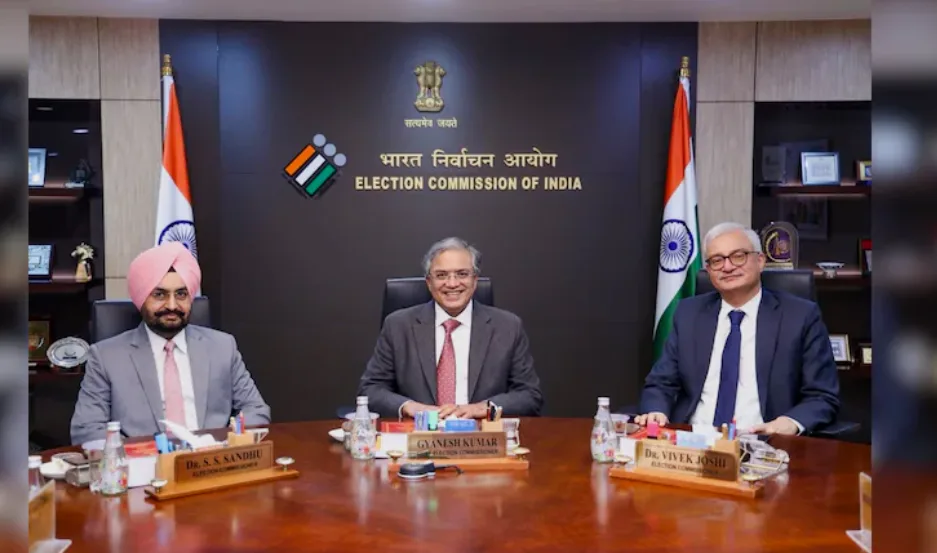
CJP announces October 10 Delhi protest against Gyanesh Kumar

CJP leader Abhijeet Dipke has announced a protest at Jantar Mantar on October 10, demanding the resignation of Chief Election Commissioner Gyanesh Kumar.

Published

on

Cockroach Janta Party (CJP) leader Abhijeet Dipke has announced a fresh protest at Delhi’s Jantar Mantar on October 10, saying the demonstration will be held if Chief Election Commissioner Gyanesh Kumar does not resign.

Dipke made the announcement after a CJP demonstration at Mumbai’s Shivaji Park. He called on people from across the country to join the proposed Delhi protest, describing it as a peaceful agitation.

Abhijeet Dipke’s October 10 protest call

In a post on X, Dipke said CJP supporters would march to Delhi and hold a protest at Jantar Mantar if Kumar did not step down. He also said that if Delhi Police stopped the protesters, the location where they were stopped would become their protest site.

The CJP leader had earlier warned of a larger agitation while addressing the gathering at Shivaji Park. He said that if the Chief Election Commissioner did not resign, the movement would expand to Delhi.

CJP’s allegations against the Election Commission

During the Mumbai protest, Dipke alleged irregularities in electoral rolls and questioned decisions concerning the election process. He claimed that 13 crore voters had been deleted over two years and alleged that voter deletions had affected electoral outcomes in several states.

These claims were made by Dipke while addressing the protesters and were not presented in the report as independently established facts.

He also alleged that voters were deleted from constituencies in Delhi, Tamil Nadu and West Bengal and linked these alleged deletions to election results.

The CJP leader further criticised the proposed simultaneous elections framework, alleging that the ruling BJP’s objective was “One Nation, One Election, One Party”.

CJP demands Gyanesh Kumar’s resignation

CJP leaders have been demanding the resignation of Chief Election Commissioner Gyanesh Kumar and have also called for criminal proceedings against him.

The group has criticised the Election Commission over the Special Intensive Revision of electoral rolls and has demanded changes to the law governing the appointment of Election Commissioners.

The Election Commission, however, has said that decisions of the three-member poll body, including those concerning the SIR exercise, were taken unanimously.

Protest at Mumbai’s Shivaji Park

The October 10 Delhi announcement followed a CJP demonstration at Mumbai’s Shivaji Park. The protest was held despite police denying permission for the event, according to the report.

Several groups and individuals participated in the demonstration. The Shiv Sena (UBT) had also extended support to the CJP’s agitation.

Dipke said the CJP would continue its campaign and called for the proposed October 10 demonstration in Delhi under the slogan “Chalo Delhi”.

Continue Reading

India News

MK Stalin attacks Vijay government over hindi signboard in Tamil Nadu

MK Stalin criticised the Tamil Nadu government over Hindi lettering on a State Highway signboard and warned the Vijay-led administration against interfering with the state’s two-language policy.

Published

on

MK Stalin

The use of Hindi on a highway signboard in Tamil Nadu has triggered a political row, with DMK chief MK Stalin criticising the Vijay-led Tamilaga Vettri Kazhagam (TVK) government over the issue.

The controversy centres on a State Highway signboard that displayed place names in Tamil, English and Hindi. The board was installed on the Alwarthirunagari-Valliyoor State Highway 93 route through Sathankulam in Thoothukudi district.

Stalin objected to the inclusion of Hindi, saying Tamil Nadu has long opposed what he described as attempts to impose Hindi and warning the state government against altering its established two-language policy.

He questioned whether the use of Hindi on the signboard represented the kind of change promised by the TVK government. Stalin also urged the administration not to interfere with Tamil Nadu’s language policy.

Hindi removed from signboard

Following the controversy, the Hindi lettering was removed from the signboard. The state government also suspended two officials from the Highways Department over the matter and initiated departmental action against them.

According to officials, the Assistant Divisional Engineer and Assistant Engineer associated with the project had failed to inform higher authorities about the inclusion of Hindi on the board.

The Tamil Nadu government has said that the use of Hindi on the State Highways Department signboard was against the state’s two-language policy and warned that strict action would be taken against officials violating the policy.

Stalin targets Vijay government

Stalin also stepped up his criticism of the TVK administration, describing it as a “Reels government” and alleging that it was responding to social media trends involving influencers from northern states.

His comments came amid a wider political debate in Tamil Nadu over the state’s established Tamil-English two-language policy and the use of Hindi in government-related signage.

The latest controversy has therefore brought the language policy issue back into focus, with the DMK questioning the TVK government’s handling of the Hindi signboard and the state administration taking action against the officials concerned.

MK Stalin has criticised the Vijay-led Tamil Nadu government over Hindi appearing on a State Highway signboard. The Hindi lettering was later removed, while two Highways Department officials were suspended and departmental action was initiated.

Continue Reading

Trending

© Copyright 2022 APNLIVE.com