English हिन्दी
Connect with us

India News

Indian scientists identify earthquake vulnerable areas in Nepal

Published

on

Indian scientists identify earthquake vulnerable areas in Nepal
[vc_row][vc_column][vc_column_text]Namrata Dave

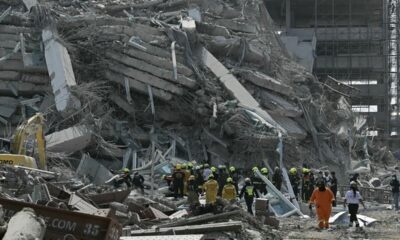
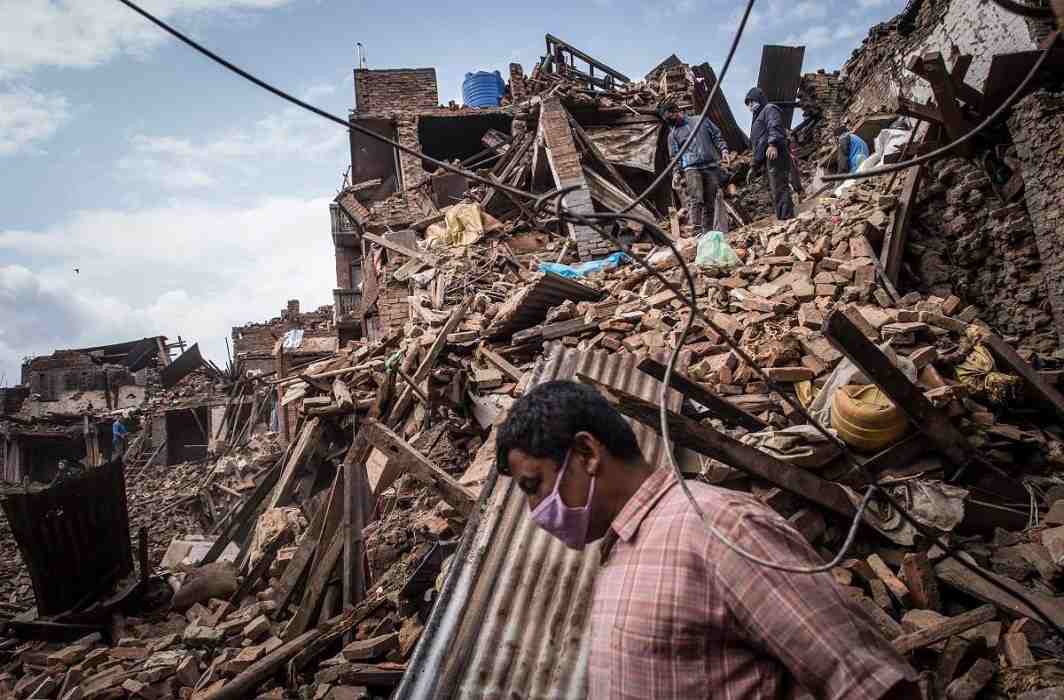
The powerful earthquake that shook Nepal on April 25, 2015 may not have been the end of seismic events in the Himalayan nation, according to a study by Indian researchers who have identified areas of Nepal that are likely to face tremors in the future.

The Gorkha Earthquake classified as ‘violent’on the Mercalli Intensity Scale had given rise to 256 strong and mild aftershocks. An extensive quantitative study on the event carried out by researchers at Raman Centre of Applied and Interdisciplinary Sciences, Kolkata, has identified areas likely to face tremors in the future.

The earthquake occurred in the region of the Main Himalayan Thrust Fault. This is one of the regions where the Indian tectonic plate is pushed under the Eurasian tectonic plate. By computing a factor known as the Coulomb Stresschanges along the fault, the researchers have obtained important correlations between the location of the main earthquake and its aftershocks.

When adjacent tectonic plates are constantly pushing against each other, it causes a huge build-up of stress, known as Coulomb stress, between the plates. If the stress exceeds a certain value that they can no longer withstand, defined by the Coulomb Failure Criterion (CFC), they simply ‘slip’ past each other. Due to this sudden movement, a large amount of built-up energy is released from the location of the ‘slip’ in the form of seismic waves, causing earthquakes.

Overall, 218 out of 256 aftershocks occurred in regions which experienced positive value of a factor known as Coulomb stress change after the main earthquake. Some locations around the periphery of the fault region, especially the southern end of it, did not experience any aftershocks despite showing positive values of Coulomb stress.  These locations are therefore vulnerable and may face earthquakes in the coming years.

According to the study, most of the aftershocks occurred in regions experiencing very high values of positive Coulomb stress. Such regions have therefore been classified as the ‘zone of greatest hazard’.

Changes in Coulomb stress are a useful input in earthquake prediction models. An earthquake reduces the average value of stress around the region where the ‘slip’ occurs, but it can cause an increase in stress in other regions, due to the geometry and orientation of plates with respect to each other. A positive value of Coulomb stress implies that the failure threshold as given by the CFC has been exceeded.

The researchers estimated the Coulomb Stress change at a depth of 10 km, where a major number of aftershocks occurred. In addition, they also performed similar computations for depths of 15 km and 22 km along the fault, where the two strongest aftershocks of magnitudes 7.3 and 6.7 respectively occurred.

The study co-authored by Mallika Mullick and Dhruba Mukhopadhyay was recently published in the journal Geodesy and Geodynamics.

Source: India Science Wire

[/vc_column_text][/vc_column][/vc_row]

India News

PM Modi marks Operation Sindoor anniversary, calls it India’s firm stand against terrorism

PM Modi said Operation Sindoor showcased India’s firm response against terrorism while paying tribute to the armed forces on the operation’s first anniversary.

Published

on

PM Modi

Prime Minister Narendra Modi on Thursday said Operation Sindoor demonstrated India’s firm response against terrorism and highlighted the country’s commitment to national security.

Marking one year of the operation, the Prime Minister praised the courage, precision and professionalism of the Indian armed forces. He said the military action was carried out in response to the Pahalgam terror attack that had claimed the lives of 26 civilians in 2025.

Operation Sindoor was launched on May 7, 2025, as a calibrated tri-services operation targeting terror infrastructure linked to cross-border terrorism. Reports said the operation showcased coordinated action by the armed forces and was seen as a major counter-terror response by India.

On the anniversary of the operation, PM Modi also changed the display pictures across his social media platforms, including X, Facebook, Instagram and WhatsApp. The image carried the text “Operation Sindoor” along with the Indian tricolour design.

The Indian Air Force also shared visuals and messages recalling the operation and highlighting India’s military response. A video released by the force described the operation as a strong message against terrorism and referred to the precision strikes carried out during the mission.

Operation Sindoor was launched following the Pahalgam terror attack, after which India carried out strikes on terror camps in Pakistan and Pakistan-occupied Kashmir, according to official statements and reports published at the time.

Continue Reading

India News

Vijay meets Tamil Nadu Governor again as TVK pushes to prove majority

TVK chief Vijay held another meeting with Tamil Nadu Governor Rajendra Vishwanath Arlekar as the party intensified efforts to secure majority support after emerging as the single-largest party in the Assembly elections.

Published

on

Actor vijay

Actor-turned-politician Vijay met Tamil Nadu Governor Rajendra Vishwanath Arlekar again on Thursday as his party, Tamilaga Vettri Kazhagam (TVK), continued efforts to prove it has enough support to form the next government in the state.

TVK emerged as the single-largest party in the 234-member Tamil Nadu Assembly after winning 108 seats, but it remains short of the majority mark of 118.

The Congress has extended support to TVK, adding five MLAs to Vijay’s side. However, the alliance still needs additional backing from other parties or independents to comfortably cross the halfway mark.

According to reports, the Governor has not yet been fully convinced that TVK currently has the required numbers to form a stable government. This has delayed clarity over the swearing-in ceremony and the formal invitation to form the government.

Political activity intensified after reports emerged that some AIADMK legislators were moved to a resort in Puducherry amid speculation over possible support to TVK. AIADMK leaders, however, publicly denied any internal crisis.

TVK sources have expressed confidence that the party will be able to demonstrate majority support during discussions with the Governor.

The Tamil Nadu election results marked a major political shift in the state, with TVK breaking the long-standing dominance of the DMK and AIADMK in its first Assembly election contest.

Continue Reading

India News

PM Modi changes social media profile pictures to mark Operation Sindoor anniversary

PM Modi changed his social media profile pictures to commemorate one year of Operation Sindoor, with several NDA leaders following the move.

Published

on

PM Modi speech

Prime Minister Narendra Modi on Thursday updated the display pictures of his social media accounts to mark the first anniversary of Operation Sindoor. The new image was seen across his profiles on X, Facebook, Instagram and WhatsApp channels.

The updated profile picture carries the text “Operation Sindoor” on a black background along with elements of the Indian tricolour. One of the letters in the word “Sindoor” has been stylised using vermilion, commonly associated with married Hindu women.

Operation Sindoor was launched a year ago by Indian defence forces and the Border Security Force along the western border. The anniversary was also marked by several Union ministers and NDA leaders, who changed their social media profile pictures in a similar manner.

External Affairs Minister S. Jaishankar and other senior leaders were among those who adopted the commemorative display image on social media platforms, according to reports.

Continue Reading

Trending

© Copyright 2022 APNLIVE.com