~By Rashme Sehgal
With the meeting between Minister of Sanitation and Drinking Water Uma Bharti and Prof GD Agarwal (Swami Gyan Swaroop Sanand) in Hardwar proving a failure last week, river activists across India are planning to intensify their stir to get the Modi government to acquiesce to this formidable environmentalist’s demands to restore the flow of the Ganga and to stop polluting the river.
Recognising the need to clean the Ganga on an immediate basis, on July 27, the National Green Tribunal asked the government to educate people about how the Ganga water was unfit both for drinking and bathing purposes.
The NGT declared that if cigarette packets can contain a warning saying it is injurious for health, why not the people be informed about the adverse effects (of Ganga water). The public can be educated by the authorities installing display boards at a gap of 100 kilometres. On July 19, the NGT had admonished the government stating that already it had spent over Rs 7000 crores in the last two years to clean the river, it still remained highly polluted.
From August 3, Agarwal’s supporters have been on a relay fast in the capital. On July 30th on the 38th day of Agarwal’s fast, his supporters and Ganga activists from 11 states converged for a prayer meeting at Rajghat. They are now planning to hold these prayers meetings at Rajghat on a weekly basis.
Agarwal is on a fast unto death at the Matri Sadan ashram in Hardwar to force the government’s hand to clean up the Ganga river for which he is willing to give up his life.
Bharti assured him that the Ganga Bill – an amended form of the “National River Ganga (Conservation and Management) Act 2012″ drafted by some non-government members of National Ganga River Basin Authority (NGRBA) – will be passed by Parliament during the winter session of Parliament. The amendments will include the banning of all pollutants in the river as also removal of encroachments along the river.
Bharti even got Agarwal to speak on the phone to Minister of Water Resources, River Development & Ganga Rejuvenation Nitin Gadkari but Agarwal refused to bend. He told both ministers in no uncertain terms that unless some concrete step were taken to save the Ganga there was no question of ending his fast which entered its 46th day on Sunday.
Agarwal had earlier written to Gadkari that the Ganga conservation law ensuring concrete action be taken to clean up the Ganga be passed in this Monsoon Session of Parliament. But Gadkari had in turn informed him that the earliest the bill could be presented in Parliament was during the Winter session.
“Just placing the bill in Parliament does not mean anything. It can be kept pending for 2-3 years and then also there can be many changes in the bill. The day the Bill is passed, I will break my fast,” said Agarwal.
Agarwal has undertaken several fasts in the past in a determined attempt to save the Ganga. Even in 2013, he had put his life at stake by undertaking a three-month long fast. The previous Manmohan Singh government had to acquiesce to his demands and had stopped three key projects on the Ganga in Uttarakhand including the Loharinag-Pal Hydropower project. They had also banned all construction on the upper stretch of Bhagirathi from Gaumukh up to Uttarakashi.
Rajendra Singh and other activists have been actively garnering support for Agarwal including appealing to the Prime Minister Narendra Modi to intervene and save his life.
Criticising their lack of commitment in cleaning up India’s most important river, Rajendra Singh said, “Ever since the BJP government led by Prime Minister Narendra Modi has come to power at the Centre, the Ganga has been completely ignored. The Prime Minister had proclaimed that he was the son of the Ganga but has acted in a contrasting manner. Nor have they focused on reviving a single tributary of the river without which the Ganga cannot survive.”
Physicist and water activist Prof Vikram Soni also pointed out, “If the country has a soul, we should all support Prof GD Agarwal who has placed his life on the line for the Ganga. It is only right for the Prime Minister to go to him and not allow him to sacrifice his life like this. Modi must reassure him that concrete action will be taken on the ground so that his life is saved.”
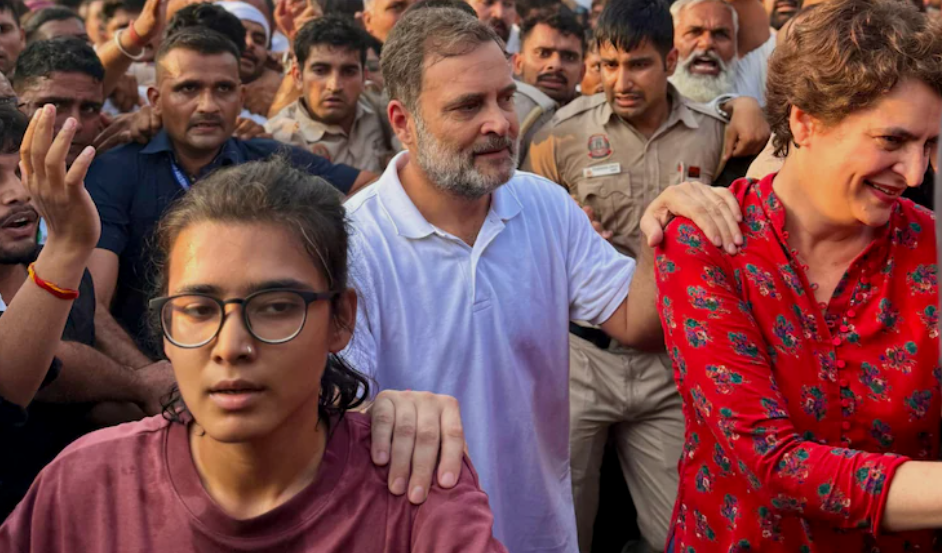
Singh and other activists also met Congress President Rahul Gandhi and JD(U) leader Sharad Yadav to seek their support and also to ensure the issue be raised in the current session of Parliament.
Agarwal became a Hindu ascetic some years ago and took on the name of Swami Gyan Swaroop Sanand, spending his time at the Matri Sadan ashram in Hardwar. The Matri Sadan ashram has emerged as the hub of the save the Ganga movement and has witnessed forty fasts to save the Ganga including the fast by Swami Nigamanand resulting in his death.
He has an impeccable academic background, having previously held the chair at the Department of Civil and Environmental Engineering at the Indian Institute of Technology in Kanpur. Former prime minister Indira Gandhi had appointed him as the first member secretary of the Central Pollution Control Board and he has also been a member of the National Ganga River Authority (NGRA). He resigned from the NGRA in 2012 stating that it was a toothless organisation that was not focusing on its job of cleaning up the Ganga. Three other members resigned with him.
He had between 2008 and 2012 conducted four fasts to save the Ganga forcing the then Minister of Environment Jairam Ramesh to enter into negotiations with him that led to the cancellation of all hydro projects on the Bhagirathi river, a tributary of the Ganga.
This time, though, the government both at the state and central level have failed to respond to him in an effective manner. Although Prime Minister Narendra Modi had made restoring the Ganga to health one of his planks while campaigning for the 2014 elections, his government’s Namani Gange project to clean the river has so far failed to come up with any substantive results.
“I appreciate Harish Rawat (former Uttarakhand chief minister) and all the river activists across the country who came to Delhi and held prayers in Rajghat,” Agarwal told reporters.
But whether the government is able to give a concrete commitment to this frail but determined green warrior is yet to be seen. It is an open secret that the Modi government has no clear road map on just how they plan to clean up the Ganga and its many tributaries by reviving both their flow and ending the huge amounts of sewage and industrial pollution being dumped in it.