English हिन्दी
Connect with us

India News

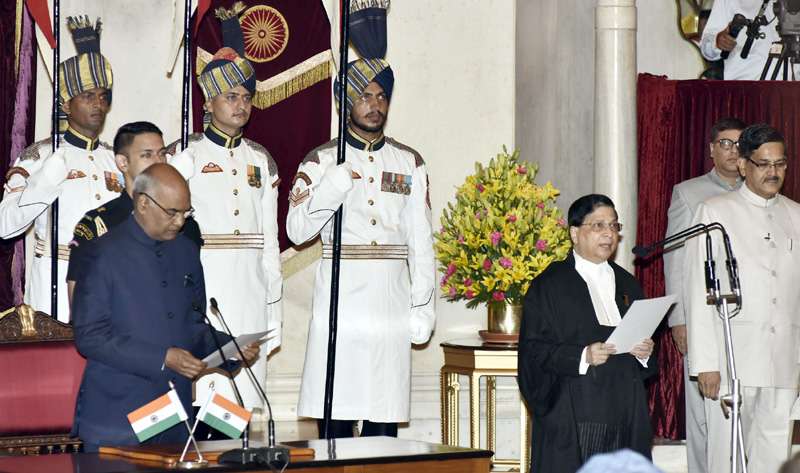
Justice Dipak Misra sworn in as 45th Chief Justice of India

Published

on

Justice Dipak Misra sworn-in as 45th Chief Justice of India

[vc_row][vc_column][vc_column_text]New Chief Justice will have the unenviable task of presiding over politically sensitive cases like the Babri Masjid-Ram Janmbhoomi land dispute, repealing Article 35A in Kashmir, among others

Justice Dipak Misra was, on Monday, sworn in as the 45th Chief Justice of India by President Ram Nath Kovind, taking over the mantle from Justice JS Khehar, who retired on Sunday. The newly sworn-in CJI is scheduled to retire on October 2, 2018 after a tenure that will last for 13 months and six days.

Justice Misra was appointed as a judge of the Supreme Court on October 10, 2011 and in the past six years has delivered several crucial judgments – those that were hailed as landmark verdicts and yet others that were criticised by legal experts for bordering on judicial over-reach.

Among the most defining moments of his stint as a judge of the apex court, perhaps came on the intervening night of July 29-30, 2015 when as part of a three-judge Bench, which also included then Chief Justice of India, HL Dattu, he dismissed the mercy petition of Yakub Memon, convicted in the Bombay blasts case. For the first time in the history of independent India, the Supreme Court had held a midnight hearing, discussing the arguments made in the case for nearly 90 minutes before reading out its verdict at 3 am. Memon was hanged at 3 am on July 30, 2015, amidst criticism and applause of the Supreme Court in equal measure.

A judgment passed on November 30, 2016 by a Bench headed by Justice Misra, however triggered a debate over whether an increasingly aggressive brand of nationalist fervour was stifling civil liberties. The verdict gave sanction for playing of the national anthem in cinema halls before the screening of a film began and made it mandatory for everyone present in the audience to stand up while the anthem was being played. In the days following the verdict, while a handicapped person, who could not stand up during the playing of the national anthem in a cinema hall, was severely heckled several similar reports of people being harassed by right-wing lumpens at movie theatres across the country collectively added to the narrative that whether the Supreme Court had erred in its verdict. A few months after the verdict, the Centre had informed the apex court that handicapped people who cannot stand when the anthem is played should be exempted from doing so.

On May 3, 2016, Justice Misra upheld the constitutional validity of the legal provision related to criminal defamation. Justices Misra and PC Pant had held that the reputation of an individual was an equally important right and stood on the same pedestal as free speech. The court said it would be a stretch to say that upholding criminal defamation in modern times would amount to imposition of silence. A section of the legal fraternity and advocates of free speech had termed the verdict as being regressive.

Then, on May 5, 2017, a bench headed by Justice Misra had upheld the execution of the three convicts in the highly publicised Nirbhaya gang rape case.

Just as verdicts passed by him or a bench that he was part of faced scrutiny by legal eagles, Justice Misra’s elevation as the CJI too had become a matter of some debate over the past few weeks. In July this year, Adish C. Aggarwala, president of the International Council of Jurists, had alleged that Justice Misra’s appointment as the CJI would “severely compromise the independence of the judiciary”. Aggarwala had written to then CJI Khehar – who had named Justice Misra as his successor – asking that an ongoing enquiry into allegations that Justice Misra had misrepresented facts in attempting to get hold of public land meant to be distributed to the landless poor for agricultural purposes in Odisha must first be resolved before he takes over India’s highest judicial post.

Aggarwala had raked up allegations made by an Odisha-based activist, Jayanta Kumar Das, who had claimed that back in 1979, when Justice Misra had not joined the judiciary but was a practicing lawyer, he had applied for allotment of the land to develop a fodder farm. While in his application to the Odisha government he had declared that his family owned 10 acres of land, Das had alleged that none of the said land was actually in Justice Misra’s name and that he had allegedly concealed this information in a subsequent affidavit. The affidavit later became the basis for allotment of two acres of land to Justice Misra.

The suicide note of former Arunachal Pradesh chief minister Kalikho Pul too had reportedly made some serious allegations against Justice Misra, which went uninvestigated.

However, these allegations notwithstanding, outgoing Chief Justice Khehar and the Narendra Modi government still went ahead with the appointment of Justice Misra as the CJI, sticking to the seniority rule.

On his hands, the new Chief Justice will have some critical cases to deal with. He might preside over the contentious Babri Masjid demolition case and also deal with the much popular BCCI reforms matter, as well as the Sahara SEBI case. The explosive issue of abrogation of Article 35A in Kashmir is also expected to be heard by the new Chief Justice.

Adding to the challenges he is certain to face is the seemingly perpetual problem of filling up vacancies in High Courts and the Supreme Court. High Courts in India are working with just 56% of their sanctioned strength while the shortfall in the Supreme Court will widen to 6 when Justice PC Pant retires on Tuesday, leaving only 25 judges in the apex court. The contentious MOP (Memorandum of Procedure) continues to remain an unresolved issue between the government and the SC collegiums, which has rejected the idea of including a security clearance clause that would allow the executive to veto superior court appointments in case of a negative remark against a proposed candidate.[/vc_column_text][/vc_column][/vc_row]

India News

Amit Shah counters delimitation concerns, says southern states to gain Lok Sabha seats

Amit Shah assures Parliament that southern states will gain Lok Sabha seats after delimitation, countering opposition criticism during the women’s reservation debate.

Published

on

Amit Shah

Union Home Minister Amit Shah on Thursday addressed concerns over the proposed delimitation exercise, asserting in the Lok Sabha that southern states will not lose representation but instead see an increase in their number of seats.

His remarks came during a heated debate linked to the implementation of women’s reservation, where opposition parties have raised fears that population-based delimitation could reduce the political weight of southern states.

Shah rejected these claims, calling them misleading, and said the proposed framework ensures fairness while expanding the overall strength of the Lok Sabha.

Seat count to rise with expansion of Lok Sabha

The government has indicated that the total number of Lok Sabha seats could increase significantly as part of the delimitation process. In this expanded House, the combined representation of southern states is expected to rise from 129 seats at present to around 195 seats.

Shah emphasised that no state will lose seats in absolute terms, and the exercise is designed to reflect population changes while maintaining balance across regions.

State-wise projections shared in Parliament

During his address, Shah also provided indicative figures for individual southern states, suggesting notable increases in representation. According to the projections:

  • Tamil Nadu could see its seats rise substantially
  • Kerala, Telangana, and Andhra Pradesh are also expected to gain additional seats
  • Karnataka’s representation may increase as well

These figures were presented to counter the argument that delimitation would disproportionately favour northern states.

Political debate intensifies over linkage with women’s quota

The delimitation exercise has been closely linked to the rollout of women’s reservation, which proposes one-third seats for women in Parliament and state assemblies.

Opposition leaders have questioned this linkage, arguing that tying reservation to delimitation could delay its implementation and raise federal concerns. Some leaders have also warned that the move could impact national unity if apprehensions among states are not addressed.

The government, however, maintains that the reforms are necessary to ensure equitable representation and to align the electoral system with demographic realities.

Centre dismisses ‘false narrative’ on southern states

Shah reiterated that concerns about southern states losing influence are unfounded. He said the delimitation process will increase representation across regions and described the criticism as a “false narrative” aimed at creating confusion.

The issue is expected to remain a key flashpoint as Parliament continues discussions on the women’s reservation framework and related legislative changes.

Continue Reading

India News

PM Modi assures no discrimination in women’s quota, delimitation debate intensifies in Parliament

PM Narendra Modi has assured that women’s reservation will be implemented without discrimination, amid a heated debate over delimitation in Parliament.

Published

on

PM modi

Prime Minister Narendra Modi has assured that there will be no discrimination in the implementation of women’s reservation, as Parliament witnessed a sharp debate over the proposed linkage between the quota and delimitation exercise.

During the ongoing special session, the government reiterated its commitment to ensuring fair representation while addressing concerns raised by opposition parties regarding the timing and structure of the legislation.

The proposed framework aims to reserve 33 percent of seats for women in the Lok Sabha and state assemblies. However, its implementation is tied to a fresh delimitation exercise, which is expected after the next census.

Opposition questions timing and intent

Opposition leaders have raised concerns that linking the women’s quota to delimitation could delay its implementation. They argue that the process of redrawing constituencies may push the actual rollout further into the future.

The issue has triggered a broader political confrontation, with multiple parties questioning whether the move could alter representation across states.

Some critics have also alleged that the delimitation exercise could disproportionately benefit certain regions based on population, a charge the government has rejected.

Government reiterates commitment to fair implementation

Responding to these concerns, the Centre has maintained that the reforms are necessary to ensure accurate and updated representation based on population data.

Leaders from the ruling side have repeatedly emphasized that the process will be carried out transparently and without bias. The assurance that there will be “no discrimination” is aimed at addressing fears among states and opposition parties.

The debate marks a key moment in Parliament, with both sides engaging in intense exchanges over one of the most significant electoral reforms in recent years.

Continue Reading

India News

Give all tickets to Muslim women, Amit Shah says, attacking Akhilesh Yadav on sub-quota demand

A sharp exchange between Amit Shah and Akhilesh Yadav in Parliament over sub-quota for Muslim women highlights key divisions on women’s reservation implementation.

Published

on

A heated exchange broke out in Parliament during discussions on the women’s reservation framework, with Union Home Minister Amit Shah and Samajwadi Party chief Akhilesh Yadav locking horns over the demand for a sub-quota for Muslim women.

The debate unfolded as the government pushed forward key legislative measures to implement 33% reservation for women in the Lok Sabha and state assemblies.

Akhilesh Yadav argued that the proposed reservation must ensure representation for women from marginalised communities, including Other Backward Classes (OBCs) and Muslim women. He said that without such provisions, large sections could remain excluded from political participation.

He also questioned the timing of the bill, alleging that the Centre was avoiding a caste census. According to him, a census would lead to renewed demands for caste-based reservations, which the government is reluctant to address.

Government rejects religion-based quota

Responding to the demand, Amit Shah made it clear that reservation based on religion is not permitted under the Constitution.

He stated that any proposal to provide quota to Muslims on religious grounds would be unconstitutional, firmly rejecting the idea of a separate sub-quota for Muslim women within the broader reservation framework.

The government has maintained that the existing framework already includes provisions for Scheduled Castes (SC) and Scheduled Tribes (ST) women within the overall reservation structure.

Wider political divide over implementation

The issue of sub-categorisation within the women’s quota has emerged as a major flashpoint, even as most opposition parties broadly support the idea of women’s reservation.

Samajwadi Party leaders reiterated that their support for the bill depends on inclusion of OBC and minority women, while the government continues to defend its constitutional position.

The debate is part of a broader discussion during the special Parliament session, where multiple bills linked to delimitation and implementation of the women’s quota are being taken up.

Continue Reading

Trending

© Copyright 2022 APNLIVE.com