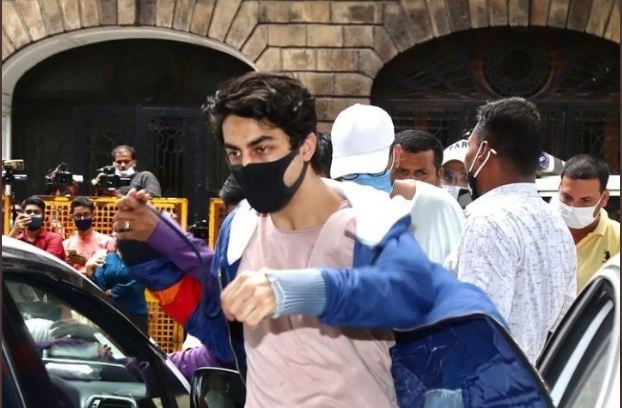
The Bombay High Court on Tuesday adjourned the hearing of Aryan Khan’s bail application for Wednesday.
Senior Advocate Mukul Rohatgi represented Aryan Khan, son of Bollywood actor Shah Rukh Khan, in his bail plea before Bombay High Court in the cruise ship drug case on Tuesday.
Aryan is seeking bail from the High Court after both Magistrate and Sessions Court had rejected his plea.
WHO reviews data on Covaxin, may get recommendation in 24 hours, says WHO official
World Health Organization technical advisory group has been reviewing data on Covaxin shot against Covid-19 with a decision on its emergency use listing likely soon, a WHO spokesperson said.
WHO spokesperson Margaret Harris told journalists that if all is in place and all goes well and if the committee is satisfied, we would expect a recommendation within the next 24 hours or so.
CBI arrests Navy officers in submarine information leak case, Navy orders probe
The Central Bureau of Investigation (CBI) has arrested three Indian Navy officials, including a serving Commander-rank officer in connection with the leakage of confidential information related to the modernisation of a Kilo-class submarine going.
The CBI launched the operation after getting tip-offs from the intelligence agencies who were monitoring the activities of the serving and retired officers for some time.
Mamata Banerjee says Bengal doesn’t need extra BSF jurisdiction, border areas peaceful
West Bengal Chief Minister Mamata Banerjee on Friday said that security forces cannot intentionally harass citizens in the name of security.
She said that she has already written a letter to the Centre opposing the BSF jurisdiction issue. She said the border areas are completely peaceful and we don’t need their involvement.
Supreme Court verdict tomorrow on pleas seeking judicial probe into Pegasus spyware case
The Supreme Court will pronounce its judgement on Wednesday on pleas seeking a judicial probe into the alleged Pegasus snooping by Centre. The matter has been listed for 10:30 AM before the SC bench of Chief Justice of India NV Ramana, Justice Surya Kant and Justice Hima Kohli. The court is hearing as many as 12 pleas, including the one filed by the Editors Guild of India, seeking an independent probe into the matter.
Punjab government to move Supreme Court over Centre’s decision to expand BSF jurisdiction in state
Punjab CM Charanjit Singh Channi on Tuesday announced that the state govt will approach the SC against the Centre’s recent move to expand jurisdiction of the BSF from 15 km to 50 km from the international border in Punjab. As per the notification, the BSF will now have the power to arrest, search, and seizure to the extent of 50 km inside three new states – West Bengal, Punjab, and Assam – sharing international boundaries with Pakistan and Bangladesh.
NCB claims attempts to derail investigation in Bombay HC in Aryan Khan case
Opposing Aryan khan’s bail in the Bombay High Court today, the NCB has alleged that attempts are being made to tamper with evidence and influence witness.
Aryan Khan has been denied bail twice, both by a Mumbai magistrate court and special anti-drugs court, ever since his arrest on October 3 in connection with a drugs raid on a Mumbai cruise ship party by Narcotics Control Bureau officers in disguise.
He has been in Mumbai’s Arthur Road jail since October 8.
Supreme Court directs Uttar Pradesh govt to provide security to witnesses in Lakhimpur Kheri violence
The Supreme Court on Tuesday during the hearing in Lakhimpur kheri violence case directed the Uttar Pradesh government to grant protection to the witnesses of the violence where eight people lost their lives during a farmers’ protest.
A bench headed by Chief Justice N V Ramana asked the Uttar Pradesh government to record the statements of other relevant witnesses before judicial magistrates under Section 164 of the CrPC.
Congress president Sonia Gandhi urges party leaders to maintain discipline, unity in party
Congress president Sonia Gandhi has called for the paramount need for discipline and unity in the party in order to fight the BJP and RSS.
In an address to the party leaders, speaking to Congress general secretaries and state presidents, she has called for the paramount need for discipline and unity in the party in order to fight the BJP and RSS.
She said that need is to fight the diabolical campaign of BJP/RSS ideologically.
SC asks UP government to file reply on killing of journalist in Lakhimpur Kheri violence
In the latest development in Lakhimpur Kheri violence, Supreme Court has asked the Uttar Pradesh government to file a reply on the investigation of the killing of a journalist Raman Kashyap and Shyam Sundar. Moreover, SC has also asked forensic labs to expedite the process of submitting reports relating to videos of the incident.
The wife of Shyam Sundar said that her husband was killed and she wants justice. The killers are roaming free and are threatening her. The top court’s bench has demanded a separate reply from the government for Shyam Sundar and journalist’s death in Lakhimpur Kheri.
PM Modi assures no discrimination in women’s quota, delimitation debate intensifies in Parliament
PM Narendra Modi has assured that women’s reservation will be implemented without discrimination, amid a heated debate over delimitation in Parliament.
Prime Minister Narendra Modi has assured that there will be no discrimination in the implementation of women’s reservation, as Parliament witnessed a sharp debate over the proposed linkage between the quota and delimitation exercise.
During the ongoing special session, the government reiterated its commitment to ensuring fair representation while addressing concerns raised by opposition parties regarding the timing and structure of the legislation.
The proposed framework aims to reserve 33 percent of seats for women in the Lok Sabha and state assemblies. However, its implementation is tied to a fresh delimitation exercise, which is expected after the next census.
Opposition questions timing and intent
Opposition leaders have raised concerns that linking the women’s quota to delimitation could delay its implementation. They argue that the process of redrawing constituencies may push the actual rollout further into the future.
The issue has triggered a broader political confrontation, with multiple parties questioning whether the move could alter representation across states.
Some critics have also alleged that the delimitation exercise could disproportionately benefit certain regions based on population, a charge the government has rejected.
Government reiterates commitment to fair implementation
Responding to these concerns, the Centre has maintained that the reforms are necessary to ensure accurate and updated representation based on population data.
Leaders from the ruling side have repeatedly emphasized that the process will be carried out transparently and without bias. The assurance that there will be “no discrimination” is aimed at addressing fears among states and opposition parties.
The debate marks a key moment in Parliament, with both sides engaging in intense exchanges over one of the most significant electoral reforms in recent years.
Give all tickets to Muslim women, Amit Shah says, attacking Akhilesh Yadav on sub-quota demand
A sharp exchange between Amit Shah and Akhilesh Yadav in Parliament over sub-quota for Muslim women highlights key divisions on women’s reservation implementation.
A heated exchange broke out in Parliament during discussions on the women’s reservation framework, with Union Home Minister Amit Shah and Samajwadi Party chief Akhilesh Yadav locking horns over the demand for a sub-quota for Muslim women.
The debate unfolded as the government pushed forward key legislative measures to implement 33% reservation for women in the Lok Sabha and state assemblies.
Akhilesh Yadav argued that the proposed reservation must ensure representation for women from marginalised communities, including Other Backward Classes (OBCs) and Muslim women. He said that without such provisions, large sections could remain excluded from political participation.
He also questioned the timing of the bill, alleging that the Centre was avoiding a caste census. According to him, a census would lead to renewed demands for caste-based reservations, which the government is reluctant to address.
Government rejects religion-based quota
Responding to the demand, Amit Shah made it clear that reservation based on religion is not permitted under the Constitution.
He stated that any proposal to provide quota to Muslims on religious grounds would be unconstitutional, firmly rejecting the idea of a separate sub-quota for Muslim women within the broader reservation framework.
The government has maintained that the existing framework already includes provisions for Scheduled Castes (SC) and Scheduled Tribes (ST) women within the overall reservation structure.
Wider political divide over implementation
The issue of sub-categorisation within the women’s quota has emerged as a major flashpoint, even as most opposition parties broadly support the idea of women’s reservation.
Samajwadi Party leaders reiterated that their support for the bill depends on inclusion of OBC and minority women, while the government continues to defend its constitutional position.
The debate is part of a broader discussion during the special Parliament session, where multiple bills linked to delimitation and implementation of the women’s quota are being taken up.
No state will lose a seat, Centre assures as delimitation debate takes centre stage in Parliament
Parliament’s special session begins with key focus on implementing women’s reservation and delimitation, setting the stage for major electoral changes.
A special session of Parliament commenced on Thursday, with the Centre set to take up crucial legislation related to women’s reservation and delimitation of constituencies. The session, scheduled over three days, is expected to witness intense debate as the government pushes forward its legislative agenda.
At the centre of discussions is the proposal to operationalise the women’s reservation law, which seeks to allocate 33 percent of seats in the Lok Sabha and state assemblies to women. The law, passed earlier, requires enabling provisions before it can be implemented.
The rollout of the reservation is closely tied to the delimitation exercise — a process that redraws parliamentary constituencies based on updated population data. The implementation is expected only after the next census and delimitation process are completed.
The government is aiming to put in place the framework so that the reservation can be enforced in future elections, likely around 2029.
Delimitation and numbers at play
Delimitation is a key aspect of the proposed changes, as it will determine how seats are redistributed and which constituencies are reserved. The exercise is expected to reflect population shifts and may also involve an increase in the total number of Lok Sabha seats.
This linkage has made the issue politically sensitive, with several opposition parties backing women’s reservation in principle but raising concerns over how and when delimitation will be carried out.
Political reactions and expected debate
The session is likely to see sharp exchanges between the government and opposition. While there is broad agreement on increasing women’s representation, disagreements remain over the timing, process, and potential political implications of the delimitation exercise.
Some leaders have argued that delimitation could significantly alter the balance of representation among states, making it a contentious issue beyond the women’s quota itself.
The government, however, has framed the move as a step toward strengthening women’s participation in governance and ensuring more inclusive policymaking.
APN News is today the most watched and the most credible and respected news channel in India. APN has been at the forefront of every single news revolution. The channel is being recognized for its in-depth, analytical reportage and hard hitting discussions on burning issues; without any bias or vested interests.