English हिन्दी
Connect with us

India News

Cow dung, urine can strengthen economy: Madhya Pradesh CM Shivraj Chouhan gives suggestion to boost economy

This is not the first time when the BJP led ministers led emphasis on cows, their dung and urine. Earlier, BJP MLA Surendra Singh from Bairia in Uttar Pradesh asked people to drink cow urine to defeat coronavirus.

Published

on

Shivraj Singh Chouhan

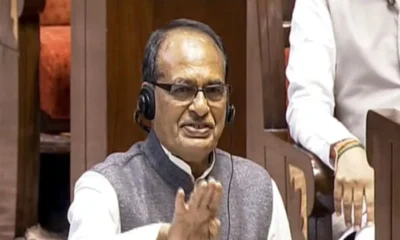
Madhya Pradesh Chief Minister Shivraj Singh Chouhan on Saturday gave suggestions to boost the economy. While addressing a convention of the women’s wing of the Indian Veterinary Association in Bhopal, Shivraj Chouhan said that Cows are very crucial, their dung and urine can help strengthen the economy of the state and the country if a proper system is put in place.

In the address, he said that there is a lot of work that cannot progress without cows or ox. Therefore, they are very crucial. Cows, their dung and urine can help strengthen the economy of the state and the country if a proper system is put in place.

He also said that they are trying their best to lend support and with the contribution of women in this field. Shivraj Chouhan further said that from cow dung and urine, people can make a range of important substances, starting from pesticides to medicines, and that can help to boost the economy.

This is not the first time when the BJP led ministers led emphasis on cows, their dung and urine. Earlier, BJP MLA Surendra Singh from Bairia in Uttar Pradesh asked people to drink cow urine to defeat coronavirus.

Moreover, he also shared a video on social media in which he was drinking cow urine and was telling people how exactly should people drink cow urine to fight the deadly coronavirus.

Earlier, in 2020, the BJP government in Madhya Pradesh also announced the constitution of gau cabinet with ministers of six departments who would work towards the protection of cows and promotion of cow produce in the state

India News

Union Budget 2026 live updates: Historic Speech Tabled as India Awaits Key Announcements

Finance Minister Nirmala Sitharaman is presenting the Union Budget 2026 in Parliament today. Follow this space for live updates, key announcements, and policy insights.

Published

on

Finance Minister Nirmala Sitharaman arrives to present Union Budget 2026

Finance Minister Nirmala Sitharaman will shortly present the Union Budget 2026 in the Lok Sabha, marking her ninth consecutive Budget. The annual financial statement is expected to outline the government’s policy priorities, reform agenda and spending plans for the coming year. Stay tuned for live updates, key announcements and immediate reactions as the Budget speech unfolds.

Finance Minister Nirmala Sitharaman tabled her ninth Union Budget today, beginning her speech at 11 am.

Nirmala Sitharaman is set to present her ninth Union Budget today, with the finance minister scheduled to begin her speech at 11 am.

Budget 2026 live updates: Presenting the Union Budget for 2026–27, Finance Minister Nirmala Sitharaman said the occasion coincided with Magh Purnima and the birth anniversary of Guru Ravidas. She noted that over the past 12 years, India’s economic journey has been defined by stability, fiscal discipline, sustained growth and moderate inflation.

The budgeted fiscal deficit for fiscal 2026 is estimated at 4.4 per cent of gross domestic product (GDP)

Planned capital expenditure this fiscal year Rs 11.2 lakh crore

Rare earth corrdiors in Odisha and Kerala

Hi-tech tool rooms to be set up by PSUs

Construction equipment scheme to be launched

Container manufacturing scheme for Rs 10,000 crore over 5 years

Continue Reading

India News

Nirmala Sitharaman to present ninth Union Budget with reforms in focus

Nirmala Sitharaman will present her ninth consecutive Union Budget today, with expectations centred on reforms, growth priorities, rural development and capital expenditure.

Published

on

Union budget 2026

Finance Minister Nirmala Sitharaman will present her ninth consecutive Union Budget today, marking another key moment in India’s economic policy calendar. The Budget is expected to lay out measures aimed at sustaining growth in what remains the world’s fastest-growing major economy.

For fiscal 2027, policy priorities are likely to include defence, infrastructure, capital expenditure, power and faster growth in affordable housing, according to expectations ahead of the presentation.

Shift in Budget speech structure

This year’s Union Budget is expected to break with a long-standing tradition in the structure of the finance minister’s speech. Until now, most major policy announcements were typically made in Part A, while Part B focused on taxation. This time, Part B is expected to be used to present a broader vision for India’s economic future.

The finance minister is also expected to outline short-term priorities as well as longer-term goals, positioning India’s economic strategy as the country moves deeper into the 21st century, with emphasis on domestic strengths and global ambitions.

Market backdrop ahead of Budget

Ahead of the Budget presentation, equity markets opened lower. Gold and silver futures also declined sharply on the Multi Commodity Exchange, extending the impact of a severe two-day global sell-off.

India’s economy has so far remained resilient despite punitive tariffs imposed by the United States under President Donald Trump. Growth is forecast at 7.4 per cent for the year ending March 31, supported by government spending on infrastructure and tax measures that boosted consumption.

Focus on rural development and jobs

Rural development and agriculture are expected to be among the top priorities in Union Budget 2026. The finance minister may announce higher allocations for programmes aimed at expanding employment opportunities in rural areas.

The Rural Development Ministry has sought a sharp increase in funding for the new employment guarantee scheme, ‘Viksit Bharat – G Ram G’ or VB-G Ram G, proposing a budget of Rs 1.51 lakh crore, a 72 per cent rise. In comparison, the Mahatma Gandhi National Rural Employment Guarantee Scheme received Rs 86,000 crore in the previous Budget.

Fiscal deficit and capital expenditure

The budgeted fiscal deficit for fiscal 2026 is estimated at 4.4 per cent of gross domestic product. With the government having achieved a consolidation path that brought the deficit below 4.5 per cent, markets will closely watch signals on further debt-to-GDP reduction.

Capital expenditure for the current fiscal year has been budgeted at Rs 11.2 lakh crore. The government is expected to continue prioritising capex, with a possible increase of 10 to 15 per cent, as private sector investment remains cautious.

Investment reforms and global challenges

Further policy changes aimed at attracting domestic and foreign investment are also expected. These may include steps to make it easier for foreign companies to invest in defence firms that already hold licences.

The Union Budget 2026 comes at a time of mixed signals globally. While domestic demand remains steady and inflation has eased from recent highs, uncertainties linked to geopolitics, commodity price volatility and uneven monetary policy easing by major central banks continue to pose challenges.

Continue Reading

India News

Union budget 2026 to be presented on Sunday with special trading session

The Union Budget 2026 will be presented on a Sunday for the first time in over two decades, with NSE and BSE announcing special trading sessions for the day.

Published

on

Nirmala Sitharaman

For the first time in more than two decades, the Union Budget will be presented on a Sunday. Finance Minister Nirmala Sitharaman is scheduled to table the Union Budget for 2026 in the Lok Sabha on February 1 at 11 am, even as the day is usually observed as a holiday for government offices and financial markets.

February 1 falls on a Sunday this year, raising questions about market operations and investor response. To ensure uninterrupted trading and immediate market reaction to budget announcements, stock exchanges have announced special arrangements for the day.

Markets to remain open on budget day

Both the National Stock Exchange and the Bombay Stock Exchange have confirmed that markets will remain open on February 1. The NSE has announced a special trading session, with the pre-open market scheduled from 9 am to 9:08 am, followed by normal trading hours from 9:15 am to 3:30 pm.

The BSE has also declared the day a special trading day, with regular market hours applicable. Trading is expected to continue across equity, derivatives, and futures and options segments.

What the Sunday budget means for investors

A weekend budget presentation is seen as offering certain advantages for market participants. With trading active on the same day, investors will be able to respond to policy announcements immediately rather than waiting for the next working day.

The Sunday timing also gives investors, analysts, and financial institutions additional time to go through detailed proposals, including tax changes, fiscal deficit targets, and sector-wise allocations. The extended window for analysis may help reduce sharp, headline-driven reactions and encourage more informed decision-making.

With fewer competing developments on a non-working day, budget announcements are also expected to receive more focused attention from markets and stakeholders.

Parliamentary schedule and key milestones

The Economic Survey is expected to be tabled on January 29, ahead of the budget presentation. The Budget Session of Parliament began on January 28 with the President’s address to a joint sitting of the Lok Sabha and Rajya Sabha.

The upcoming budget will mark Nirmala Sitharaman’s ninth consecutive Union Budget. It will also be India’s 80th budget since Independence. Since 2017, Union Budgets have been presented at 11 am on February 1, following a timing change introduced during the tenure of former finance minister Arun Jaitley.

Continue Reading

Trending

© Copyright 2022 APNLIVE.com