English हिन्दी
Connect with us

India News

Odds of an SP-BSP alliance in UP

Published

on

Odds of a SP-BSP alliance in UP

[vc_row][vc_column][vc_column_text]Will defeat bring arch rivals closer?

By APN Bureau

Following the debacle in the recently concluded assembly elections in Uttar Pradesh, the Samajwadi Party and the Bahujan Samaj Party have been seen to be coming closer by political observers. There are now indications that the two arch-rivals may form an alliance ahead of the 2019 parliamentary elections.

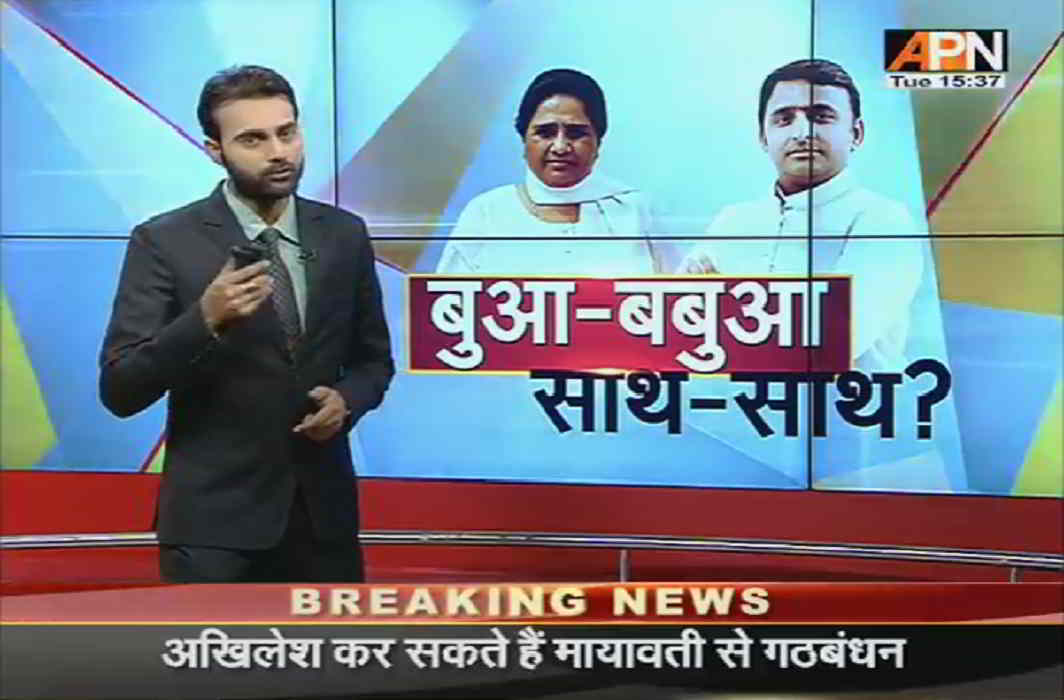
On April 11, APN carried a special report Bua Babua Saath Saath? It discussed the duo having a possible change of heart and explored the possibilities of a political tie-up between the two.

Introducing the subject, the anchor raised the question if the two party heads, Mayawati Prabhu Das and Akhilesh Singh Yadav, can come closer in the same way that rivals Lalu Prasad and Nitish Kumar did in Bihar before the 2015 elections. He also referred to the efforts of West Bengal Chief Minister Mamata Banerjee and Prasad in this direction. These leaders have been proposing a grand alliance to defeat the BJP in the forthcoming parliamentary elections. In fact, way back in 2015, Akhilesh’s uncle and SP thinktank Ram Gopal Yadav had first mooted the idea of an SP-BSP tie-up.

Quoting unnamed sources among members of the national executives in the two parties, the APN report said that after being defeated badly in two consecutive elections, both are now exploring chances of a pre-poll truck. It also said that there are possibilities of Mayawati forgiving the SP for the 1995 guesthouse incident when she was virtually confined to a VIP bungalow in Lucknow as SP goons paraded outside. Just a day ago, she had winded up her alliance with the SP, and this experience ruled out any further tie-up between the two, turning them into bitter rivals, an enmity that has persisted to this day.

Indeed, in 1993, the BSP and SP had established a coalition government. But since neither of the party heads had a power sharing attitude, it fell through. The BSP continued to rule for just a few more months—till October 1995—with outside support from the BJP.

Quoting sources in Samajwadi Party, the APN anchor said that the SP leaders are now watching how Mayawati behaves. However, the SP has not given any formal indication of warming up to the BSP.

It is worth mentioning that in the last assembly elections, the BJP got a clear majority in Uttar Pradesh after 26 years. The Modi wave has caused ruptures in the SP, the BSP and the Congress. These resulted in the Samajwadi Party winning only 47 seats. This was the worst election outcome for the SP in the last 25 years. The BSP, too, experienced its worst defeat, securing only 19 seats.[/vc_column_text][/vc_column][/vc_row]

India News

CBSE denies OSM portal data breach, terms online allegations misleading

CBSE has strongly dismissed social media allegations of a security breach in its On-Screen Marking (OSM) portal, clarifying that the exposed URL is a mere testing site containing no actual student data or exam marks.

Published

on

CBSE

The Central Board of Secondary Education (CBSE) has refuted viral claims circulating on social media regarding a security breach in its On-Screen Marking (OSM) portal. In an official statement, the national education board dismissed the allegations, labeling them completely false and highly misleading.

The clarification comes after social media posts suggested that sensitive student records and internal assessment systems had been compromised by unauthorised actors. Media reports indicate that the board has categorically denied any leak of actual student marks or examination-related details.

Testing site hosted no real student details

According to the statement released by the board, the web address highlighted in the viral allegations belongs strictly to a testing environment. The board clarified that this URL is utilized purely for internal evaluations, data sampling, and platform reviews during development phases.

The board firmly reiterated that no live student details, official scoreboards, or active examination data are stored on this testing site. Authorities have advised stakeholders and students to refrain from panic and avoid circulating unverified rumors that challenge the integrity of the examination system.

Continue Reading

India News

Congress Dismisses Karnataka Leadership Transition Rumors After Six-Hour Delhi Meet

The Congress party has rejected ongoing rumors regarding a leadership change or a rotating Chief Minister formula in Karnataka, stating that a recent six-hour meeting in Delhi focused strictly on the upcoming Rajya Sabha and MLC elections.

Published

on

The Congress party has strongly downplayed the intense political buzz surrounding a potential leadership transition or a change in the Chief Minister’s post in Karnataka. Following a marathon six-hour meeting with the state’s top leadership in New Delhi, the party explicitly rejected the ongoing speculation, labeling it as having “no reality.”

A brief statement issued to the media after the high-level meeting advised against spreading rumors, clarifying that the discussions were entirely centered on upcoming electoral strategies rather than structural changes within the state government. The party stated that the deliberations solely revolved around the state’s three vacant Rajya Sabha seats and the upcoming Member of Legislative Council (MLC) elections.

Rajya Sabha and MLC Polls Take Center Stage

The high-stakes meeting was attended by Congress President Mallikarjun Kharge, senior leader Rahul Gandhi, and party General Secretary KC Venugopal, alongside Karnataka Chief Minister Siddaramaiah and Deputy Chief Minister DK Shivakumar.

Briefing the media post-meeting, KC Venugopal stated that conversations were strictly confined to the Rajya Sabha and MLC elections, emphasizing that there is no truth to any other political speculation. Chief Minister Siddaramaiah also confirmed that the agenda of a potential cabinet expansion or a leadership shift did not come up during the six-hour-long discussion.

Background of the Power Struggle

The question of leadership in Karnataka has remained a recurring theme for over a year. Supporters of Deputy Chief Minister DK Shivakumar have consistently maintained that the central leadership promised a rotating Chief Ministership arrangement when the government was formed after the 2023 assembly elections.

Speculation had intensified recently as the ruling government faced local anti-incumbency pressures alongside renewed political activity from the opposition bench. Some internal reports had even indicated a push from within certain sections of the high command, including Priyanka Gandhi Vadra, for a leadership revamp.

Balancing Caste Equations and Party Structure

The central leadership has navigated the situation cautiously to maintain political stability. Chief Minister Siddaramaiah, 80, commands a powerful “Ahinda” support base—a coalition comprising minority communities, backward classes, and Dalits. This social alliance was crucial in helping the party navigate the traditional Vokkaliga and Lingayat caste dynamics during the 2023 elections.

Although the rotation issue had previously gained significant momentum when the government completed two years in office, the party high command had chosen to maintain the status quo to avoid any adverse electoral impact in neighboring assembly elections, such as in Tamil Nadu. With those elections concluded, supporters of the 64-year-old Deputy Chief Minister had expressed optimism for a transition. Shivakumar currently holds the dual responsibility of being the Deputy Chief Minister as well as the state Congress chief, signaling his critical organizational value to the party. However, for the time being, the party high command has firmly signaled that the current leadership structure will remain unchanged.

Continue Reading

Cricket news

Bowlers may hold the key in high-stakes IPL 2026 Qualifier 1 at Dharamsala

Although the media build-up centers on the batting heavyweight clash between Virat Kohli and Shubman Gill, the IPL 2026 Qualifier 1 in Dharamsala is set to be decided by the bowling consistency of Bhuvneshwar Kumar and Mohammed Siraj.

Published

on

Flat pitches, towering sixes, and relentless run-scoring have defined the Indian Premier League (IPL) 2026 so far. However, when Gujarat Titans (GT) and Royal Challengers Bengaluru (RCB) lock horns in Qualifier 1 at the Himachal Pradesh Cricket Association (HPCA) Stadium in Dharamsala, the contest could ultimately hinge on the bowlers.

The HPCA Stadium has proved to be unforgiving for bowlers due to its short boundaries. A teaser of what could unfold was evident during recent net sessions, where Gujarat Titans’ Jos Buttler and Royal Challengers Bengaluru’s Tim David regularly launched monstrous hits out of the stadium. In the three matches played at this venue this season, teams crossed the 200-run mark five times, with the lowest score being 199/8. An average of nearly 25 maximums per match has been hit here, promising another potential run-fest.

Moving past the Kohli vs Gill narrative

While media attention focuses on the iconic battle between the ‘King’ Virat Kohli and the ‘Prince’ Shubman Gill—hailed as the heir to Indian cricket’s batting legacy—the true deciding factor might lie elsewhere. Both batters look in pristine touch. Gill occupies the second spot in the Orange Cap race with 616 runs from 13 matches, trailing behind his opening partner Sai Sudharsan. Meanwhile, Kohli has bounced back from a brief mid-tournament slump by smashing a sparkling century, taking his tally to 557 runs this season.

Despite the incredible batting firepower on display, the bowling units are expected to dictate which team blinks last. Media interactions with team managements highlighted that consistency and self-belief within the respective bowling departments have been the defining traits of both squads this season.

Powerplay battles to decide the finalist

For RCB, veteran pacer Bhuvneshwar Kumar leads the charge alongside Kagiso Rabada for GT, with both spearheads locked as the joint-highest wicket-takers across the two sides at 24 wickets each. Bhuvneshwar holds a slight edge due to a superior economy rate. Close behind them is GT’s Mohammed Siraj, who has taken 17 wickets so far. With supporting acts like Josh Hazlewood, Jason Holder, Prasidh Krishna, Rasikh Salam Dar, and spinners Rashid Khan and Krunal Pandya in the mix, the match promises an intriguing tactical battle.

Gujarat Titans’ assistant coach Vijay Dahiya acknowledged that negotiating Bhuvneshwar Kumar in the powerplay will be a massive task, but reminded that GT possesses equal firepower in Siraj and Rabada. “If you talk about the powerplay, our numbers are among the best in this tournament,” Dahiya stated.

RCB captain Rajat Patidar echoed similar views, placing immense faith in his bowling attack to stop GT’s prolific opening duo of Gill and Sudharsan. “Our strength is bowling. The way we bowl in the powerplay will be very crucial. We’ll look for early wickets and that is what we have done throughout the tournament,” Patidar remarked.

In a tournament dominated by towering batting displays, the team whose bowling unit holds its nerve under the Dharamsala lights will seal a direct spot in the IPL final.

Continue Reading

Trending

© Copyright 2022 APNLIVE.com