English हिन्दी
Connect with us

India News

Pakistan calls India’s move on Indus Waters Treaty as an act of war

The committee concluded by asserting that Pakistan’s armed forces are fully prepared to defend the nation’s territorial integrity against any misadventure, urging the international community to take note of India’s provocative actions.

Published

on

In a sharp escalation of tensions following India’s decision to suspend the Indus Waters Treaty, Pakistan’s Prime Minister’s Office issued a stern warning on Thursday, April 24, 2025, declaring that any attempt to disrupt water flows to Pakistan would be considered an “act of war.”

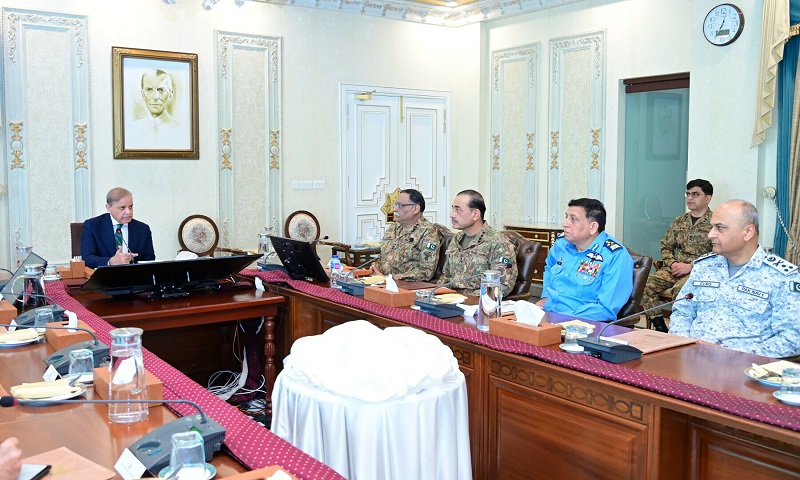
The statement came after a high-level meeting of Pakistan’s National Security Committee (NSC), chaired by Prime Minister Shehbaz Sharif, which outlined a series of retaliatory measures, including the closure of its airspace to Indian airlines and a complete halt to all trade activities with India.

The NSC, attended by senior civilian and military leaders, addressed the recent terror attack in Pahalgam, Jammu and Kashmir, which claimed 26 lives. While unequivocally condemning the violence, Pakistan rejected India’s attempts to attribute the attack to it, dismissing such claims as “frivolous” and lacking credible evidence.

The committee reiterated Pakistan’s longstanding position that Kashmir remains an unresolved dispute, emphasizing the Kashmiri people’s right to self-determination as recognized by UN resolutions.

It accused India of perpetuating violence through state oppression, demographic changes, and the marginalization of minorities, particularly Muslims, citing recent legislative moves like the Waqf Bill as evidence of systemic persecution.

Pakistan’s strongest rebuke was reserved for India’s announcement to hold the Indus Waters Treaty in abeyance. The 1960 treaty, brokered by the World Bank, has been a cornerstone of water-sharing between the two nations, surviving three wars. The NSC underscored that the agreement contains no provision for unilateral suspension and described water as a “vital national interest” for Pakistan’s 240 million people.

“Any attempt to stop or divert Pakistan’s rightful share of water under the treaty, or to usurp the rights of a lower riparian state, will be treated as an act of war and met with a comprehensive response across all domains of national power,” the statement read.

In response to India’s measures, Pakistan announced a sweeping suspension of all bilateral agreements, including the Simla Pact, accusing India of violating international norms and fostering terrorism. The Wagah border post was ordered closed immediately, with cross-border transit halted, though those with valid endorsements may return by April 30, 2025.

Pakistan also revoked all SAARC Visa Exemption Scheme (SVES) visas for Indian nationals, except for Sikh pilgrims, and instructed Indians in Pakistan to leave within 48 hours. Indian defence, naval, and air advisors in Islamabad were declared persona non grata and given until April 30 to depart, with their posts deemed annulled. The Indian High Commission in Islamabad will see its staff reduced from 55 to 30 by the same date.

Further, Pakistan closed its airspace to all Indian-owned or -operated airlines and suspended all trade with India, including third-country trade routed through Pakistan. The NSC accused India of exploiting the Pahalgam attack to advance a narrow political agenda, pointing to the case of Kulbhushan Jadhav, a serving Indian Navy officer in Pakistan’s custody, as evidence of India’s alleged state-sponsored terrorism. It also criticized India’s “irresponsible warmongering” through state-controlled media, warning that such rhetoric fuels regional instability.

The committee expressed deep sorrow for the loss of lives in Pahalgam but labeled India’s retaliatory measures—announced on April 23—as unilateral, unjust, and politically driven. It argued that India’s narrative of victimhood obscures its own role in regional violence, including alleged extraterritorial assassinations exposed by Pakistan and other nations. Pakistan vowed to pursue justice for those responsible for terrorism and to respond firmly to any threats to its sovereignty.

Reaffirming its commitment to counter-terrorism, the NSC highlighted Pakistan’s sacrifices as a frontline state against terrorism, having endured significant human and economic losses. It called on India to abandon its “reflexive blame game” and take responsibility for its security failures in Jammu and Kashmir. The committee concluded by asserting that Pakistan’s armed forces are fully prepared to defend the nation’s territorial integrity against any misadventure, urging the international community to take note of India’s provocative actions.
As the region braces for heightened tensions, Pakistan’s measures signal a deepening rift with India, with both nations adopting hardline stances in the aftermath of the Pahalgam tragedy.

India News

Congress, BJP attack Bhagwant Mann over remarks on Punjab blasts

Congress and BJP have jointly criticised Punjab CM Bhagwant Mann after he linked recent blasts near defence sites to political motives, triggering a controversy.

Published

on

Bhagwant Mann

A political row has erupted in Punjab after Chief Minister Bhagwant Mann linked recent blast incidents to political motives, drawing sharp criticism from both the Congress and the Bharatiya Janata Party (BJP).

The controversy follows two low-intensity explosions reported within a short span of time — one near the Border Security Force (BSF) headquarters in Jalandhar and another close to an army cantonment area in Amritsar. The incidents raised concerns over security, particularly given the sensitive nature of the locations.

In response, Mann suggested that the blasts could be part of a larger political strategy. His remarks triggered a strong backlash, with opposition parties accusing him of politicising a serious security issue.

Leaders from the Congress criticised the Chief Minister’s statement, calling it inappropriate and alleging that such comments undermine the gravity of the situation. They stressed that matters related to national security should be handled with caution and responsibility.

The BJP also joined the criticism, questioning the basis of Mann’s claims and urging the state government to focus on investigation and law enforcement instead of making political allegations.

The developments have led to an unusual moment where both Congress and BJP appear aligned in their criticism of the Aam Aadmi Party-led government in the state.

Meanwhile, the blasts themselves have intensified concerns over safety in border regions, with authorities continuing their investigation into the incidents. No casualties were reported, but the proximity to defence establishments has made the issue particularly sensitive.

The episode has further escalated political tensions in the state, with security and accountability emerging as key points of debate.

Continue Reading

India News

Himanta Biswa Sarma resigns as Assam chief minister, oath ceremony likely after May 11

Himanta Biswa Sarma resigns as Assam Chief Minister after BJP-led NDA’s victory. He will continue as caretaker CM until the new government is sworn in after May 11.

Published

on

Himanta sharma

Assam Chief Minister Himanta Biswa Sarma resigned from his post on Wednesday, paving the way for the formation of a new government after the BJP-led NDA secured a decisive victory in the 2026 Assembly elections.

Sarma submitted his resignation to Governor Lakshman Prasad Acharya at Lok Bhawan in Guwahati. The Governor accepted the resignation and asked him to continue as the caretaker Chief Minister until the new government takes charge.

The resignation comes after the NDA’s strong electoral performance, where the alliance won a clear majority in the 126-member Assembly, ensuring its return to power for another term.

Oath ceremony expected after May 11

Speaking to reporters after submitting his resignation, Sarma said the swearing-in ceremony for the new government is likely to be held after May 11.

He indicated that Prime Minister Narendra Modi has been invited to attend the ceremony but is unavailable until May 11, which has influenced the tentative schedule.

Decision on next chief minister soon

Sources suggest that central observers, including senior BJP leaders, are expected to arrive shortly to oversee the selection of the legislature party leader. The newly elected MLAs will then decide on the next Chief Minister.

Despite the formal resignation, party sources indicate that Sarma is likely to continue in the role for another term, given the BJP’s strong mandate in the state.

The move marks the beginning of the government formation process in Assam following the election results declared earlier this week.

Continue Reading

India News

Rahul Gandhi and Vijay alliance took shape through backchannel talks, early signals from Congress leaders

Congress outreach and political calculations led to Rahul Gandhi and Vijay coming together after the Tamil Nadu 2026 election results.

Published

on

The coming together of Rahul Gandhi and actor-politician Vijay in Tamil Nadu after the 2026 Assembly elections was not sudden, but the result of behind-the-scenes political manoeuvring and early signals within the Congress.

According to media reports, some leaders in the Tamil Nadu Congress had already sensed the scale of Vijay’s surge during the campaign, anticipating what was later described as a “wave” in favour of his party.

After the results, where Vijay’s Tamilaga Vettri Kazhagam (TVK) emerged as the single largest party but fell short of a majority, communication channels between the Congress leadership and Vijay quickly became active.

A key moment in this evolving political equation was a phone call from Rahul Gandhi to Vijay, congratulating him on the party’s strong performance. The conversation was seen as more than a courtesy, signalling the possibility of cooperation at a time when government formation required additional support.

Reports indicate that discussions within Congress weighed the political benefits of supporting Vijay, especially given the shifting dynamics in the state where traditional dominance by major Dravidian parties has been challenged.

With TVK needing allies to cross the majority mark, Congress emerged as a potential partner, leading to a broader political realignment in the state. This development also triggered tensions within opposition alliances, highlighting the strategic importance of the decision.

The evolving partnership reflects a mix of electoral pragmatism and changing voter sentiment, particularly the growing influence of younger voters, which leaders acknowledged as a key factor in the election outcome.

Continue Reading

Trending

© Copyright 2022 APNLIVE.com