English हिन्दी
Connect with us

India News

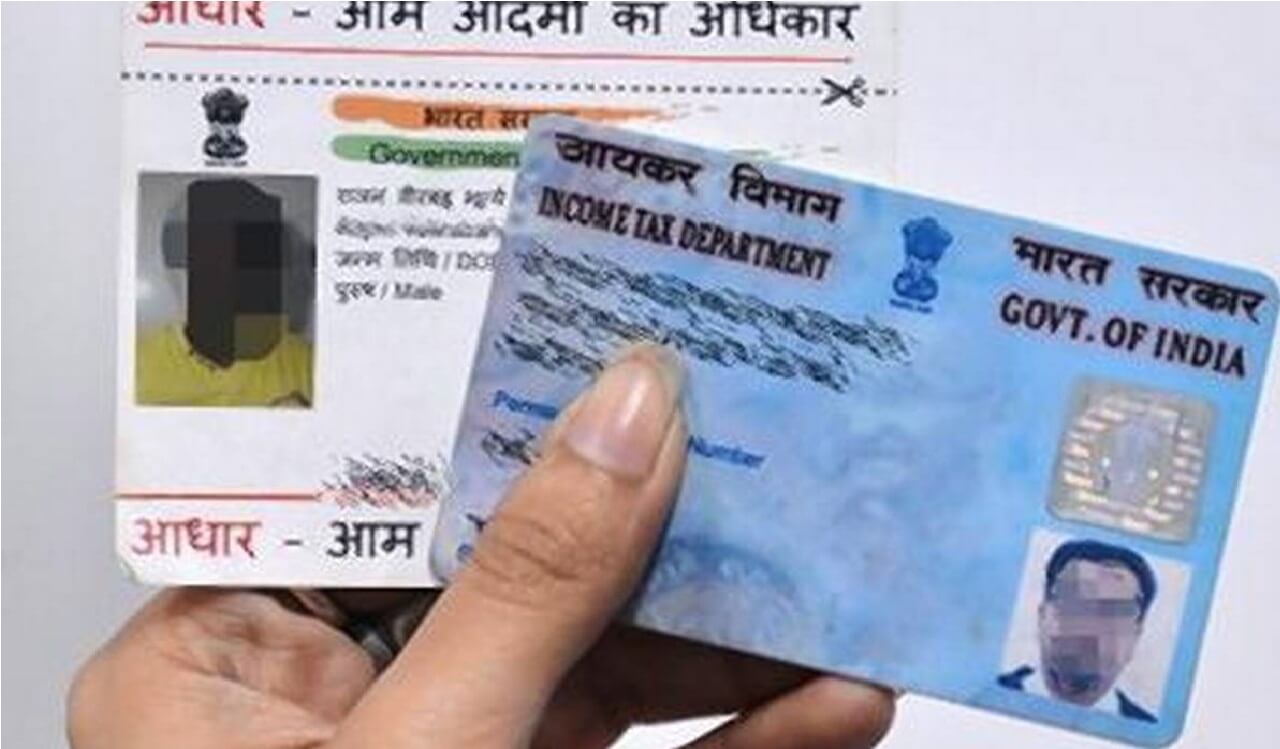
PAN-Aadhaar linking last date on March 31: What will happen if you miss deadline? Here’s step by step guide to link PAN with Aadhaar

Those who fail to link PAN with Aadhaar Card within the given deadline can face a slew of consequences, including the deactivation of PAN.


Published

on

PAN-Aadhaar linking last date

The deadline for linking a Permanent Account Number (PAN) with Aadhaar Card is quickly approaching which is March 31. Those who fail to link these two important documents within the given deadline can face a slew of consequences, including the deactivation of PAN.

This is not the first time the Central Board of Direct Taxes or CBDT has asked PAN Cardholders to link with Aadhaar Card. But people took CBDT’s order in a light way and now the department has made it clear to link these documents within the stipulated time otherwise PAN will become inoperative.

CBDT in a notification said the time limit for intimation of Aadhaar number to the Income tax Department for linking of PAN with Aadhaar has been extended from 30th September 2021 to 31st March 2022.

Inoperative PAN is the same as not having a PAN at all because you will not be able to carry out any work that requires this document. KYC is necessary for any transaction, however, an active PAN is required to complete the KYC process. With an inactive PAN, you won’t be able to invest in mutual funds or the stock market.

What consequences will you face if you miss the PAN-Aadhaar link deadline of March 31, 2022?

  1. If you miss the deadline, your PAN Card will become inactive and you will not be able to use it for future work and you will be fined Rs 10,000 under the Income Tax Act, 1961.
  2. Even if you link the documents after the deadline, you will be fined. The amount of the fine, however, has yet to be determined by the government. The fine, however, will not exceed Rs 1,000.
  3. If your PAN card is deactivated, you will be unable to file your Income Tax Return (ITR).
  4. Furthermore, if you do not link your PAN and Aadhaar by the deadline, you will be unable to invest in the stock market.
  5. Not only that, but you’ll have to pay double TDS if your PAN isn’t linked to your bank account (Tax Deduction at Source). A 10 percentage TDS is charged if your bank account is seeded with your PAN.

Read Also: Petrol, diesel prices hiked again by 80 paise for fourth time in five days: Check fuel rates in Delhi, Mumbai and other cities

How to link PAN with Aadhaar online?

  1. Go to https://incometaxindiaefiling.gov.in/ to access the Income Tax e-Filing Portal.
  2. Sign up for it (if not already done). Your user id will be your PAN (Permanent Account Number).
  3. Enter your User ID, password, and date of birth to log in.
  4. A pop-up window will open, requesting that you link your PAN to your Aadhaar number. If not, go to the Menu bar and select ‘Profile Settings’, then ‘Link Aadhaar.’
  5. Information such as name, date of birth, and gender will already be included in the PAN database.
  6. Compare the PAN information on the screen to the information on your Aadhaar card. Please keep in mind that if there is a mismatch, you must get it fixed in both documents.
  7. Enter your Aadhaar number and click the “link now” button if the information matches.
  8. You will receive a notification that your Aadhaar has been successfully linked to your PAN via a pop-up message.
  9. You can also link your PAN and Aadhaar by going to https://www.utiitsl.com/ OR https://www.egov-nsdl.co.in/.

Ukraine’s tweet making false claims about missile strikes goes viral

Burari 2.0 in Switzerland: 5 members of a family jump off from building in alleged group suicide

India News

Delhi pollution: Environment minister apologises, blames AAP as AQI stays very poor

Delhi Environment Minister Manjinder Singh Sirsa apologised for pollution but blamed AAP for the crisis, saying air quality cannot be fixed in months as AQI remains very poor.

Published

on

Delhi Environment Minister Manjinder Singh Sirsa on Tuesday apologised to residents for the city’s worsening air quality but squarely blamed the Aam Aadmi Party (AAP) for the pollution crisis, saying the problem could not be resolved within months.

Calling pollution a “disease” inherited from the previous dispensation, Sirsa said it was “impossible for any elected government to reduce AQI in 9–10 months”. He claimed the BJP-led government was working to address the issue and asserted that the air quality index (AQI) had shown daily improvement.

“I apologise for the pollution in Delhi,” the minister said, adding that the present government was doing “better work” compared to what he termed the “dishonest” AAP administration.

Air quality remains very poor across the city

Sirsa’s remarks came as Delhi continued to reel under very poor air quality conditions, though the situation improved marginally from the “severe” category that prevailed between December 13 and 15.

According to official pollution monitoring data, Delhi’s overall AQI stood at 381. Wazipur recorded the highest AQI at 434, followed by Jahangirpuri at 430. Anand Vihar and Ashok Vihar also remained in the severe category.

In November, the capital had experienced prolonged spells of severe pollution, with AQI levels staying in that range from November 11 to 26.

Political blame game intensifies

The pollution crisis has triggered a sharp political face-off between the ruling BJP and the opposition AAP. AAP leader Saurabh Bhardwaj questioned why Prime Minister Narendra Modi had not addressed the issue publicly, while the Congress demanded an immediate discussion on air pollution in the Lok Sabha.

The controversy escalated further after Singapore issued an advisory for its citizens in India over Delhi’s air quality. Bhardwaj shared the advisory on social media, calling it an “international embarrassment”.

Responding to this, Delhi BJP spokesperson Praveen Shankar Kapoor said such advisories were routine whenever pollution levels rise. He also took a swipe at the AAP, recalling that during earlier years, some foreign governments had reduced posting durations for their staff in Delhi and designated the city as a “no family station”.

Meanwhile, Punjab Chief Minister and senior AAP leader Bhagwant Mann rejected allegations that his state was contributing to Delhi’s pollution. He said the AQI in Punjab cities ranged between 70 and 100, significantly lower than that of the national capital, and urged the Centre to stop blaming Punjab.

Continue Reading

India News

Rahul Gandhi Attacks Centre over G RAM G bill, calls it an attack on MGNREGA’s core principles

Rahul Gandhi has strongly opposed the G RAM G bill, accusing the Modi government of undermining MGNREGA and shifting the financial burden of rural employment schemes onto states.

Published

on

Rahul-Gandhi

Congress MP and Leader of the Opposition Rahul Gandhi on Monday sharpened his attack on the Centre over the introduction of the G RAM G bill in the Lok Sabha, alleging that the proposed law weakens the foundations of the Mahatma Gandhi National Rural Employment Guarantee Act (MGNREGA) and undermines the rights of the rural poor.

The bill, formally titled the Viksit Bharat Guarantee for Rozgar and Ajeevika Mission (Gramin) Bill, 2025, has been brought in to replace MGNREGA, which was enacted in 2005 under the UPA government.

Reacting to the move, Rahul Gandhi described the legislation as an “insult to the ideals of Mahatma Gandhi” and accused the Narendra Modi-led government of attempting to dismantle a scheme that guarantees livelihood security to millions of rural households.

Rahul Gandhi’s sharp criticism of the G RAM G bill

In a post on X, Gandhi alleged that Prime Minister Modi has consistently opposed the ideas associated with Mahatma Gandhi and has been trying to weaken MGNREGA since coming to power in 2014. He asserted that the Congress would oppose any attempt to dilute or dismantle the employment guarantee framework.

“Modiji has a deep hatred for two things – the ideas of Mahatma Gandhi and the rights of the poor,” Gandhi said, calling MGNREGA a living embodiment of Gandhi’s vision of village self-rule. He also highlighted the role of the scheme as an economic shield for rural India, particularly during the COVID period.

According to Gandhi, the Centre is now “determined to wipe out MGNREGA completely” by replacing it with a new framework that centralises power and alters the funding structure.

Opposition protests in Parliament

The introduction of the G RAM G bill triggered protests from several opposition MPs inside and outside Parliament. Congress MPs, including Priyanka Gandhi Vadra and Shashi Tharoor, raised objections to key provisions of the bill, particularly the removal of Mahatma Gandhi’s name from the scheme.

Opposition leaders argued that MGNREGA is rooted in the right to employment, decentralised decision-making by villages, and a funding structure where the Centre bears the full wage cost and most of the material expenses.

How G RAM G differs from MGNREGA

Rahul Gandhi pointed out that under MGNREGA, the Centre pays 100 per cent of wages for unskilled workers and 75 per cent of material costs, ensuring steady employment based on demand.

The new G RAM G bill proposes a shift to normative funding, under which states will have to bear 40 per cent of the overall costs. Gandhi claimed this would reduce work availability once budgets are exhausted or during crop harvest seasons, leaving rural workers without employment for extended periods.

The funding ratio for northeastern and Himalayan states has been set at 90:10, while union territories will be fully funded by the Centre. Of the estimated annual expenditure of Rs 1.51 lakh crore, the central government’s share is projected at Rs 95,692 crore.

Leaders from several opposition parties, including those from a key BJP ally, have also expressed concerns over the increased financial burden on states.

Government’s defence of the bill

Government sources have maintained that the G RAM G bill aligns with the broader ‘Viksit Bharat 2047’ vision. According to them, the shift from a demand-based to a normative funding model brings the scheme in line with budgeting practices followed for other central government programmes.

However, the sharp political pushback indicates that the replacement of MGNREGA is set to remain a major flashpoint in Parliament in the coming days.

Continue Reading

India News

Priyanka Gandhi leads protest against G Ram G Bill, calls move to replace MGNREGA unconstitutional

Priyanka Gandhi objected in Lok Sabha to the Centre’s G Ram G Bill, saying it weakens MGNREGA and dilutes the constitutional right to employment.

Published

on

Senior Congress leader and Wayanad MP Priyanka Gandhi Vadra on Tuesday led a protest in Parliament against the Centre’s move to replace the Mahatma Gandhi National Rural Employment Guarantee Act (MGNREGA) with the proposed Viksit Bharat Rozgar and Ajeevika Mission (Gramin) Bill, 2025, popularly referred to as the G Ram G Bill.

Holding up photographs of Mahatma Gandhi on the Parliament premises, Congress MPs objected to the introduction of the Bill, alleging that it weakens a landmark welfare law that has supported rural livelihoods for two decades.

Priyanka Gandhi opposes Bill in Lok Sabha

During proceedings in the Lok Sabha, Union Agriculture Minister Shivraj Singh Chouhan sought permission to introduce the new Bill, which aims to replace MGNREGA. Priyanka Gandhi opposed the move under Rule 72(1) of the Rules of Procedure and Conduct of Business, registering what she described as a “strong objection”.

She said MGNREGA had been a revolutionary law since its introduction in 2005 by the UPA government and had enjoyed support across party lines. According to her, the scheme guarantees 100 days of employment annually to the poorest sections in rural India and has played a key role in strengthening the rural economy.

Concerns over funding model and role of Gram Sabhas

Priyanka Gandhi flagged concerns over changes proposed in the new Bill, particularly the shift from a demand-based funding model to a system where allocations are decided in advance by the Centre. She argued that MGNREGA works on demand from the ground, with Gram Sabhas empowered to assess local employment needs.

“The right to employment is being weakened, and this goes against the Constitution,” she said, adding that the proposed law reduces the role of Gram Sabhas and dilutes the core principle of guaranteed work.

She also pointed out that the Centre’s funding share for the scheme has come down to 60 per cent for most states, warning that this could strain state finances at a time when several states are already awaiting GST dues.

Objection to renaming and passage without discussion

The Congress leader questioned what she described as a “craze” to rename existing schemes, noting that such changes involve additional costs. She urged the government not to rush the legislation and to withdraw the Bill for wider discussion in the House.

When members from the treasury benches made a remark referring to her family, Priyanka Gandhi responded by saying that Mahatma Gandhi may not belong to her family but is regarded as family by the entire nation.

Wider opposition, government defence

Several opposition leaders echoed these concerns. Congress MP Shashi Tharoor opposed the Bill, calling it immoral to remove Mahatma Gandhi’s name from the scheme. Other विपक्ष members raised issues over normative funding and the reduced central contribution.

Government sources, however, defended the Bill, saying it aligns with the Viksit Bharat 2047 vision. They argued that normative funding allows predictable and rational budgeting, unlike a demand-based model that can lead to uncertainty, while still ensuring employment or unemployment allowance for eligible workers.

BJP leader and former Minority Affairs Minister Mukhtar Abbas Naqvi dismissed the opposition’s protest, alleging that the objection stemmed from the inclusion of Lord Ram’s name in the scheme.

Continue Reading

Trending

© Copyright 2022 APNLIVE.com