English हिन्दी
Connect with us

India News

SC to hear plea by Omar Abdullah’s sister challenging his detention on March 4

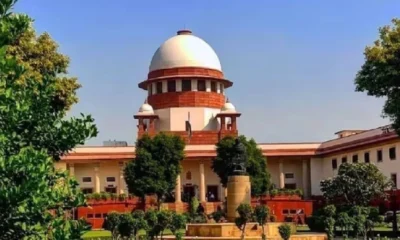
The Supreme Court on Thursday will hear the petition plea filed by Sarah Abdullah Pilot against the detention of her brother Omar Abdullah, former Chief Minister of Jammu and Kashmir, under the J&K Public Safety Act.

Published

on

Supreme-Court

The Supreme Court on Thursday will hear the petition plea filed by Sarah Abdullah Pilot against the detention of her brother Omar Abdullah, former Chief Minister of Jammu and Kashmir, under the J&K Public Safety Act.
Attorney General. KK Venugopal, had told the bench that Sara Abdullah Pilot had not demonstrated any reason for not approaching the high court in the first instance but directly coming to the Supreme Court.

A Supreme Court bench, headed by Justices Arun Mishra and Indira Banerjee rejected Venugopal’s opposition to the top court hearing the petition and said that “The matter pertains to liberty.”

Sara, wife of Rajasthan Deputy Chief Minister Sachin Pilot, had moved the plea in the apex court, seeking issuance of a writ of habeas corpus to the authorities to forthwith produce Omar before the court and set him at liberty.

Sara has said the detention of her 49-year-old brother and National Conference leader Omar under the Jammu and Kashmir Public Safety Act, 1978, on February 5, 2020 is “manifestly illegal” and there is no question of him being a “threat to the maintenance of public order”.

Noting that she gravely concerned about the welfare, safety and security of her brother, Sara has said Omar has been under detention since August 5 last year when the Centre abrogated the special status of Jammu and Kashmir of under Article 370 of the Constitution.

The petition has said Omar’s six month period of detention was supposed to end on February 7, but fresh detention orders under the PSA were issued against him and former J&K CM Mehbooba Mufti before the expiry of that detention period.

Omar was under detention under section 107 of the Code of Criminal Procedure (CrPC) since last year without charges, it has said, adding the exercise of power by the authorities under the CrPC to detain individuals, including political leaders, was “clearly mala fide to ensure that the opposition to the abrogation of Article 370 of the Constitution is silenced”.

The plea has submitted that the intent of exercise of power was to “incarcerate not just him (Omar) but the entire leadership of the National Conference, as well as the leadership of other political parties, who were similarly dealt with including Farooq Abdullah, who has served the state and the Union over several years… stood by India whenever the situation so demanded”.

It has said, “In fact, a reference to all the public statements and messages posted by the detenue (Omar) during the period up to his first detention would reveal that he has kept calling for peace and co-operation – messages which in Gandhi’s India cannot remotely affect public order.”

The petition has contended that his detention is politically motivated and is a part of concerted effort to muzzle all political rivals. Mere opposition to the policy of the central government is being projected as against national interest to justify the detention, it has claimed.

In its detention order, the government has cited Omar’s popularity among masses and his ability to convince electorates to vote in large numbers even during the peak of militancy in the Kashmir Valley.

The plea has said Omar was not even served with the material that formed the basis of grounds of detention order and its non-supply vitiates the detention, which is liable to be quashed.

India News

Shashi Tharoor warns US tariffs on Iran could make Indian exports unviable

Shashi Tharoor has warned that cumulative US tariffs linked to Iran trade could rise to 75%, making most Indian exports to America commercially unviable.

Published

on

Shashi Tharoor

Congress MP and chairman of the Standing Committee on Foreign Affairs Shashi Tharoor has expressed serious concern over the United States’ latest tariff announcement targeting countries that continue to trade with Iran, warning that such measures could severely impact Indian exporters.

Reacting to the decision by US President Donald Trump to impose a 25% tariff on countries doing business with Iran, Tharoor said Indian companies would struggle to remain competitive if cumulative tariffs rise to 75%. He noted that India was already at a disadvantage compared to several regional competitors.

Tharoor said he had been troubled by the US tariff regime from the outset, pointing out that India was initially subjected to a 25% tariff while rival exporting nations in Southeast Asia were charged significantly lower rates. According to him, countries such as Vietnam, Thailand, Indonesia, Pakistan and Bangladesh faced tariffs ranging between 15% and 19% on labour-intensive goods exported to the US.

He explained that the situation had worsened with additional sanctions-linked duties. With the existing 25% tariff, another 25% related to Russia-linked sanctions, and a further 25% tied to Iran-related measures, the total burden could rise to 75%. At that level, Tharoor said, most Indian exports would no longer be commercially viable in the American market.

While noting that certain sectors such as pharmaceuticals may continue to export as they are not heavily impacted by sanctions, he warned that other key export categories would be hit hard. Tharoor described the situation as very serious and said it required urgent attention.

The Congress MP also expressed hope that the newly appointed US Ambassador could help facilitate progress on a bilateral trade agreement. He stressed that India could not afford to wait through the entire year for a deal and said an agreement should ideally be concluded in the first quarter of 2026.

Commenting on recent diplomatic engagements between India and the US, Tharoor underlined the need for faster consensus on trade issues. He said that at tariff levels as high as 75%, the idea of a meaningful trade deal loses relevance. According to him, a rate closer to what the UK enjoys with the US, around 15%, would reflect the respect due to a strategic partner.

Tharoor’s remarks come after President Trump announced that any country continuing business with Iran would face a 25% tariff on all trade with the United States, a move that has raised concerns among several trading partners.

Continue Reading

India News

Indian Army symbolizes selfless service and duty, says PM Modi on Army Day

PM Narendra Modi on Army Day praised the Indian Army as a symbol of selfless service and unwavering duty, saluting the courage and sacrifice of its soldiers.

Published

on

pm modi speech

On the occasion of Army Day, Prime Minister Narendra Modi on Thursday paid tribute to the Indian Army, describing its soldiers as a symbol of selfless service who protect the nation with unwavering resolve, even in the most challenging circumstances.

In a message shared on social media platform X, the prime minister said the country salutes the courage and steadfast commitment of Indian Army personnel. He noted that their dedication to duty inspires confidence and gratitude among citizens across the country.

“Our soldiers stand as a symbol of selfless service, safeguarding the nation with steadfast resolve, at times under the most challenging conditions,” PM Modi said. He added that the nation remembers with deep respect those who have laid down their lives while serving the country.

Army Day is observed every year on January 15 to commemorate a historic moment in India’s military history. The day marks the appointment of Field Marshal K M Cariappa as the first Indian Commander-in-Chief of the Indian Army in 1949, when he took over from British officer General Sir F R R Bucher.

The occasion serves as a reminder of the Indian Army’s role in defending the country’s sovereignty and honour, as well as the sacrifices made by its personnel in the line of duty.

Continue Reading

India News

Air India, IndiGo flights disrupted after Iran shuts airspace amid US tensions

International flights operated by Air India, IndiGo and SpiceJet were disrupted after Iran shut its airspace, forcing rerouting and cancellations.

Published

on

Air india flight

International flights operated by Air India, IndiGo and SpiceJet were disrupted on Thursday after Iran abruptly shut its airspace to commercial aircraft, triggering delays and cancellations on several long-haul routes.

Iran ordered the closure of its airspace without providing an official explanation, as tensions remain elevated between Tehran and Washington and protests continue across the country against Supreme Leader Ayatollah Ali Khamenei.

Indian airlines issue travel advisories

Air India said its flights overflying the region are now operating through alternative routes, resulting in longer flight times and possible delays. The airline also confirmed that some services have been cancelled where rerouting is not feasible.

“Due to the emerging situation in Iran and the subsequent closure of its airspace, Air India flights overflying the region are using alternate routing, which may lead to delays. Some flights are being cancelled where rerouting is currently not possible,” the airline said in a statement on social media.

Passengers were advised to check flight status before travelling to the airport, with the airline reiterating that passenger and crew safety remains its top priority.

IndiGo also acknowledged disruptions to its international network, describing the situation as a “sudden airspace closure” beyond the airline’s control. The carrier said it is working to assist affected passengers by offering alternative travel options.

Customers have been advised to use flexible rebooking options or claim refunds, depending on their preference.

SpiceJet issued a similar advisory, confirming that some of its flights have been impacted due to the closure of Iranian airspace.

Airspace shutdown linked to regional security concerns

According to official notices issued to pilots, Iran’s airspace closure is expected to remain in place until 7:30 am local time. The move comes amid heightened regional tensions and follows earlier shutdowns during military confrontations involving Israel earlier this year.

Aviation risk monitoring platforms have noted that several international airlines are already avoiding Iranian airspace, citing concerns over possible military activity, air defence operations and the risk of misidentification of civilian aircraft.

The situation continues to be monitored closely, with further disruptions possible if the airspace restrictions are extended.

Continue Reading

Trending

© Copyright 2022 APNLIVE.com