English हिन्दी
Connect with us

Entertainment

Shyam Benegal’s Cannes debut: How Nishant & a bold saree stunt put Indian cinema on the global map

Published

on

Shyam Benegal

Shyam Benegal, the legendary filmmaker who revolutionized Indian cinema, has died at the age of 90. Known for his trailblazing contributions to parallel cinema, Benegal’s death marks the end of an era that redefined Indian filmmaking. His legacy, built on realism, social commentary, and a break from conventional narratives, continues to inspire filmmakers today. As the nation mourns the loss of a visionary, his remarkable body of work remains an integral part of India’s cinematic history.

In 1976, Indian cinema witnessed a turning point when Shyam Benegal, a trailblazing director, made his debut at the prestigious Cannes Film Festival. At a time when Cannes was still firmly grounded in the world of cinema, not yet a fashion-driven spectacle, Benegal’s film Nishant was featured in competition. It was a groundbreaking moment for both the director and Indian cinema as a whole, marking India’s arrival on the global film stage.

Benegal, at the age of 42, had already made a lasting impact with his previous film Ankur, which subtly introduced the nation to a new wave of filmmaking. Nishant, like Ankur, showcased a unique narrative style that was rooted in realism, tackling socio-political issues with a raw sensitivity that resonated with audiences. But it was the film’s Cannes screening that truly marked a turning point for Indian cinema.

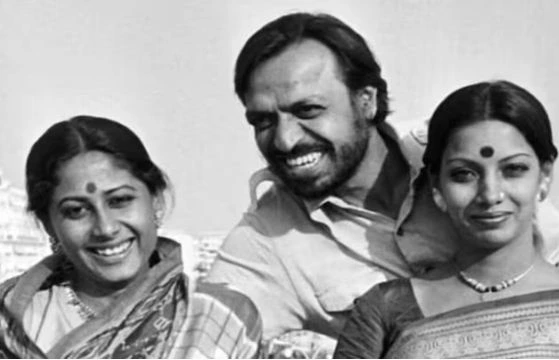
The 1976 Cannes Festival was different from the glitzy, fashion-focused events we see today. It was a celebration of cinema in its purest form. However, Benegal’s presence was far from typical. Along with Nishant, the director brought along his two lead actresses, Smita Patil and Shabana Azmi, to the French Riviera. Although the film was accompanied by posters from the National Film Development Corporation (NDFC), a mix-up meant that the posters never made it to the festival, but the trio of Indians did.

Shabana Azmi later shared how they made an unforgettable impression at Cannes. “In a place where we had no money and everybody was throwing lavish parties, Shyam came up with this unique idea. He said, ‘I want both of you [Azmi and Patil] to wear your finest South Indian saris and walk the promenade from eight in the morning,'” Azmi recalled. While everyone else was dressed in beachwear, the two actresses, in their traditional silk saris, paraded the streets of Cannes. They became living advertisements for their film, greeting passersby and inviting them to the screening. This unconventional tactic helped them attract an audience in the absence of a big promotional budget.

The story of Nishant at Cannes is as much about the film as it is about the personalities behind it. Benegal, known for his modest approach, had a keen understanding of how to present Indian cinema on the world stage. In an era when films were promoted with lavish budgets and star power, Benegal’s approach was simple yet effective. The director was also a seasoned adman who had spent years in the advertising world before venturing into filmmaking. His commercial acumen translated well into his filmmaking, as evidenced by his strategy to promote Nishant at Cannes.

Benegal’s cinematic journey started with Ankur in 1973, a film that introduced a new era in Indian cinema. Following Nishant, he directed other masterpieces such as Manthan (1976) and Bhumika (1977). Together, these films laid the foundation for what became known as “New Cinema” in India, a movement that sought to tell more socially conscious, realistic stories, often drawing attention to issues of class, caste, and gender. Through his films, Benegal introduced a new generation of actors, including Shabana Azmi, Smita Patil, Naseeruddin Shah, Kulbhushan Kharbanda, Om Puri, and Neena Gupta, many of whom became icons of Indian cinema.

Benegal’s approach to filmmaking was notably collaborative. He ran a tight-knit ship where everyone, from the actors to the crew, contributed in whatever capacity they could. The actors, many of whom were at the beginning of their careers, often worked for little to no money, driven by their desire to be part of a revolution in Indian cinema.

In Nishant, Benegal pitted Shabana Azmi and Smita Patil against each other, creating a compelling dynamic that made the film stand out. While Azmi’s character received more screen time, Patil, who was making her feature film debut, played an equally significant role. The film, which was set against the backdrop of rural India, focused on social issues and gender dynamics, and it became known for its powerful female leads.

Nishant was nominated for the Palme d’Or at Cannes and won the National Film Award for Best Feature Film in Hindi. Benegal’s participation in the Cannes Film Festival in 1976 proved to be a turning point for Indian cinema, and his legacy continues to inspire filmmakers today.

With films that were ahead of their time and an unwavering commitment to realism, Shyam Benegal ushered in a new era for Indian cinema. He not only changed the way stories were told but also made sure that India’s voice was heard loud and clear on the world stage. Nishant at Cannes marked the dawn of a new era — an era where Indian films, for the first time, garnered the international attention they truly deserved.

Entertainment

Vijay’s last film Jana Nayagan poised for massive opening, Rs 100 crore business expected on Day 1

Published

on

By

Tamil Nadu Chief Minister Vijay’s final film, Jana Nayagan, is expected to make a record-breaking start at the box office, with trade analysts predicting an opening-day collection of around Rs 100 crore worldwide.

If the prediction proves accurate, the film could surpass the opening-day collections of blockbuster films such as Jailer, The Greatest of All Time (GOAT), and Pathaan, making it one of the biggest openings in Indian cinema.

Directed by H. Vinoth and produced by KVN Productions, Jana Nayagan was Vijay’s final film before his full-time entry into politics. The movie also stars Pooja Hegde, Bobby Deol, Mamitha Baiju, Prakash Raj, Priyamani, and Gautham Vasudev Menon in key roles. The film is scheduled for a worldwide theatrical release on July 23, 2026.

Advance bookings for Jana Nayagan have shown an overwhelming response in India and overseas. Trade reports indicate that the film has sold more than 6.45 lakh tickets in advance, generating over Rs 16 crore in pre-sales across India. Industry analysts note that the advance booking figure is still lower than those of Vijay’s earlier blockbuster releases, Leo and The Greatest of All Time (GOAT).

The excitements surrounding Jana Nayagan is driven not only by Vijay’s popularity but also by the emotional significance of it being his last film. Fans have been booking first-day-first-show tickets in large numbers, especially in Tamil Nadu and Karnataka.

Trade experts believe that if positive audience reviews and word-of-mouth follow the release, Jana Nayagan could become one of the highest-grossing Tamil films of the year.

As of now, the film is gearing up for its July 23 release, with distributors and exhibitors expecting packed theatres across the country. Whether Jana Nayagan crosses the Rs 100 crore mark on its opening day and breaks the records of Jailer and GOAT, and Pathaan will become clear once box-office figures are released after its premiere.

Continue Reading

Entertainment

FIFA World Cup final halftime show divides fans despite stars

Published

on

FIFA’s decision to introduce a halftime show during the 2026 FIFA World Cup final has sparked mixed reactions among football fans around the world. While the announcement of stars Shakira, Justin Bieber, Madonna, and BTS generated excitement, many supporters questioned whether a concert-style performance belongs in football’s biggest event.

The 2026 FIFA World Cup, jointly hosted by the United States, Canada, and Mexico, concluded with the final at MetLife Stadium in New Jersey in the small hours of Monday. For the first time in the tournament’s history, FIFA held an entertainment show during halftime, similar to the Super Bowl tradition in the United States.

FIFA president Gianni Infantino said the halftime show was intended to make the World Cup final a larger global entertainment event and attract a wider audience. The performance featured internationally recognized artists, including Shakira, known for her iconic World Cup songs Waka Waka and La La La, former boy wonder Justin Bieber along with pop legend Madonna and South Korean music group BTS. FIFA said the event will celebrate football, music, and culture on one stage.

However, the announcement has divided fans and football experts. Many welcomed the idea, saying it would make the final more entertaining and help attract younger audiences. They said the presence of world-famous artists will increase the tournament’s global appeal and create an unforgettable experience for spectators.

Others, including seminal punk rock band The Cure frontman Robert Smith, strongly criticized the decision, arguing that football traditions should not be changed. Critics fear that extending the halftime break for a concert could affect players’ physical rhythm, preparation, and match intensity. Some fans also said the focus should remain on the sport rather than celebrity performances.

FIFA assured that the performance was carefully planned to avoid disrupting the match while maintaining high production standards. Security, stage setup, and broadcast arrangements were also coordinated to ensure a smooth event.

As of now, the halftime show remains one of the most talked-about aspects of the 2026 FIFA World Cup final apart from the boorish behavior of the Argentine squad.

Continue Reading

Entertainment

Telugu cinema bags nine honours at 72nd National Film Awards as Kalki 2898 AD and Pushpa 2 shine

Telugu cinema secured nine honours at the 72nd National Film Awards, with Kalki 2898 AD, Pushpa 2: The Rule, Committee Kurrollu, 35-Chinna Katha Kaadu and Lucky Baskhar emerging among the key winners.

Published

on

The Telugu film industry emerged as one of the standout performers at the 72nd National Film Awards, securing a total of nine honours for films certified by the Central Board of Film Certification (CBFC) between January 1 and December 31, 2024.

Leading the tally was director Nag Ashwin’s Kalki 2898 AD, which received the award for Best Popular Film Providing Wholesome Entertainment. The film also earned Best Production Design for Nitin Zihani Choudhary, whose work brought to life the contrasting worlds of Kasi, Shambala and the futuristic Complex.

Pushpa 2 earns screenplay and costume design honours

Director Sukumar’s blockbuster Pushpa 2: The Rule added two National Awards to its achievements. Sukumar won Best Original Screenplay, while costume designers Deepali Noor and Sheetal Sharma were honoured with the Best Costume Design award for their work on the film.

The film was among the biggest commercial successes of 2024 and was recognised for its storytelling and visual presentation.

Lucky Baskhar and 35-Chinna Katha Kaadu receive national recognition

Director Venky Atluri received the Best Dialogue Writer award for Lucky Baskhar, starring Dulquer Salmaan in the lead role.

Meanwhile, 35-Chinna Katha Kaadu, directed by Nanda Kishore Emani, was named Best Children’s Film. Child actor Arundev was honoured as Best Child Artist, sharing the award with Riddhiman Banerjee, Topomoy Deb, Gitashree Chakraborty (for Onko Ki Kothin) and Athish S. Shetty (for Mithya).

Committee Kurrollu wins Best Telugu Film

Debut director Yadhu Vamsi’s Committee Kurrollu was recognised as the Best Telugu Film at the awards. The nostalgic drama, produced by Niharika Konidela, also earned P. Ravi Kumar the Best Make-Up Artist award.

Following the announcement, the teams behind the award-winning films expressed their gratitude to the National Film Awards jury and audiences through social media posts celebrating the recognition.

Continue Reading

Trending

© Copyright 2022 APNLIVE.com