English हिन्दी
Connect with us

India News

State Governments scuttling SC ‘anti-cheers’ orders

Published

on

State Governments scuttling SC ‘anti-cheers’ orders
[vc_row][vc_column][vc_column_text]APN Correspondent

The hotel and liquor industries, shocked by recent Supreme Court verdict for shutting down all cheer vendors within 500 yards of National and State Highways in the country, was now being systematically scuttled by various state governments, including those headed by BJP.

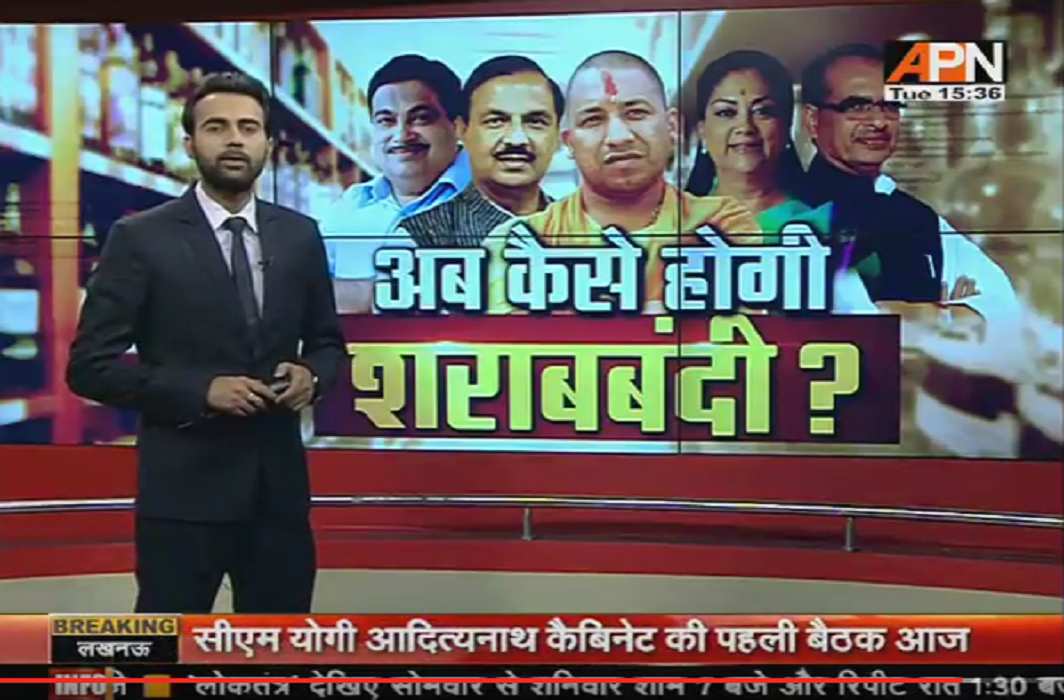
APN carried a Special show ‘ab kaise hogi sharab bandi’ on April 4, telling its audience that Mahesh Sharma, Minister of  State for Culture and  Tourism, has recently assured a group of hoteliers that government was consulting legal experts and mulling to find a middle path within the legal framework. He has also met Chief Minister Yogi Adityanath for resolving the crisis. There are some eight thousand liquor shops situated on U.P. highways.
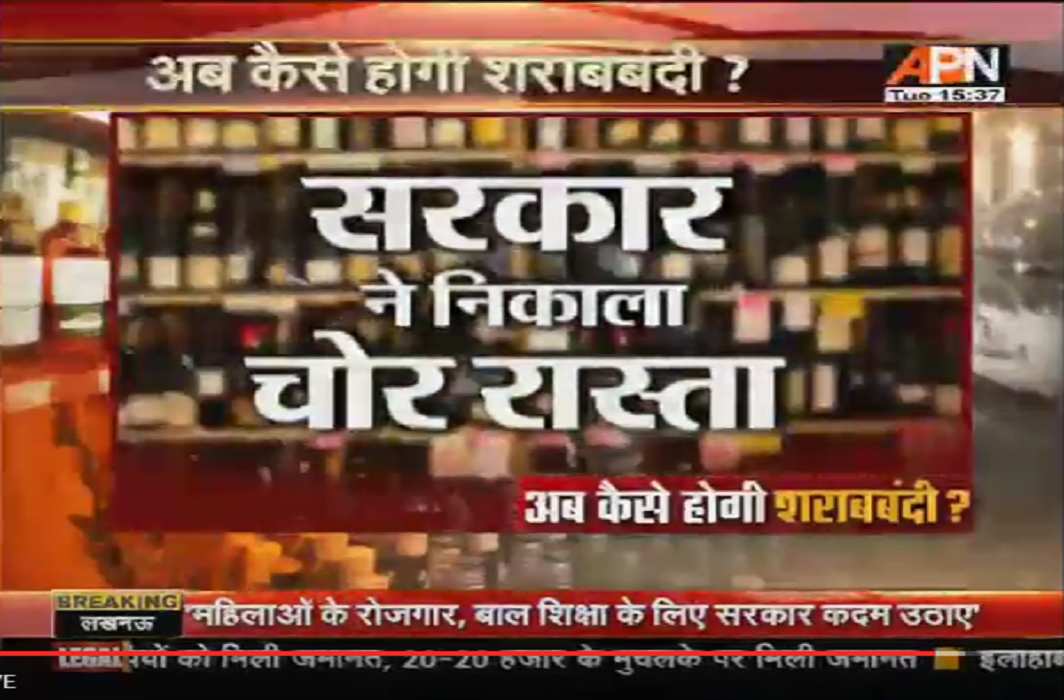
State Governments scuttling SC ‘anti-cheers’ orders - 1The report said that governments of Uttar Pradesh, Madhya Pradesh, Rajasthan, Maharashtra and West Bengal were taking identical steps to relax the situation for the industry to groom again. In several cases State Highways and By-passes were being de-notified so that they do not fall in the highway category. Hence the liquor outlets will be allowed to run at their present locations.

According to some estimates, enforcement of Supreme Court order banning liquor outlets within periphery of 500 yards of the high ways will result in whopping revenue losses of Rs. 50,000 crores while ten lac people will lose their jobs.

The overwhelming support to the complete liquor ban in Bihar under the leadership of Chief Minister Nitish Kumar was appreciated in the show.[/vc_column_text][/vc_column][/vc_row]

India News

PM Modi calls for secure sea routes at BRICS event, references Hormuz

PM Modi highlighted the need for secure sea lanes, open supply routes and seafarer safety at the BRICS Business Forum amid tensions in the Strait of Hormuz.

Published

on

PM Modi

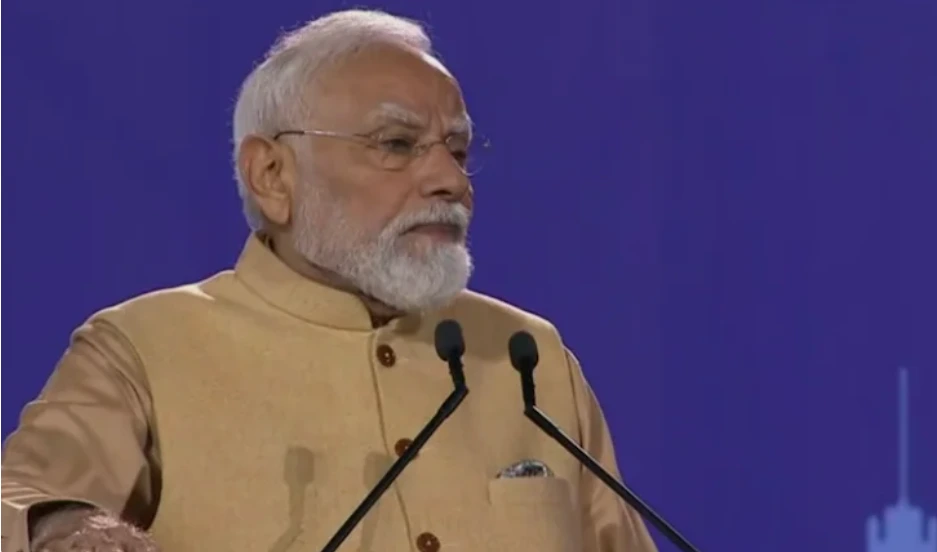
Prime Minister Narendra Modi on Friday stressed the importance of secure maritime routes and the safety of seafarers while addressing the BRICS Business Forum in New Delhi.

Speaking at the forum, which was also attended by Iranian President Masoud Pezeshkian, PM Modi linked the growth of global trade with the need to keep sea lanes secure, supply routes open and seafarers safe.

PM Modi stresses freedom of navigation

PM Modi said that global trade can progress only when maritime routes remain secure and supply lines stay open. He also reaffirmed India’s support for freedom of navigation and the safety of seafarers.

The remarks came against the backdrop of recent attacks on ships, particularly in and around the Strait of Hormuz. The strategically important waterway has been affected by the ongoing conflict involving the United States and Iran.

The issue of maritime security is also significant for India because disruptions to shipping routes can affect trade and the safety of Indian seafarers.

PM Modi highlights BRICS economic growth

During his address, PM Modi also highlighted the expanding economic importance of the BRICS grouping.

He said BRICS countries now account for around 50 per cent of the world’s population, 40 per cent of global GDP and more than 25 per cent of global trade. According to the Prime Minister, the combined GDP of BRICS nations has expanded nearly four-and-a-half times, compared with global GDP growth of about two-and-a-half times.

PM Modi described BRICS countries as emerging centres for innovation and said the business forum being hosted by India was the largest BRICS Business Forum so far.

Focus on trade and business cooperation

The Prime Minister also spoke about India’s efforts to reduce trade barriers and expand opportunities for businesses.

He said India has entered into free trade agreements with 40 countries and highlighted new cooperation networks established under India’s BRICS presidency in areas including agriculture, healthcare, skills and smart grids.

PM Modi also referred to initiatives such as the BRICS Incubator Network, BRICS MSME Portal and BRICS Startup Innovation Fund, aimed at connecting startups and small businesses with markets and finance.

Iran highlights global economic uncertainty

Iranian President Masoud Pezeshkian, who was present at the forum, spoke about the impact of geopolitical uncertainty and supply-chain disruptions on the global economy.

He said geopolitical tensions and the use of economic measures as political instruments had made the environment for countries and businesses more complicated. Pezeshkian argued that BRICS should turn its economic potential into practical cooperation in trade, investment and joint financing.

Russian President Vladimir Putin also spoke about major structural changes taking place in the global economy, saying new engines of growth were emerging.

PM Modi separately held bilateral meetings with Russian President Vladimir Putin and President Pezeshkian on the sidelines of the 18th BRICS Summit. During his meeting with Putin, Modi said dialogue and diplomacy were the way forward for resolving conflicts.

Continue Reading

India News

Shashi Tharoor lists BRICS benefits after P Chidambaram questions gains

Shashi Tharoor highlighted BRICS’ diplomatic value and role for the Global South after P Chidambaram questioned the tangible benefits India has gained from recent summits.

Published

on

Shashi Tharoor

Congress MP Shashi Tharoor has highlighted the diplomatic and global significance of BRICS after senior party leader P Chidambaram questioned the tangible benefits India has received from recent meetings of the grouping.

Speaking ahead of the BRICS summit in Delhi, Tharoor described BRICS as an important platform for the Global South and said hosting the summit was a matter of prestige for India. He also acknowledged challenges within the grouping, including differences among member countries and India’s trade imbalance with BRICS nations.

What Shashi Tharoor said about BRICS benefits

Tharoor said BRICS provides an important platform for the Global South. He pointed out that the grouping has 11 countries representing a majority of the world’s population and 41% of global GDP.

According to Tharoor, the size and diversity of the grouping make it significant on the global stage. He said the platform should therefore be taken seriously by other countries.

He also highlighted the importance of India hosting the BRICS summit. Tharoor said the presence of several heads of state and government, along with observers attending at the presidential and prime ministerial level, was a matter of prestige for India.

He linked the summit to India’s diplomatic convening power, saying that its value extends beyond immediate outcomes.

Tharoor flags challenges for BRICS

While listing the benefits, Tharoor also acknowledged that BRICS faces several challenges.

One of the key issues, according to him, is the difficulty of reaching a common position on major international developments. He pointed to differences over the Iran war and the Russia-Ukraine conflict.

Tharoor noted that when BRICS foreign ministers met in New Delhi in May, the countries were unable to agree on a joint statement. India, as the chair, instead issued a chair’s declaration.

He said the ability of the grouping to reach consensus would remain an important challenge for diplomats.

India faces trade imbalance with BRICS countries

Tharoor also raised concerns about the economic side of BRICS.

He said trade among BRICS countries has been growing but argued that the trend has been disadvantageous for India. According to him, India’s exports to BRICS countries have declined while imports from those countries have increased.

This trade imbalance was presented as one of the practical concerns that India needs to consider while assessing its engagement with the grouping.

What P Chidambaram said about BRICS

Tharoor’s comments came a day after former Union minister and Congress leader P Chidambaram questioned the tangible benefits India has received from recent BRICS summits.

Chidambaram said he did not think the last two or three BRICS meetings had produced significant tangible benefits or results for India.

He also pointed out that India participates in several multilateral groupings, including BRICS, the Shanghai Cooperation Organisation, the G20 and the Quad, and questioned what concrete benefits the country had received from them.

The BJP criticised Chidambaram’s remarks and described him as part of the “naraaz phupha” group that, according to the party, could not accept India’s progress.

Why are BRICS benefits being debated?

The latest exchange highlights two sides of the BRICS debate.

Chidambaram has questioned whether the grouping has delivered enough concrete outcomes for India, while Tharoor has emphasised its diplomatic importance, its representation of the Global South and India’s ability to bring major countries together.

At the same time, Tharoor has acknowledged challenges related to consensus and India’s trade position within the grouping.

Continue Reading

India News

Delhi BRICS Summit: Schools shut, Metro runs as traffic restrictions begin

BRICS Summit 2026, Delhi BRICS Summit, Delhi traffic restrictions, Delhi schools closed, Delhi government offices

Published

on

Brics Summmit

Delhi is witnessing heightened security and traffic arrangements as the 18th BRICS Leaders’ Summit is being held at Bharat Mandapam on September 12 and 13. The movement of foreign delegations, heads of state and senior dignitaries has led to additional security measures and traffic restrictions across several parts of the capital.

For residents, the arrangements will affect schools, government offices, roads and some public services between September 11 and 13. Here’s what will remain open and what will be closed during the summit period.

Schools and Delhi government offices closed

All government, government-aided and recognised unaided private schools under the Delhi Directorate of Education will remain closed on Friday, September 11.

The Delhi Lieutenant Governor has also declared September 11 a public holiday in the capital. Delhi government offices, autonomous bodies and public sector undertakings under the Delhi government will also remain closed on the day.

Schools are expected to reopen on Monday following the weekend.

Banks and private offices to remain open

Banks in Delhi will remain operational on September 11 as the date is not listed as a bank holiday in the Reserve Bank of India’s holiday calendar.

Private offices will also continue to function. However, employees travelling through central Delhi and other areas affected by VVIP movements may encounter diversions, restrictions and delays.

Companies have been advised to allow employees to work from home wherever possible.

Delhi Metro services to continue

Delhi Metro services will continue to operate across the network during the BRICS Summit.

However, the Delhi Metro Museum at Supreme Court Metro station will remain closed from September 11 to 13. It will reopen on September 15, as September 14 is the museum’s weekly closure day.

Traffic restrictions and bus diversions

The Delhi Traffic Police has prepared arrangements for the movement of foreign dignitaries and VVIP convoys. Around 4,800 traffic personnel have been deployed for summit-related arrangements.

Traffic will be regulated at 22 identified diversion points during motorcade rehearsals and VVIP movements.

More than 35 roads may be affected at different times, including Mathura Road, Sardar Patel Marg, Shanti Path, Janpath, Ashoka Road, Barakhamba Road, Tolstoy Marg, Africa Avenue Road, Niti Marg and APJ Abdul Kalam Road.

Buses may be diverted or temporarily regulated, while cab services will continue to operate. Commuters have been advised to check traffic updates before starting their journeys and allow additional travel time.

What Delhi residents should know

The main changes during the summit period are:

  • Schools: Closed on September 11
  • Delhi government offices: Closed on September 11
  • Banks: Open
  • Private offices: Open, but employees may face travel disruptions
  • Delhi Metro: Operational across the network
  • Delhi Metro Museum at Supreme Court: Closed September 11-13
  • Road traffic: Restrictions and diversions on several routes
  • Buses: May be diverted or temporarily regulated
  • Cab services: Continue to operate

The restrictions are linked to security arrangements for the BRICS Leaders’ Summit, with authorities preparing for the movement of foreign dignitaries and VVIP convoys across the capital.

Continue Reading

Trending

© Copyright 2022 APNLIVE.com