English हिन्दी
Connect with us

India News

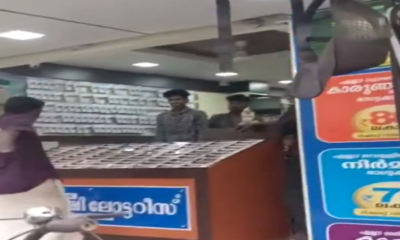
Sthree Sakthi SS-300 Kerala lottery result for February 15 announced: First prize winner gets Rs 75 lakh | Check winners list here

Kerala State Lottery Department has announced the lucky draw winners of the Sthree Sakthi SS-300 lottery ticket today. The next Sthree Sakthi Draw will be held on February 22.

Published

on

Kerala engineer swallows bribe money after being caught red-handed by vigilance department, admitted to hospital

Kerala State Lottery Department has announced the lucky draw winners of the Sthree Sakthi SS-300 lottery ticket today at 3 pm. The draw took place at Gorky Bhavan, near Bakery Junction, in the state capital Thiruvananthapuram. The winner of the first prize will fetch Rs 75 lakh while the second and third prize winner will get Rs 10 lakh and Rs 5,000 respectively.

The lottery holders can check the winning list on the official website of Kerala Lotteries.

The winner of the first prize (Rs 75 lakh) is SV 213855

The winner of the second prize (Rs 1 lakh) is SX 214223

The winners of the third prize (Rs 5,000) are 0471 0998 1008 1554 2229 2281 2982 3033 3813 4191 4803 5558 6020 6265 7164 7187 8977 9459

The winners of the consolation prize (Rs 8,000) are SN 213855 SO 213855 SP 213855 SR 213855 SS 213855 ST 213855 SU 213855 SW 213855 SX 213855 SY 213855 SZ 213855

The winners of fourth prize (Rs 2,000) are 0797 0960 1364 2854 3398 3973 6075 6079 6331 6716

The winners of fifth prize (Rs 1,000) are 1390 1499 1764 1794 2871 3013 3059 3248 4136 4178 5190 5380 5518 6050 6754 7814 7953 8455 8830 9429

The winners of sixth prize (Rs 500) are 0073 0127 0947 1112 1119 1131 1198 1212 1421 1498 1528 2022 2296 2549 2643 2654 2671 2792 2850 3040 3136 3185 3560 3657 3804 3904 4365 4606 4706 4991 5078 5161 5204 5377 6329 6402 6459 6722 6995 7652 7887 8302 8436 8439 8453 8669 8774 8841 8877 9118 9174 9963

The winners of seventh prize (Rs 200) are 0243 0258 0504 1050 1129 1635 1698 2530 2945 3249 3259 3626 3907 4321 4413 4510 5123 5129 5257 5523 5552 5831 5867 6209 6451 6527 6904 6999 7327 7662 7895 8317 8382 8452 8654 8761 8950 8979 9017 9133 9328 9368 9553 9805 9894

The winners of eighth prize (Rs 100) are 8993 5045 1109 4920 2640 1400 8080 1938 8183 1673 3766 9846 7806 9896 4133 8423 5766 1653 0647 0693 6991 3698 5416 8971 1712 4943 7727 3142 9942 4714 1829 8629 5893 8470 1815 6416 9361 4474 3681 4791 0149 6368 7245 4908 5371 3777 2559 8874 6057 1434 8892 6886 0429 4925 3638 6976 8812 4196 3913 1251 5675 1908 7911 2345 5343 2216 4484 1761 8412 3480 3716 1963 6313 8893 0409 6925 7243 6734 9823 3824 1798 4441 9885 8011 1702 4506 3645 1366 0923 2638 3909 7752 5385 6956 4118 2785 5627 5656 6526 6951 1391 1871 6719 7404 3751 6291 0587 7996 5291 7184 0273 2703 1896 7816 5152 2599 2666 6782 9800 961 0064 7634 7852 9832 0226 4313

The prize winners are advised to verify the winning numbers with the results published in the Kerala Government Gazette and surrender the winning tickets within 30 days.

Kerala Sthree Sakthi Lottery

Sthree Sakthi lottery ticket has 9 prizes including a consolation prize. The first prize winner receives Rs 75 lakh and the second and third prizes get Rs 10 lakh and Rs 5,000 respectively. The 10 percent of the first to third prizes will be deducted and the amount will be given to the agents (who sell the winning tickets) by the lottery agency. In the case of 3rd to 8th and the consolation prizes, 10 percent of the prize amount (agent’s commission) will be given from the fund allotted by the government.

Next Sthree Sakthi Kerala Lottery

The next Sthree Sakthi Draw will be held on February 22, 2022, at Gorky Bhavan, near Bakery Junction, in the state capital Thiruvananthapuram.

India News

PM Modi assures no discrimination in women’s quota, delimitation debate intensifies in Parliament

PM Narendra Modi has assured that women’s reservation will be implemented without discrimination, amid a heated debate over delimitation in Parliament.

Published

on

PM modi

Prime Minister Narendra Modi has assured that there will be no discrimination in the implementation of women’s reservation, as Parliament witnessed a sharp debate over the proposed linkage between the quota and delimitation exercise.

During the ongoing special session, the government reiterated its commitment to ensuring fair representation while addressing concerns raised by opposition parties regarding the timing and structure of the legislation.

The proposed framework aims to reserve 33 percent of seats for women in the Lok Sabha and state assemblies. However, its implementation is tied to a fresh delimitation exercise, which is expected after the next census.

Opposition questions timing and intent

Opposition leaders have raised concerns that linking the women’s quota to delimitation could delay its implementation. They argue that the process of redrawing constituencies may push the actual rollout further into the future.

The issue has triggered a broader political confrontation, with multiple parties questioning whether the move could alter representation across states.

Some critics have also alleged that the delimitation exercise could disproportionately benefit certain regions based on population, a charge the government has rejected.

Government reiterates commitment to fair implementation

Responding to these concerns, the Centre has maintained that the reforms are necessary to ensure accurate and updated representation based on population data.

Leaders from the ruling side have repeatedly emphasized that the process will be carried out transparently and without bias. The assurance that there will be “no discrimination” is aimed at addressing fears among states and opposition parties.

The debate marks a key moment in Parliament, with both sides engaging in intense exchanges over one of the most significant electoral reforms in recent years.

Continue Reading

India News

Give all tickets to Muslim women, Amit Shah says, attacking Akhilesh Yadav on sub-quota demand

A sharp exchange between Amit Shah and Akhilesh Yadav in Parliament over sub-quota for Muslim women highlights key divisions on women’s reservation implementation.

Published

on

A heated exchange broke out in Parliament during discussions on the women’s reservation framework, with Union Home Minister Amit Shah and Samajwadi Party chief Akhilesh Yadav locking horns over the demand for a sub-quota for Muslim women.

The debate unfolded as the government pushed forward key legislative measures to implement 33% reservation for women in the Lok Sabha and state assemblies.

Akhilesh Yadav argued that the proposed reservation must ensure representation for women from marginalised communities, including Other Backward Classes (OBCs) and Muslim women. He said that without such provisions, large sections could remain excluded from political participation.

He also questioned the timing of the bill, alleging that the Centre was avoiding a caste census. According to him, a census would lead to renewed demands for caste-based reservations, which the government is reluctant to address.

Government rejects religion-based quota

Responding to the demand, Amit Shah made it clear that reservation based on religion is not permitted under the Constitution.

He stated that any proposal to provide quota to Muslims on religious grounds would be unconstitutional, firmly rejecting the idea of a separate sub-quota for Muslim women within the broader reservation framework.

The government has maintained that the existing framework already includes provisions for Scheduled Castes (SC) and Scheduled Tribes (ST) women within the overall reservation structure.

Wider political divide over implementation

The issue of sub-categorisation within the women’s quota has emerged as a major flashpoint, even as most opposition parties broadly support the idea of women’s reservation.

Samajwadi Party leaders reiterated that their support for the bill depends on inclusion of OBC and minority women, while the government continues to defend its constitutional position.

The debate is part of a broader discussion during the special Parliament session, where multiple bills linked to delimitation and implementation of the women’s quota are being taken up.

Continue Reading

India News

No state will lose a seat, Centre assures as delimitation debate takes centre stage in Parliament

Parliament’s special session begins with key focus on implementing women’s reservation and delimitation, setting the stage for major electoral changes.

Published

on

Parliament

A special session of Parliament commenced on Thursday, with the Centre set to take up crucial legislation related to women’s reservation and delimitation of constituencies. The session, scheduled over three days, is expected to witness intense debate as the government pushes forward its legislative agenda.

At the centre of discussions is the proposal to operationalise the women’s reservation law, which seeks to allocate 33 percent of seats in the Lok Sabha and state assemblies to women. The law, passed earlier, requires enabling provisions before it can be implemented.

The rollout of the reservation is closely tied to the delimitation exercise — a process that redraws parliamentary constituencies based on updated population data. The implementation is expected only after the next census and delimitation process are completed.

The government is aiming to put in place the framework so that the reservation can be enforced in future elections, likely around 2029.

Delimitation and numbers at play

Delimitation is a key aspect of the proposed changes, as it will determine how seats are redistributed and which constituencies are reserved. The exercise is expected to reflect population shifts and may also involve an increase in the total number of Lok Sabha seats.

This linkage has made the issue politically sensitive, with several opposition parties backing women’s reservation in principle but raising concerns over how and when delimitation will be carried out.

Political reactions and expected debate

The session is likely to see sharp exchanges between the government and opposition. While there is broad agreement on increasing women’s representation, disagreements remain over the timing, process, and potential political implications of the delimitation exercise.

Some leaders have argued that delimitation could significantly alter the balance of representation among states, making it a contentious issue beyond the women’s quota itself.

The government, however, has framed the move as a step toward strengthening women’s participation in governance and ensuring more inclusive policymaking.

Continue Reading

Trending

© Copyright 2022 APNLIVE.com