Supreme Court dismisses all petitions seeking review of Ayodhya verdict
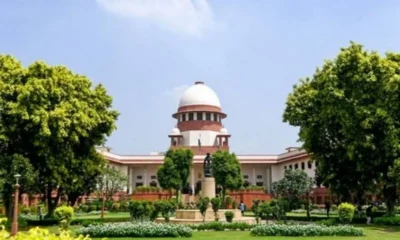
The Supreme Court today dismissed all the 18 petitions seeking a review of its November 9 Ayodhya judgment. The apex court also denied permission to 40 civil rights activists to file a review petition, as they were not parties to the original case.
The Supreme Court today dismissed all the 18 petitions seeking review of its November 9 Ayodhya judgment. The apex court also denied permission to 40 civil rights activists to file review petitions, as they were not parties to the original case.
A five-judge bench headed by Chief Justice SA Bobde comprised Justices DY Chandrachud, Ashok Bhushan, S Abdul Nazeer, and Sanjiv Khanna. Former Chief Justice of India Ranjan Gogoi was replaced by Justice Khanna in the new bench, after the former retired from the his post last month. The bench heard the review petitions in-chamber, instead in open court.
Eighteen review petitions on Ayodhya land dispute verdict were filed in the court, of which nine were filed by those who were the original parties in the case. The other nine were filed by third parties. The majority of petitions were filed by Muslim parties which include – Jamiat-Ulama-i-Hind and All India Muslim Personal Law Board (AIMPLB) – expressing their discontentment with the verdict.
The apex court in its historic judgment had ruled in favour of the Hindus parties by giving them 2.77 acres of the disputed site for the construction of a Ram temple and ordered the Uttar Pradesh government to allocate five-acre of land in a prominent place in Ayodhya to Sunni Waqf Board for constructing a mosque.
Jamiat-i-Hind in its petition filed on December 2 had contended that the judgment of the court amounts to giving validity to the Hindu parties’ action of demolishing the Babri Masjid. The verdict of the court seems to reward the criminal action of the Hindu parties by giving them title to the disputed site, said Jamiat in its petition.
They had further contended that despite acknowledging that the demolition of the Babri Masjid in 1993 amounted to a criminal action, the court went on to reward the crimes of the Hindu parties by giving judgment in their favour. If justice is to prevail, then it can be done in this case only by allowing restitution of the damage done to the Muslim parties i.e., ordering for the reconstruction of the Babri Masjid.
The Jamiat-i-HInd in its petition also said that the court gave precedence to oral testimonies of the Hindu parties and disregarded the documentary evidence produced by the Muslim parties to show that the structure in question had always been a mosque and had been in exclusive possession of the Muslims.
The All India Muslim Personal Law Board contended that the court was wrong in awarding the title to the Hindu parties, since the court acknowledged the fact that the site was in exclusive possession of the Muslims and they entered and prayed at the disputed site uninterruptedly till 1949.
Their petition further contended that the judgment of the top court gives legal sanctions to the crimes committed by Hindu parties – criminal trespassing and vandalising the personal property. The petition added that the court erred in the verdict by handing over the possession of the disputed site to Ram Lalla, when the court itself had acknowledged that the idol was forcibly and illegally placed there by the Hindu parties.
One of the major Hindu parties, Akhil Bharat Hindu Mahasabha had also filed a review petition challenging the Supreme Court’s direction to the Uttar Pradesh government to allot 5 acres of land to Uttar Pradesh Sunni Waqf Board for the construction of a mosque as a “compensatory measure”.
In their review petition, they argued that the Muslim parties have failed to prove the construction in question at the site is a ‘mosque.
The plea filed on behalf of the Hindu Mahasabha by Advocate Vishnu Shankar Jain also urged the top court to reconsider the references made by the court to the same structure as “mosque” or as a “masjid” and the same shall be expunged.
“The building in dispute could not be termed as mosque or masjid or Babari Masjid. In view of the fact and law concerning the case, it would be desirable that the Hon’ble Court may delete the word Babri mosque/ Babri Masjid/mosque/masjid in paragraph 788 (XVIII) and wherever occurs in the judgment and the same may be substituted by the word ‘disputed structure’,” it read.
The petitioner had also made submissions as to why the Hindu parties should not be condemned for the demolition of the Babri mosque on December 6, 1992. The rationale that the petitioner gave for this submission is that Muslims never had a claim to the Ayodhya site. Even if there was a time when they offered prayers in the inner courtyard of the site, it amounts to an encroachment on the sacred land and place of worship for the Hindus.
On December 9, 40 activists and members of civil society, including historian Irfan Habib, economist Prabhat Patnaik, activist Harsh Mander, and sociologist Nandini Sundar had also filed review petitions, saying the said judgment errs in both facts and law.
Supreme Court seeks detailed report from Punjab, Haryana on stubble burning amid severe Delhi air pollution
The Supreme Court has sought detailed reports from Punjab and Haryana on stubble burning as Delhi’s air quality deteriorates to ‘severe’ levels, warning that stricter action may be required.
As Delhi’s air quality worsened to “severe” levels, the Supreme Court on Wednesday directed the governments of Punjab and Haryana to submit affidavits outlining the measures taken to curb stubble burning in their respective states.
A Bench led by Chief Justice of India BR Gavai, along with Justice K Vinod Chandran, took note of concerns raised regarding the worsening air quality in Delhi-NCR despite the enforcement of the Graded Response Action Plan (GRAP).
Court questions delay in stronger pollution control steps
Senior advocate Gopal Sankaranarayanan urged the court to consider implementing GRAP-IV, the most stringent stage of anti-pollution measures, stating that the Air Quality Index (AQI) had crossed 450 in multiple areas. He also pointed out that construction activities, such as drilling near court premises, should be halted temporarily.
Amicus curiae Aparajita Singh highlighted discrepancies in official pollution data and warned that the situation had become “very dangerous,” urging immediate and coordinated action.
Further hearing scheduled for Monday
The CJI-led Bench directed both Punjab and Haryana to file detailed reports before the next hearing, scheduled for Monday. The court also reiterated its earlier directions to enforce strict measures against stubble burning and monitor implementation closely.
In an earlier hearing in September, the top court had sought a report from the Commission for Air Quality Management (CAQM) and advised the Centre to consider stringent penalties, including arrests, to prevent crop residue burning.
Despite repeated judicial interventions, the apex court expressed concern over the states’ failure to effectively control stubble burning — a major contributor to the seasonal spike in pollution across northern India.
Madhya Pradesh Chief Minister Dr Mohan Yadav will on Wednesday transfer the increased monthly assistance of Rs1,500 each to women beneficiaries under the state government’s Ladli Behna Yojana. The event will take place in Seoni, where the Chief Minister will, in a single click, disburse Rs 1,857 crore to over 1.26 crore women across all 52 districts of the state.
Earlier, the beneficiaries were receiving Rs1,250 per month, which was increased following Cabinet approval earlier this month. The revised payout will cost the state exchequer an additional Rs300 crore per month.
Background of the scheme
The Ladli Behna Yojana was launched in June 2023 to provide monthly financial support to women. Initially, the amount was Rs1,000, later raised to Rs1,250 in September 2023. The current increment to Rs1,500 fulfills a major pre-election promise made by the ruling party, which had pledged to gradually increase the assistance up to Rs3,000 per month.
Since the inception of the scheme, the government has directly transferred a total of Rs44,917.92 crore into beneficiaries’ bank accounts, according to official data. The scheme currently benefits around 1.26 crore women.
Possible renaming of the scheme
During the event, the Chief Minister may also announce a new name for the scheme — Devi Subhadra Yojana. Dr Yadav had hinted at this possibility during the Bhai Dooj celebrations last month, drawing a symbolic connection between Lord Krishna’s care for his sister Subhadra and the government’s support for women’s empowerment.
He had said, “Just as Lord Krishna ensured Subhadra’s dignity and protection, our government stands as a guardian for our sisters, ensuring their happiness, safety, and self-reliance.”
Impact on women’s empowerment
Officials have highlighted that the initiative has significantly improved women’s participation in local economies. Many beneficiaries have started small-scale ventures like tailoring, dairy farming, and photocopy services, turning financial aid into livelihood opportunities.
PM Modi visits Delhi blast victims after returning from Bhutan
PM Narendra Modi visited Lok Nayak Hospital to meet victims of the Red Fort blast that killed nine people and injured 20. Investigations reveal terror links across three states.
Prime Minister Narendra Modi on Wednesday met victims of the recent blast near Delhi’s Red Fort at Lok Nayak Hospital, shortly after returning from his two-day Bhutan visit. The visit came amid tight security arrangements around the hospital, where all the injured were admitted.
Nine killed, several injured in Red Fort blast
The explosion occurred on Monday evening when a white Hyundai i20 car exploded near the Red Fort traffic signal, killing nine people and injuring 20 others. The blast, which happened during rush hour, also gutted several nearby vehicles.
Officials said the blast is linked to a terror module spread across Jammu and Kashmir, Haryana, and Uttar Pradesh. Hours before the incident, eight people, including three doctors, were arrested and 2,900 kg of explosives were recovered in a joint police operation.
Investigations link suspects to Faridabad university
Among those arrested were Dr Muzammil Ganaie and Dr Shaheen Sayeed, both associated with Al Falah University in Faridabad, where 360 kg of ammonium nitrate was seized. Another suspect, Dr Umar Nabi — who reportedly died in the explosion — was also linked to the same institution.
Sources said Ganaie and Nabi had previously surveyed the Red Fort area and planned to carry out a major attack during Diwali, which was later aborted. They were also suspected of planning another attack on Republic Day.
Investigators believe an ANFO-based improvised explosive device (IED), containing ammonium nitrate and fuel oil, was packed into the car and manually detonated, indicating a possible suicide attack. High-grade explosives stronger than ammonium nitrate were also found at the site.
APN News is today the most watched and the most credible and respected news channel in India. APN has been at the forefront of every single news revolution. The channel is being recognized for its in-depth, analytical reportage and hard hitting discussions on burning issues; without any bias or vested interests.