English हिन्दी
Connect with us

India News

Mevani Targets PM Modi At Rally Held Without Delhi Police Permission

Published

on

Mevani Targets PM Modi At Rally Held Without Delhi Police Permission

Photo: Jignesh Mevani with Kanhaiya Kumar

Directly targeting Prime Minister Narendra Modi, dalit youth leader and newly elected MLA from Vadgam in Gujarat, Jignesh Mevani, said that his government poses a threat to democracy and the Constitution of the country.

Speaking at a youth rally, ‘Yuva Hunkar’ rally at Parliament Street in Delhi, held despite a curious denial of permission by the Delhi Police, Mevani asked PM Modi to speak up on Bhima Koregaon violence. “It is you who has to answer the reason behind violence on Dalits, violence in Saharanpur, in Bhima Koregaon. You have to answer why Rohit Vemula was killed. You have to answer why people are not getting the money that is in the foreign accounts of Indians. You have to answer why millions of people are not getting jobs despite promises,” he said.

“The way corruption, poverty, unemployment and the real issues are being swept under the carpet and ghar wapasi, love jihad and cows are being given space, we stand against that. We do not believe in love jihad. We are the believers of love. We will celebrate April 14 (Ambedkar Jayanti) and February 14 (Valentine’s Day).”

Reacting to Minister of State MoS, Anantkumar Hegde’s remarks on the Constitution, Mevani said, “We believe in the constitution and will protect it. You attack me as much as you want, I will stick to the Constitution.  PM Modi has to choose between the two, Manusmriti and the constitution. These aren’t books, but belief systems” Addressing a rally in Karnataka recently, Hegde had that the BJP had come to power to “change the Constitution” and would do so in the “near future”.

Mevani termed the Delhi Police’s denial of permission for the rally as ‘Gujarat model’ of politics. “The 125 crore people of this country are watching that someone is not being allowed to speak for merely demanding the release of Chandrashekhar Azad, effective implementation of the Constitution and two crore jobs to the youth,” he said.

“If an elected representative does not have the right to do so, then this is Gujarat model,” Mevani said to the crowd comprising student activists from Delhi, Lucknow and Allahabad and other places.

The rally was oragnised to raise the demand for the release of Dalit outfit Bhim Army’s founder Chandrashekhar Azad who was arrested in June last year from Himachal Pradesh in connection with the Thakur-Dalit clashes in Uttar Pradesh’s Saharanpur district. His supporters turned up at the rally with posters bearing his image.

The rally also sought to highlight issues like educational rights, employment, livelihood and gender justice.

Mevani said he will stand guard against the politics of hatred and stick to constitutional values and the “politics of love”, along the lines of statements made by Congress president Rahul Gandhi after the Gujarat polls, said media reports.

“I believe in politics of unity. I believe in politics of love, not love jihad. Alpesh Thakore, Hardik Patel and I are being targeted because we demolished their (BJP) pride and arrogance and crushed BJP’s target of 150 seats in Gujarat…There’s a looming threat to our democracy and Constitution today,” he said.

Former and current Jawaharlal Nehru University (JNU) student leaders, including Kanhaiya Kumar, Shehla Rashid and Umar Khalid, present on stage, also spoke at the rally.

Former JNU students union president Kanhaiya Kumar launched a scathing attack against the BJP. “BJP isn’t a party, it’s like a brand new washing machine, where something goes in but comes out sparkling clean. Of the 282 MPs, 109 MPs have serious crimes allegations against them. Not asking about Lalu, but what about Sukhram’s son or Mukul Roy?” he said. “We are not against any religion or any community, we are here for the constitution. We don’t have crowds, I agree. We don’t have crowds, but we have real, living breathing people.”

“They are afraid of Chandrashekhar, not because he’s a threat to the country: but to those who want to convert this to a Hindu Rashtra. There’s no space for Dalits in the Hindu Rashtra that they envision,” JNU student Umar Khalid said at the rally.

RTI activist Akhil Gogoi said a national programme was needed to get rid of the BJP-RSS government. “Twelve States in India had special status after the BJP government came into being, the autonomy of these States was compromised. Our voices are silenced because we speak against BJP and RSS. We fight the fight on the streets,” he said.

Assam farmers leader Akhil Gogoi and senior Supreme Court lawyer Prashant Bhushan were also present, apart from students from JNU, Delhi University, Lucknow University and Allahabad University among others.

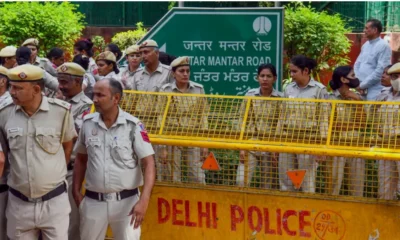
Around 2,000 security personnel, including paramilitary forces, with water cannon vehicles were deployed in connection with the rally. Additional forces from other states had also been called in.

India News

PM Modi assures no discrimination in women’s quota, delimitation debate intensifies in Parliament

PM Narendra Modi has assured that women’s reservation will be implemented without discrimination, amid a heated debate over delimitation in Parliament.

Published

on

PM modi

Prime Minister Narendra Modi has assured that there will be no discrimination in the implementation of women’s reservation, as Parliament witnessed a sharp debate over the proposed linkage between the quota and delimitation exercise.

During the ongoing special session, the government reiterated its commitment to ensuring fair representation while addressing concerns raised by opposition parties regarding the timing and structure of the legislation.

The proposed framework aims to reserve 33 percent of seats for women in the Lok Sabha and state assemblies. However, its implementation is tied to a fresh delimitation exercise, which is expected after the next census.

Opposition questions timing and intent

Opposition leaders have raised concerns that linking the women’s quota to delimitation could delay its implementation. They argue that the process of redrawing constituencies may push the actual rollout further into the future.

The issue has triggered a broader political confrontation, with multiple parties questioning whether the move could alter representation across states.

Some critics have also alleged that the delimitation exercise could disproportionately benefit certain regions based on population, a charge the government has rejected.

Government reiterates commitment to fair implementation

Responding to these concerns, the Centre has maintained that the reforms are necessary to ensure accurate and updated representation based on population data.

Leaders from the ruling side have repeatedly emphasized that the process will be carried out transparently and without bias. The assurance that there will be “no discrimination” is aimed at addressing fears among states and opposition parties.

The debate marks a key moment in Parliament, with both sides engaging in intense exchanges over one of the most significant electoral reforms in recent years.

Continue Reading

India News

Give all tickets to Muslim women, Amit Shah says, attacking Akhilesh Yadav on sub-quota demand

A sharp exchange between Amit Shah and Akhilesh Yadav in Parliament over sub-quota for Muslim women highlights key divisions on women’s reservation implementation.

Published

on

A heated exchange broke out in Parliament during discussions on the women’s reservation framework, with Union Home Minister Amit Shah and Samajwadi Party chief Akhilesh Yadav locking horns over the demand for a sub-quota for Muslim women.

The debate unfolded as the government pushed forward key legislative measures to implement 33% reservation for women in the Lok Sabha and state assemblies.

Akhilesh Yadav argued that the proposed reservation must ensure representation for women from marginalised communities, including Other Backward Classes (OBCs) and Muslim women. He said that without such provisions, large sections could remain excluded from political participation.

He also questioned the timing of the bill, alleging that the Centre was avoiding a caste census. According to him, a census would lead to renewed demands for caste-based reservations, which the government is reluctant to address.

Government rejects religion-based quota

Responding to the demand, Amit Shah made it clear that reservation based on religion is not permitted under the Constitution.

He stated that any proposal to provide quota to Muslims on religious grounds would be unconstitutional, firmly rejecting the idea of a separate sub-quota for Muslim women within the broader reservation framework.

The government has maintained that the existing framework already includes provisions for Scheduled Castes (SC) and Scheduled Tribes (ST) women within the overall reservation structure.

Wider political divide over implementation

The issue of sub-categorisation within the women’s quota has emerged as a major flashpoint, even as most opposition parties broadly support the idea of women’s reservation.

Samajwadi Party leaders reiterated that their support for the bill depends on inclusion of OBC and minority women, while the government continues to defend its constitutional position.

The debate is part of a broader discussion during the special Parliament session, where multiple bills linked to delimitation and implementation of the women’s quota are being taken up.

Continue Reading

India News

No state will lose a seat, Centre assures as delimitation debate takes centre stage in Parliament

Parliament’s special session begins with key focus on implementing women’s reservation and delimitation, setting the stage for major electoral changes.

Published

on

Parliament

A special session of Parliament commenced on Thursday, with the Centre set to take up crucial legislation related to women’s reservation and delimitation of constituencies. The session, scheduled over three days, is expected to witness intense debate as the government pushes forward its legislative agenda.

At the centre of discussions is the proposal to operationalise the women’s reservation law, which seeks to allocate 33 percent of seats in the Lok Sabha and state assemblies to women. The law, passed earlier, requires enabling provisions before it can be implemented.

The rollout of the reservation is closely tied to the delimitation exercise — a process that redraws parliamentary constituencies based on updated population data. The implementation is expected only after the next census and delimitation process are completed.

The government is aiming to put in place the framework so that the reservation can be enforced in future elections, likely around 2029.

Delimitation and numbers at play

Delimitation is a key aspect of the proposed changes, as it will determine how seats are redistributed and which constituencies are reserved. The exercise is expected to reflect population shifts and may also involve an increase in the total number of Lok Sabha seats.

This linkage has made the issue politically sensitive, with several opposition parties backing women’s reservation in principle but raising concerns over how and when delimitation will be carried out.

Political reactions and expected debate

The session is likely to see sharp exchanges between the government and opposition. While there is broad agreement on increasing women’s representation, disagreements remain over the timing, process, and potential political implications of the delimitation exercise.

Some leaders have argued that delimitation could significantly alter the balance of representation among states, making it a contentious issue beyond the women’s quota itself.

The government, however, has framed the move as a step toward strengthening women’s participation in governance and ensuring more inclusive policymaking.

Continue Reading

Trending

© Copyright 2022 APNLIVE.com