English हिन्दी
Connect with us

India News

Supreme Court hears challenge to Waqf Amendment Act over inclusion of non-Muslims

Petitions challenging the Waqf Amendment Act were heard in the Supreme Court, with senior lawyers raising concerns about religious autonomy and minority rights.

Published

on

Supreme Court

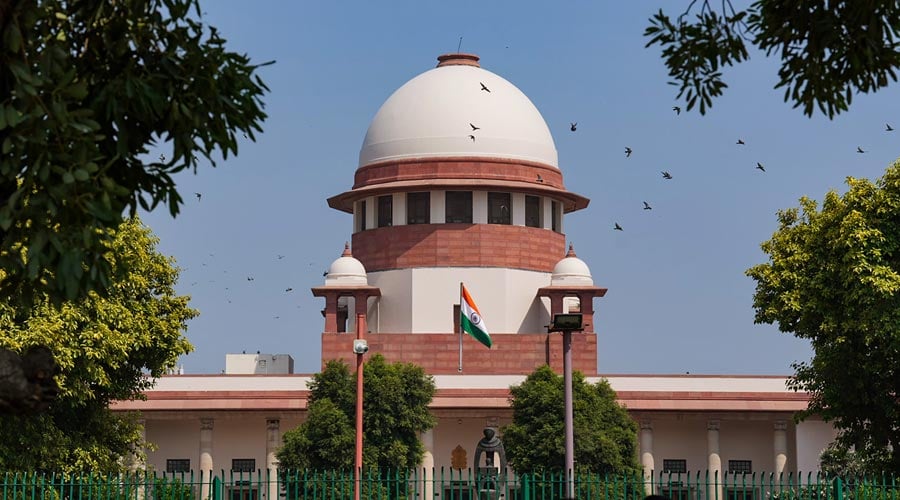
The Supreme Court on Monday heard a series of petitions challenging the recent Waqf Amendment Act, with senior legal experts questioning the constitutional validity of including non-Muslims in Waqf institutions. The controversial amendments, passed into law just last month, have stirred public protests and sparked debate over minority rights and religious autonomy.

Muslim control over Waqf institutions at risk, argue petitioners

Senior Advocate Kapil Sibal, representing one of the petitioners, strongly opposed the inclusion of non-Muslim members in the Central Waqf Council. He stated that such a move fundamentally alters the religious character of Waqf, which is defined as a Muslim’s dedication of property to God. “The creation of Waqf is not a secular act,” Sibal told the bench led by Chief Justice BR Gavai. He warned that the new structure of the 22-member Council could potentially result in Muslims becoming a minority within their own religious institution.

Sibal compared the control over Hindu and Sikh endowments, which are exclusively managed by their respective communities, and asked why Waqf institutions should be treated differently. “There is no non-Hindu in Hindu religious trusts. The same principle must apply here,” he submitted.

When Chief Justice Gavai raised the example of Bodh Gaya, Sibal clarified that places of worship can be shared between religious groups but that does not change the religious nature of the endowment itself.

Criticism over ‘proof of religion’ requirement

Senior Advocate Abhishek Singhvi added that the new law creates unreasonable hurdles for those seeking to register Waqf properties. He criticized provisions that may require individuals to prove religious practice over five years, calling it “a mechanism to infuse fear and delay”. “Which religious endowment in this country demands proof that you have been practising your faith for years? This defies logic,” Singhvi remarked.

Senior Advocate Huzefa Ahmadi also questioned how religious adherence would be verified. “Will I be asked if I pray five times a day or if I consume alcohol? Is that the criteria to judge someone’s faith?” he asked.

Senior Advocate Rajeev Dhawan emphasized that the matter also touches on broader secular values. He shared that one of his clients, a Sikh, wanted to contribute to a Waqf trust but fears the legal barriers will prevent him. “This is the first time religion is being redefined within a religious statute,” he argued.

Court maintains legislative presumption of constitutionality

Chief Justice Gavai, while acknowledging the arguments, reminded the courtroom that any law passed by Parliament carries a presumption of constitutionality. Courts, he said, must refrain from intervening unless a clear and egregious constitutional violation is evident.

The hearing is set to continue, with the court expected to examine in greater depth whether the amendments violate constitutional principles or minority rights.

Background on the amendment

The Waqf Amendment Act, passed in Parliament last month, has faced widespread backlash from Muslim organizations. Critics allege that it enables state interference in Waqf properties under the guise of inclusivity. The government, however, defends the law, claiming it promotes efficiency, transparency, and broader participation in managing Waqf assets.

India News

DU VC Prof Yogesh Singh entrusted with additional charge of AICTE Chairman

Published

on

By

Prof. Yogesh Singh, Vice Chancellor of the University of Delhi, has been entrusted with the additional charge of the post of Chairman, AICTE till the appointment of a Chairman of AICTE or until further orders, whichever is earlier.

It is noteworthy that AICTE Chairman Prof. TG Sitharam was relieved of his duties after his term ended on December 20, 2025. According to a letter issued by the Ministry of Education, Government of India, on Monday, Prof. Yogesh Singh’s appointment is until the appointment of a regular AICTE Chairman or until further orders whichever is earlier.

Prof. Yogesh Singh is a renowned academician with excellent administrative capabilities, who has been the Vice-Chancellor of University of Delhi since October 2021. He has also served as the Chairperson of the National Council for Teacher Education. In August 2023, he was also given the additional charge of Director of the School of Planning and Architecture (SPA).

Prof. Yogesh Singh served as the Vice-Chancellor of Delhi Technological University from 2015 to 2021; Director of Netaji Subhas Institute of Technology, Delhi from 2014 to 2017, and before that, he was the Vice-Chancellor of Maharaja Sayajirao University, Baroda (Gujarat) from 2011 to 2014. He holds a Ph.D. in Computer Engineering from the National Institute of Technology, Kurukshetra. He has a distinguished track record in quality teaching, innovation, and research in the field of software engineering.

Continue Reading

India News

Goa nightclub fire case: Court extends police custody of Luthra brothers by five days

A Goa court has extended the police custody of Saurabh and Gaurav Luthra, owners of the nightclub where a deadly fire killed 25 people, by five more days.

Published

on

Luthra brothers

A court in Goa on Monday extended the police custody of Saurabh Luthra and Gaurav Luthra, the owners of the Birch by Romeo Lane nightclub, by five more days in connection with the deadly fire incident that claimed 25 lives on December 6.

The order was passed as investigators sought additional time to question the two accused in the case linked to the blaze at the Anjuna-based nightclub.

Owners were deported after fleeing abroad

According to details placed before the court, the Luthra brothers had left the country following the incident and travelled to Thailand. They were subsequently deported and brought back to India on December 17, after which they were taken into police custody.

Advocate Vishnu Joshi, representing the families of the victims, confirmed that the court granted a five-day extension of police custody for both Saurabh and Gaurav Luthra.

Another co-owner sent to judicial custody

The court also remanded Ajay Gupta, another owner of the nightclub, to judicial custody. Police did not seek an extension of his custody, following which the court passed the order, the victims’ counsel said.

The Anjuna police have registered a case against the Luthra brothers for culpable homicide not amounting to murder along with other relevant offences related to the fire incident.

Continue Reading

India News

Delhi High Court issues notice to Sonia Gandhi, Rahul Gandhi in National Herald case

Delhi High Court has sought responses from Sonia Gandhi and Rahul Gandhi on the ED’s plea challenging a trial court order in the National Herald case.

Published

on

The Delhi High Court has sought responses from Congress leaders Sonia Gandhi and Rahul Gandhi on a petition filed by the Enforcement Directorate (ED) in connection with the National Herald case. The petition challenges a trial court order that refused to take cognisance of the agency’s prosecution complaint.

Justice Ravinder Dudeja issued notices to the Gandhis and other accused on the main petition, as well as on the ED’s application seeking a stay on the trial court’s December 16 order. The high court has listed the matter for further hearing on March 12, 2026.

The trial court had ruled that taking cognisance of the ED’s complaint was “impermissible in law” because the investigation was not based on a registered First Information Report (FIR). It observed that the prosecution complaint under the Prevention of Money Laundering Act (PMLA) was not maintainable in the absence of an FIR for a scheduled offence.

According to the order, the ED’s probe originated from a private complaint rather than an FIR. The court further noted that since cognisance was declined on a legal question, it was not necessary to examine the merits of the allegations at that stage.

The trial court also referred to the complaint filed by BJP leader Subramanian Swamy and the summoning order issued in 2014, stating that despite these developments, the Central Bureau of Investigation (CBI) did not register an FIR in relation to the alleged scheduled offence.

The ED has accused Sonia Gandhi, Rahul Gandhi, late Congress leaders Motilal Vora and Oscar Fernandes, Suman Dubey, Sam Pitroda, and a private company, Young Indian, of conspiracy and money laundering. The agency has alleged that properties worth around Rs 2,000 crore belonging to Associated Journals Limited (AJL), which publishes the National Herald newspaper, were acquired through Young Indian.

The agency further claimed that Sonia and Rahul Gandhi held a majority 76 per cent shareholding in Young Indian, which allegedly took over AJL’s assets in exchange for a Rs 90 crore loan.

Continue Reading

Trending

© Copyright 2022 APNLIVE.com