[vc_row][vc_column][vc_column_text]~By Rajesh Sinha
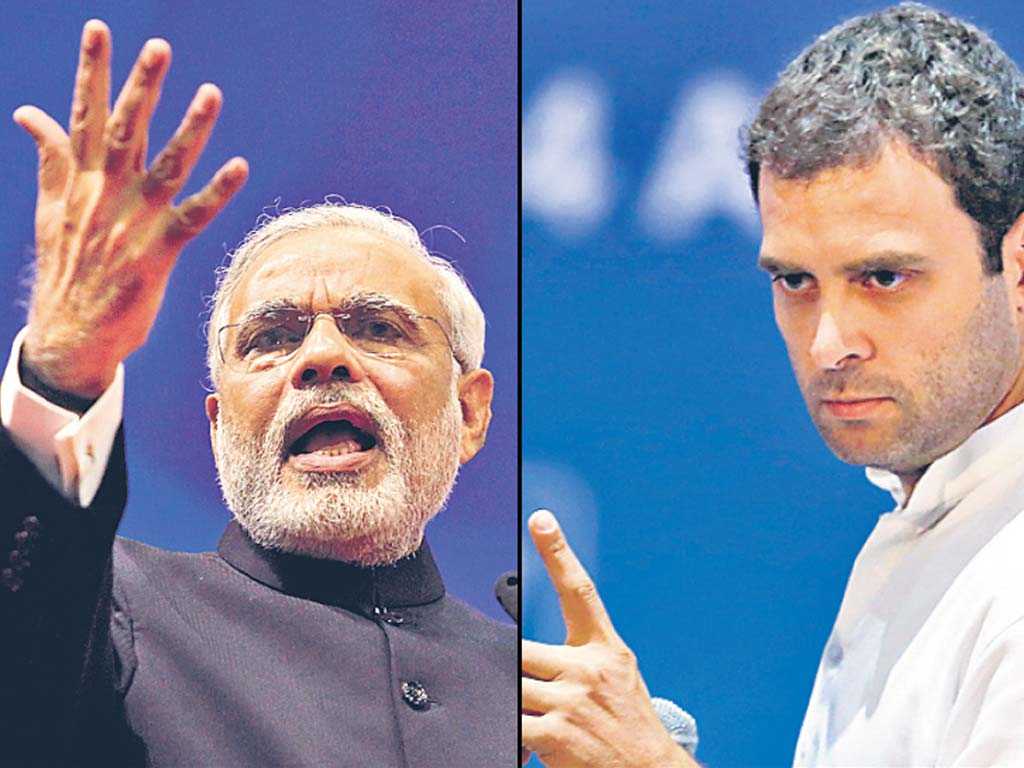
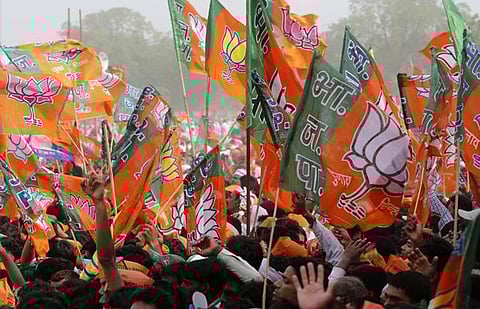
The BJP emerged victorious in assembly polls, reaffirming its status as the dominant party in the country. Many, however, also see a revival of sorts for the Congress which managed to put up a tough fight in BJP bastion, the ‘Hindutva laboratory’ and home state of its top two leaders Prime Minister Narendra Modi and party president Amit Shah. Also noticed was the coming into his own of Rahul Gandhi, newly elevated as Congress chief.
The question is, will the Congress under Rahul Gandhi be able to fight back and emerge as a credible challenger to Modi-Shah-led BJP? Together with other Sangh parivar affiliates, BJP under Modi-Shah duo determines not just the agenda for governance but also the society, either of the two aspects taking centre stage as per the situation.
Now that the assembly election results are out, Prime Minister Narendra Modi is once again talking about ‘vikas’ and how the BJP owes its victory to it. The theme was conspicuous by its absence during the shrill election campaign that he led from the front and seems aimed more at keeping the faith of voters in his projected image of a man who delivers – failures notwithstanding.
That is what the BJP owes its victory to – voters’ faith in Modi, his personal appeal. They were unwilling to desert him even after the blow dealt by inept implementation of demonetisation and the GST, and it was he that the electoral battle was turned into, especially during the campaign in the second phase. It was not about development – ‘vikas’ – but more about ‘insult’ to ‘Gujarat ka beta’ (Gujarat’s son) in the ‘neech’ comment of Mani Shankar Aiyar and the bizarre charge of Congress being hand-in-glove with Pakistan which wanted Ahmed Patel as Gujarat chief minister.
This was after the first phase in which the Congress significantly improved its previous tally and the BJP leadership was defensively avoiding answers to charges of scam in Rafale deal or BJP chief Amit Shah’s son’s controversial business deals, or development (‘vikas’) gone crazy. In Saurashtra, Congress won 28 seats as compared to 15 in the 2012 election.
In the end, the BJP did manage to save the day and improved its vote share marginally – from 47.85 per cent of total votes polled (48.30 of total in seats it contested) to 49.1 per cent. So did the Congress – from 38.93 per cent of total votes polled (40.59 per cent of total in the seats it contested) to 41.4 per cent. But Congress improved its seats by 16 and the BJP lost as many. In fact, the BJP tally came down to double digits for the first time since 1995.
Also, in at least 15 seats, BJP candidates’ margin of victory was less than 3,000 votes. In many, the number of votes polled by independents and ‘None Of The Above’ (NOTA) was bigger than the margin of victory.
As reported by APN yesterday (Monday, Dec 18), the Congress appears to have obtained a good support in rural areas while the urban and semi urban voters preferred the BJP. Of the 73 urban clusters, BJP led in 55 and, out of 109 seats in rural areas, the Congress was ahead in 62. Modi’s ‘vikas’ seems to have bypassed rural areas.
As for the way ahead, there are a series of battles lined up. Assembly elections are scheduled in eight states – Meghalaya, Karnataka, Mizoram, Nagaland, Tripura, Chhattisgarh, Madhya Pradesh and Rajasthan – next year (2018). After that will follow the Lok Sabha elections in 2019.
Both parties would need to work on their strengths and remove weaknesses. The task is easier for the more organised BJP, with its leaders already talking about getting to work for the next election. For Lok Sabha, the ‘Mission 2019’ is already on. As far agenda is concerned, the BJP is accustomed to dictating it, leaving the Congress to react to it. That it is mostly aimed at polarisation is another matter – even in 2014, when the people were sick of scams and ready to get rid of Congress, this element was very much there even though Modi himself was talking vikas then.
And, after the present assembly poll results were declared, the charge made against Congress by BJP leaders – of polarising society along caste lines – is also because it undermines the other polarisation BJP and Modi worked to promote. That is a card BJP always has.
For the Congress, it is still a long road. Taking its strengths, its defeat in Gujarat, home state of both PM Modi and Amit Shah and BJP’s original laboratory of Hindutva, has not been disheartening for the Congress as it managed to make gains and improve its tally significantly. Some analysts even called it a ‘revival’ of Congress and the death of the ‘TINA’ (There Is No Alternative) factor in Indian politics.
In estimating Congress performance, while BJP has made much about its defeat despite the most favourable circumstances, one also has to take note of the fact that the party, whose organisation was in shambles and had suffered the jolt of its top leader Shankersinh Vaghela quitting the party with 14 MLAs just a few months ago, still managed to put up a serious fight and had the BJP rattled. It was because of this that the BJP government in the state used the extra time it got due to delayed poll dates to give out a number of sops and Modi inaugurating a spate of projects, from ferry service to parking lots.
Another positive for Congress is that its new top leader Rahul Gandhi is no longer seen as a liability. He is now taken more seriously and is not being referred to as ‘Pappu’ anymore. He has to build on this, consolidate his leadership and give direction to the party – ideological and programmatic. The positive for Congress in its defeat is that it would perhaps not become complacent. The organisation has to be built and party units set up: the BJP has done it from booth level upwards.
Most importantly, the Congress has to take care of an aspect directly linked to the ideological aspect and program. The push it got from movements led by Dalit leader Jignesh Mevani, OBC leader Alpesh Thakur and Patidar agitation leader Hardik Patel would need to be looked into and the inherent lesson learnt and marshalled. It is not enough to opportunistically try to capitalise on the prevailing mood, or seek gains by appeasing the vocal section of society or a community. The party needs to define its stance in keeping with the progressive, democratic, secular principles it claims to adhere to. This stance should determine its response in various cases. The party needs to provide direction to society and show it a way, rather than being swayed and buffeted about its currents. The significance of having a vision for the kind of society needs to be understood, for it is as important in a developing (if not actually ‘backward’) society as a program for governance. This is one feature that has been missing in Congress plans and functioning, while the BJP has an active ‘Hindutva’ program. Even the regional parties that have come up have had a social agenda at their foundation.[/vc_column_text][/vc_column][/vc_row]