English हिन्दी
Connect with us

Latest Politics News

I do not have the luxury of being a former finance minister: Arun Jaitley responds to Yashwant Sinha

Published

on

[vc_row][vc_column][vc_column_text]A day after senior BJP leader Yashwant Sinha slammed the Modi government’s handling of economy in a stinging article in The Indian Express, Finance Minister Arun Jaitley defended the government policies saying they are aimed at ending corruption.

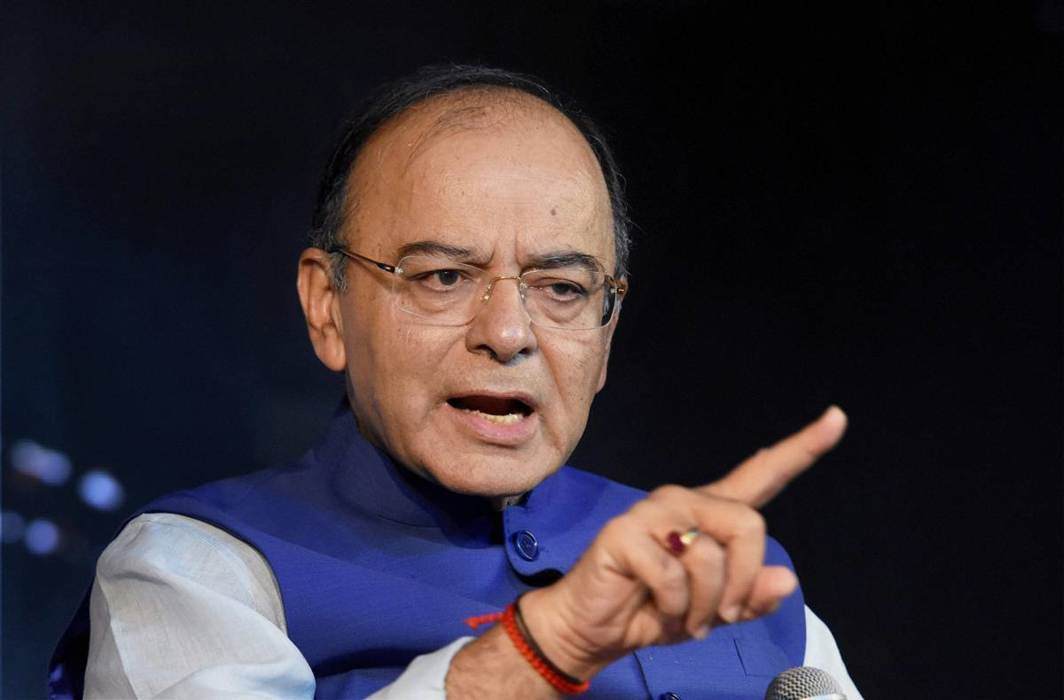
Speaking at the Nehru Memorial Museum and Library, Jaitley defended the government’s decision of demonetisation and the launch of Goods and Services Tax (GST) and took a dig at his predecessor and said he does not have the luxury of being a former finance minister.

Refusing to respond to the charges made by Sinha, Jaitley said, “I must confess that I do not have the luxury as yet of being a former finance minister. Nor do I have the luxury of being a former finance minister who has turned a columnist.”

He added, “Therefore I can conveniently forget a policy paralysis, 4 billion reserves left in 1991 and I can switch over and change a narrative. Speaking of persons and then bypassing the issues is something which is very easily done.”

The minister also rejected the notion that the economy is in a downward spiral as suggested by Sinha. He mentioned the figures of tax collection to substantiate his claim of a strong economy. “Direct tax figures are 15.7% over and above last year’s figure, so this so-called slowdown visualized by some, hasn’t even impacted,” said Jaitley.

On GST, Jaitley said that the decision was taken with consensus and it was everybody’s call that a single rate should be introduced. He said that while some Congress leaders have been critical, most of the state governments have been supportive. Some teething problems were always expected, he added.

Calling fiscal prudence a difficult job, he said that there has been no reduction in the collection of direct taxes during his tenure. He said that the GST collection in the first two months has also been on expected lines and will pick up pace soon.

Speaking about slow down of growth in the private sector, Jaitley said some harsh steps were taken to control the effects of the “reckless lending” that took place during the UPA era.

On ease of doing business, Jaitley said that the government has ended rep-tapism. Earlier there was a lot of government discretion, which led to corruption. PM Modi has scrapped government discretion and left it to market forces, he said. This, he said, has made India a more attractive destination.

“Today the challenge really is during the boom period of 2003 to 2008-09, our private sector expanded when global economy slowed down. Private companies had undertaken large liabilities from bank, did not find demand. When global commodity prices went down, many of them did not find their loans serviceable.

“Then came a situation in 2012-14 when the governmet virtually gave up, there was no policy initiative, they allowed things to drift on their own. When you allow this, the figure (NPAs) mounted up. I must say that those in government, those in banking industry, those in RBI, when reckless lending took place, all looked the other way.

“Then suddenly some harsh steps were required. so debate is are all those steps taken a bit too harsh. Bankers believe the steps with regard to excessive provisioning are a bit too hard on them. therefore the private sector area itself was one area we have not grown…several areas of private sector have grown.

“Large industry is borrowing more from the bond market than the banks itself. that is the problem that needs to be addressed by us.

Talking about the criticism against demonetisation, Jaitley said it “one of the smoothest possible replacements of currency itself.” He said, “People saw riots would begin, starvation would take place. It was one of smoothest possible replacements of currency itself.”

He also said that the note ban targeted the shadow economy. “Demonetisation was to make sure that the anonymous tender which operated in market gets identified to its owner. The prime minister has a strong agenda on creating a new normal as far as countery’s shadow economy was concerned,” said Jaitley.

The minister added that the government is serious at checking the improper political funding. He added that illegtimate political funding has corrupted the society and tarnished the country’s image globally.[/vc_column_text][/vc_column][/vc_row]

India News

Congress, BJP attack Bhagwant Mann over remarks on Punjab blasts

Congress and BJP have jointly criticised Punjab CM Bhagwant Mann after he linked recent blasts near defence sites to political motives, triggering a controversy.

Published

on

Bhagwant Mann

A political row has erupted in Punjab after Chief Minister Bhagwant Mann linked recent blast incidents to political motives, drawing sharp criticism from both the Congress and the Bharatiya Janata Party (BJP).

The controversy follows two low-intensity explosions reported within a short span of time — one near the Border Security Force (BSF) headquarters in Jalandhar and another close to an army cantonment area in Amritsar. The incidents raised concerns over security, particularly given the sensitive nature of the locations.

In response, Mann suggested that the blasts could be part of a larger political strategy. His remarks triggered a strong backlash, with opposition parties accusing him of politicising a serious security issue.

Leaders from the Congress criticised the Chief Minister’s statement, calling it inappropriate and alleging that such comments undermine the gravity of the situation. They stressed that matters related to national security should be handled with caution and responsibility.

The BJP also joined the criticism, questioning the basis of Mann’s claims and urging the state government to focus on investigation and law enforcement instead of making political allegations.

The developments have led to an unusual moment where both Congress and BJP appear aligned in their criticism of the Aam Aadmi Party-led government in the state.

Meanwhile, the blasts themselves have intensified concerns over safety in border regions, with authorities continuing their investigation into the incidents. No casualties were reported, but the proximity to defence establishments has made the issue particularly sensitive.

The episode has further escalated political tensions in the state, with security and accountability emerging as key points of debate.

Continue Reading

India News

Himanta Biswa Sarma resigns as Assam chief minister, oath ceremony likely after May 11

Himanta Biswa Sarma resigns as Assam Chief Minister after BJP-led NDA’s victory. He will continue as caretaker CM until the new government is sworn in after May 11.

Published

on

Himanta sharma

Assam Chief Minister Himanta Biswa Sarma resigned from his post on Wednesday, paving the way for the formation of a new government after the BJP-led NDA secured a decisive victory in the 2026 Assembly elections.

Sarma submitted his resignation to Governor Lakshman Prasad Acharya at Lok Bhawan in Guwahati. The Governor accepted the resignation and asked him to continue as the caretaker Chief Minister until the new government takes charge.

The resignation comes after the NDA’s strong electoral performance, where the alliance won a clear majority in the 126-member Assembly, ensuring its return to power for another term.

Oath ceremony expected after May 11

Speaking to reporters after submitting his resignation, Sarma said the swearing-in ceremony for the new government is likely to be held after May 11.

He indicated that Prime Minister Narendra Modi has been invited to attend the ceremony but is unavailable until May 11, which has influenced the tentative schedule.

Decision on next chief minister soon

Sources suggest that central observers, including senior BJP leaders, are expected to arrive shortly to oversee the selection of the legislature party leader. The newly elected MLAs will then decide on the next Chief Minister.

Despite the formal resignation, party sources indicate that Sarma is likely to continue in the role for another term, given the BJP’s strong mandate in the state.

The move marks the beginning of the government formation process in Assam following the election results declared earlier this week.

Continue Reading

India News

Rahul Gandhi and Vijay alliance took shape through backchannel talks, early signals from Congress leaders

Congress outreach and political calculations led to Rahul Gandhi and Vijay coming together after the Tamil Nadu 2026 election results.

Published

on

The coming together of Rahul Gandhi and actor-politician Vijay in Tamil Nadu after the 2026 Assembly elections was not sudden, but the result of behind-the-scenes political manoeuvring and early signals within the Congress.

According to media reports, some leaders in the Tamil Nadu Congress had already sensed the scale of Vijay’s surge during the campaign, anticipating what was later described as a “wave” in favour of his party.

After the results, where Vijay’s Tamilaga Vettri Kazhagam (TVK) emerged as the single largest party but fell short of a majority, communication channels between the Congress leadership and Vijay quickly became active.

A key moment in this evolving political equation was a phone call from Rahul Gandhi to Vijay, congratulating him on the party’s strong performance. The conversation was seen as more than a courtesy, signalling the possibility of cooperation at a time when government formation required additional support.

Reports indicate that discussions within Congress weighed the political benefits of supporting Vijay, especially given the shifting dynamics in the state where traditional dominance by major Dravidian parties has been challenged.

With TVK needing allies to cross the majority mark, Congress emerged as a potential partner, leading to a broader political realignment in the state. This development also triggered tensions within opposition alliances, highlighting the strategic importance of the decision.

The evolving partnership reflects a mix of electoral pragmatism and changing voter sentiment, particularly the growing influence of younger voters, which leaders acknowledged as a key factor in the election outcome.

Continue Reading

Trending

© Copyright 2022 APNLIVE.com