
India News
Kanhaiya Kumar can get the Congress some traction but what next?
Kanhaiya Kumar, former JNUSU president, can be an asset but why is the Congress busy collecting assets when it has no strategy to use them. Kanhaiya’s move from the CPI to the Congress indicates that Bihar’s Leningrad is getting bored with just slogans and wants more. Of what, even Kanhaiya won’t know.

By Vikram Kilpady
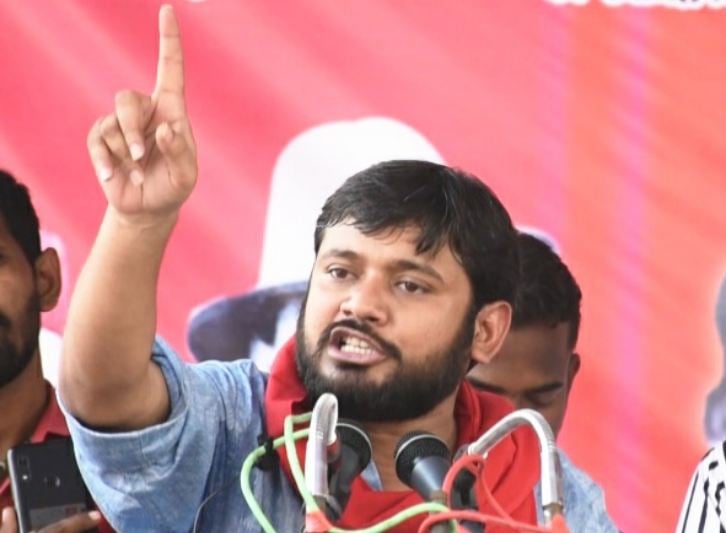
With the Congress woefully short on motormouth Hindi speakers ahead of the Uttar Pradesh elections and the larger 2024 Lok Sabha polls, Kanhaiya Kumar looks like a gain for the Congress which he joined in the presence of Rahul Gandhi on Tuesday. Gujarat Vadgam MLA Jignesh Mewani, who was with Kanhaiya, voiced his support for the Congress agenda though he did not formally join it citing Assembly rules since he is an independent MLA. Kanhaiya is a good speaker and a livewire who can keep people entertained and hold his own against hectoring by either the centrists or by the right. That too with elan and good humour to bat away attacks. There are many good YouTube videos as evidence, one just needs to do a cursory search.
Kanhaiya can do all this in Hindi, and English, without missing a beat or a wink or being caught in unsure pauses that several Congress speakers resort to, Rahul Gandhi included, and are often parodied by the media for their inability to speak the language and what-not. If Rahul Gandhi is a load and shoot rifle, Kanhaiya is the KK-47 and therein lies the rub because like all assault rifles, can the Congress suffer the heat a speaker like Kanhaiya can generate?
As well-documented, Kanhaiya was a Communist Party of India member and had been president of the Jawaharlal Nehru University Students’ Union on the ticket of the CPI’s student wing. He had also contested the 2019 Lok Sabha election for the CPI from Begusarai, Bihar’s so-called Leningrad, and lost to Giriraj Singh of the BJP, the original go-to-Pakistan man.
This is possibly where Kanhaiya realised that revolutionary slogans were fine to enthuse the youth, both rural and urban, and the poor, predominantly rural, but power was not for the taking so easily for the CPI (seen as a Bhumihar party) anymore. Unlike the CPI and its allies, the ultra-left CPIML Liberation won 5 seats in the Bihar elections. Possibly, the masses of Bihar didn’t trust their own boy, now a big Delhi man spouting slogans of aazadi for everyone, including Kashmiris.
This is what will weigh him down, and by extension, the Congress. The pre-spring 2016 sloganeering in JNU of aazadi is still the smallest thorn that can be used to prick the otherwise impregnable wall of rhetoric and common sense that Kanhaiya can raise in a debate. The BJP has had a measure of him in Bihar and he can be easily read by the party there. That’s the right-wing point against him.
The centrist remembers that Kanhaiya kept his distance when the dadis of Shaheen Bagh put out quilts and shamianas to protest against the Citizenship Amendment Act-NRC-NPR. Unlike his comrades from JNU who came and kept a low-profile, Kanhaiya has almost no profile when Shaheen Bagh stood out as an example of citizens holding the State to account for being crass and despotic, even when the media sided against them. Further, Umar Khalid still continues to be in prison under the draconian UAPA but Kanhaiya has largely kept quiet.
The silence on his part is emblematic of the way the Left has of coming apart like the Titanic after hitting the iceberg of caste and privilege. The original Communist Party, the CPI, formed in 1925, had lost its spunk post-1950 after it toed the Soviet Union line not to disturb the Congress. What else could it do as the global fountainhead of Communism was not keen on antagonizing Nehru and his daughter?
Unhappy with this line, the alleged hotheads formed the Communist Party of India (Marxist) (CPM) as the differences between the Soviets under Khrushchev and China under Mao Zedong, who had the same big ideas as the now-dead Stalin, divided the communist world. The Marxists, meaning the CPM, as the Communists (i.e. the CPI) would derisively call the newer and more vibrant party, would see another split, leading to the birth of the ultra-left Marxist Leninists.
The CPIML would turn away from parliamentary democracy and take up arms, beginning in Naxalbari in 1967. The State, under Indira Gandhi, cracked down hard and destroyed that violent left turn with far more violent suppression of human rights. Many of those killed in pursuit of spring thunder were young men and women high on the ideas of revolution and low on the realities of the rural hinterland, policing and the generous use of extra-legal force. For a cinematic depiction, check this trailer.
So why is the Congress party bent upon getting Kanhaiya to join it. When his mere presence can become a huge negative? The Congress is stumbling from one crisis to another; just when the Punjab front was healing, Navjot Singh Sidhu ripped open a new fracture by quitting as PPCC chief.

The answer possibly lies in the fact that Kanhaiya is a champion at raising the esprit de corps among the Congress grassroots, which needs tending and protecting from the harsh lure of money and influence that the other side offers.
As someone said on social media, the Congress POV on the Ram Mandir doesn’t leave it much to hope for in terms of regaining Muslim votes, but Kanhaiya’s avowed aazadi stance could help swing a few of them, not to speak of Dalit votes pan-India, for among the many things the aazadi slogan seeks liberation from is Manu-wad.
It is significant that both Kanhaiya and Jignesh Mevani are turning away from the CPI and the CPM, respectively. The waning of the Communist-Marxist parties across the Hindi heartland, with the RSS-led BMS snatching away even its trade union constituency, the sign of the times is dispiriting for the mainstream Left.
Read Also: Amid Punjab Congress turmoil, Kapil Sibal revives leadership questions
It would be amusing to see Kanhaiya Kumar and Congress leaders like P. Chidambaram share a table at a discussion. The hope that verbal flourish can give the Congress a fighting chance for more seats in the Lok Sabha is worth a gamble with avowed leftists, to overcome the charge of soft Hindutva.
The Congress, it has been said so many times, encompasses both the left and the right. But can the centre hold? Especially when dissent is eating it away from the inside.
Then, there’s always the Trinamool Congress for Kanhaiya







India News
Supreme Court questions EC over missing records in Sringeri election dispute
The Supreme Court questioned the Election Commission over missing video footage of the 2023 counting in Karnataka’s Sringeri constituency. The case involves a revised result following a recount of postal ballots.

India News
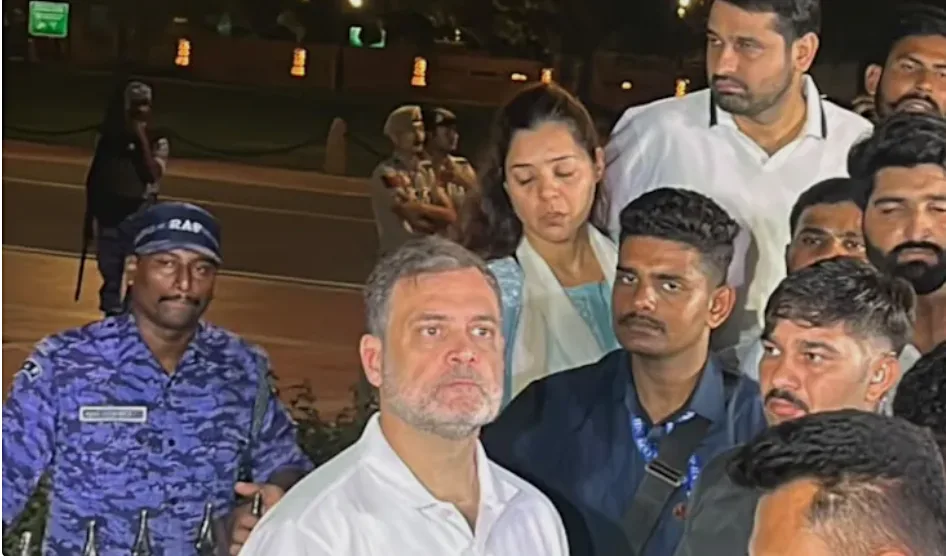
Rahul Gandhi joins India Gate protest by Ankita Bhandari’s parents
Rahul Gandhi joined the protest by Ankita Bhandari’s parents at India Gate in New Delhi on October 14. The demonstration has brought renewed attention to the 2022 murder case and the family’s concerns following Dushyant Gautam’s appointment as Sikkim Governor.
India News
Meerut murder: Muskaan Rastogi and Sahil Shukla get death sentence
A Meerut court has sentenced Muskaan Rastogi and Sahil Shukla to death in the blue drum murder case involving the killing of merchant navy officer Saurabh Rajput in March 2025.

CJP leaders Saurav Das, Ashutosh Ranka, Ajinkya Shinde sent to 5-day judicial custody

S Jaishankar says India is a natural option for Russia amid Europe tensions

PM Modi speaks to Mark Carney as India and Canada push to strengthen ties

Meerut murder: Muskaan Rastogi and Sahil Shukla get death sentence

Rahul Gandhi joins India Gate protest by Ankita Bhandari’s parents

Supreme Court questions EC over missing records in Sringeri election dispute
Rahul Gandhi joins India Gate protest by Ankita Bhandari’s parents
Meerut murder: Muskaan Rastogi and Sahil Shukla get death sentence
PM Modi speaks to Mark Carney as India and Canada push to strengthen ties
S Jaishankar says India is a natural option for Russia amid Europe tensions

Afghan Men Try To Hang With The Jet Engine Of The Aircraft in Kabul- Afghanistan News – Kabul News
Trending Top 10 News: 10000 Crore Fine on Flipkart, Apple to Launch Unique Feature, Hdfc Bank Job Ad

Trending Top 10 News: Nokia 6310, Apple sales, Bachpan ka Pyar Video Kid, Dainik Bhaskar IT Raid

Trending Top 10 News: Canada bans Indian flights, Rain in Delhi NCR, AIMIM Twitter hacked, Raj Kundra case

Trending Top 10 News: Shein India, Apple New Service, Pocket Oxygen, Oppo Launched New Phone
-
 India News22 hours ago
CJP leaders Saurav Das, Ashutosh Ranka, Ajinkya Shinde sent to 5-day judicial custody
-
 Latest world news22 hours ago
S Jaishankar says India is a natural option for Russia amid Europe tensions
-
 India News21 hours ago
PM Modi speaks to Mark Carney as India and Canada push to strengthen ties
-
 India News11 hours ago
Meerut murder: Muskaan Rastogi and Sahil Shukla get death sentence
-
 India News10 hours ago
Rahul Gandhi joins India Gate protest by Ankita Bhandari’s parents
-
 India News9 hours ago
Supreme Court questions EC over missing records in Sringeri election dispute
