English हिन्दी
Connect with us

Latest Politics News

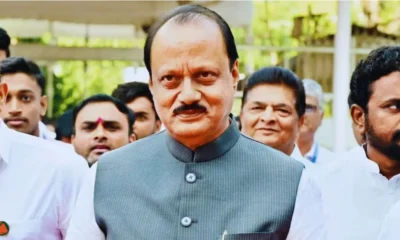
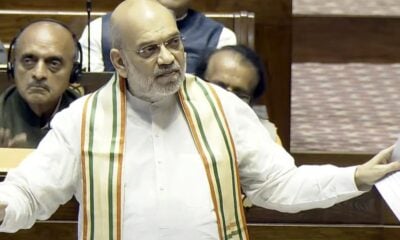
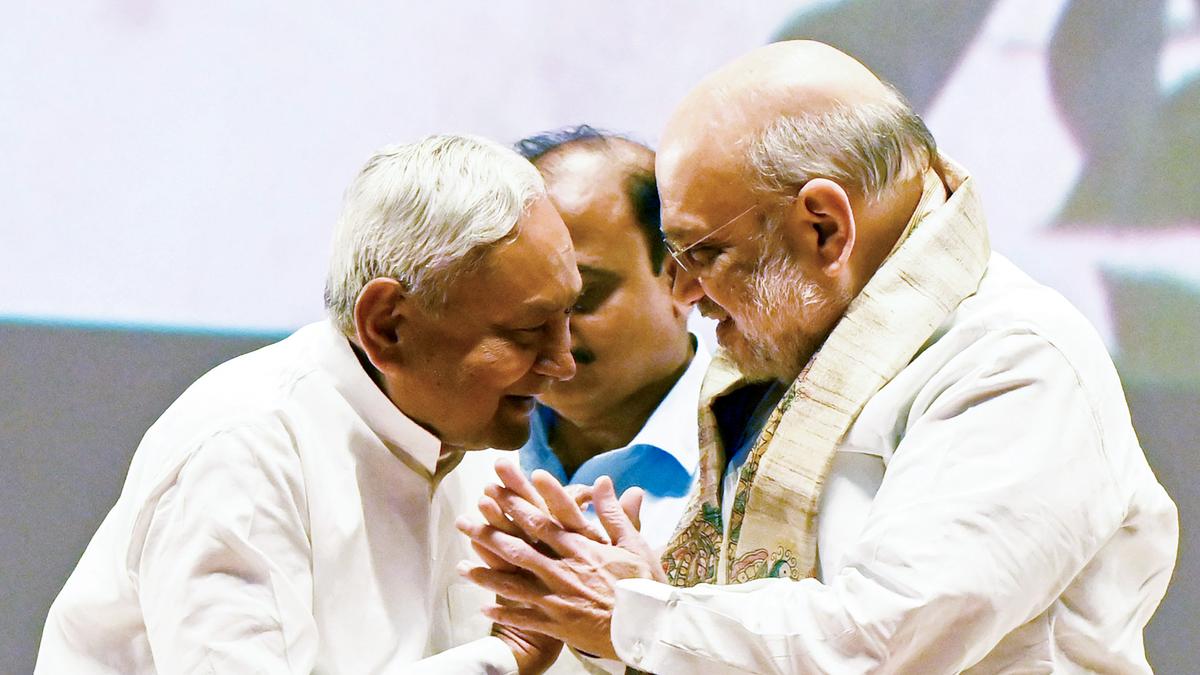
In Patna, Nitish Kumar tells Amit Shah he will never break-up again with BJP

As the political landscape in Bihar intensifies with elections just months away, Kumar’s comments reflect a renewed commitment to the ruling coalition.

Published

on

Bihar Chief Minister Nitish Kumar assured Union Home Minister Amit Shah on Sunday that he would “never again” part ways with the BJP, referencing his previous separations as “mistakes.”

This came during an event in Patna, where both leaders announced various projects benefiting both the Centre and the State amid an impending Assembly election season.

As the political landscape in Bihar intensifies with elections just months away, Kumar’s comments reflect a renewed commitment to the ruling coalition.
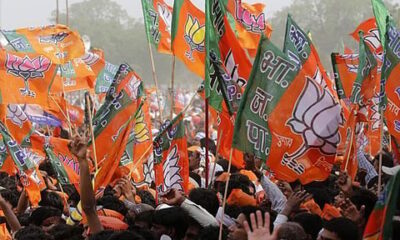
Shah, who has been instrumental in the BJP’s strategy nationwide, had addressed party workers late Saturday night. He reportedly emphasized that “our victory in Bihar will resonate far and wide,” underscoring the significance of Bihar to the BJP’s broader electoral ambitions.

Shah’s visit, anticipated to conclude with a strategic discussion at Kumar’s residence involving other National Democratic Alliance (NDA) partners, showcased his rapport with the Chief Minister.

During the event held in Patna, Kumar appeared enthusiastic, mentioning the large turnout: “This grand auditorium is filled beyond capacity.”

The gathering also highlighted the robust presence of BJP supporters, as chants of “Jai Shri Ram” filled the hall. Despite the religious undertones, Kumar maintained his commitment to his secular image, stating, “What did the previous government [RJD-Congress alliance] achieve? They secured Muslim votes but failed to prevent communal riots.”

Moreover, Kumar criticized the state of affairs prior to the JD(U)-BJP regime, asserting that Bihar lacked quality healthcare and educational facilities. He reminisced about his ascent to power in November 2005, attributing improved conditions to the JD(U)-BJP partnership.

Kumar’s political journey with the BJP has seen tumultuous shifts; he first parted ways with the party in 2014 but realigned in 2017. After another separation in 2022, he sought to unify regional parties against the BJP under the newly formed INDIA coalition. However, as the Lok Sabha elections approached last year, he made a surprising return to the NDA.

In his address, Kumar attributed his past split decisions to “some individuals within my party” and firmly declared his resolve, stating, “I made a mistake twice, but that will not happen again.” This statement aligns with his aim to solidify the JD(U)’s role within the NDA as the political stakes rise in Bihar.

India News

Shashi Tharoor warns US tariffs on Iran could make Indian exports unviable

Shashi Tharoor has warned that cumulative US tariffs linked to Iran trade could rise to 75%, making most Indian exports to America commercially unviable.

Published

on

Shashi Tharoor

Congress MP and chairman of the Standing Committee on Foreign Affairs Shashi Tharoor has expressed serious concern over the United States’ latest tariff announcement targeting countries that continue to trade with Iran, warning that such measures could severely impact Indian exporters.

Reacting to the decision by US President Donald Trump to impose a 25% tariff on countries doing business with Iran, Tharoor said Indian companies would struggle to remain competitive if cumulative tariffs rise to 75%. He noted that India was already at a disadvantage compared to several regional competitors.

Tharoor said he had been troubled by the US tariff regime from the outset, pointing out that India was initially subjected to a 25% tariff while rival exporting nations in Southeast Asia were charged significantly lower rates. According to him, countries such as Vietnam, Thailand, Indonesia, Pakistan and Bangladesh faced tariffs ranging between 15% and 19% on labour-intensive goods exported to the US.

He explained that the situation had worsened with additional sanctions-linked duties. With the existing 25% tariff, another 25% related to Russia-linked sanctions, and a further 25% tied to Iran-related measures, the total burden could rise to 75%. At that level, Tharoor said, most Indian exports would no longer be commercially viable in the American market.

While noting that certain sectors such as pharmaceuticals may continue to export as they are not heavily impacted by sanctions, he warned that other key export categories would be hit hard. Tharoor described the situation as very serious and said it required urgent attention.

The Congress MP also expressed hope that the newly appointed US Ambassador could help facilitate progress on a bilateral trade agreement. He stressed that India could not afford to wait through the entire year for a deal and said an agreement should ideally be concluded in the first quarter of 2026.

Commenting on recent diplomatic engagements between India and the US, Tharoor underlined the need for faster consensus on trade issues. He said that at tariff levels as high as 75%, the idea of a meaningful trade deal loses relevance. According to him, a rate closer to what the UK enjoys with the US, around 15%, would reflect the respect due to a strategic partner.

Tharoor’s remarks come after President Trump announced that any country continuing business with Iran would face a 25% tariff on all trade with the United States, a move that has raised concerns among several trading partners.

Continue Reading

India News

Maharashtra civic body polls today with focus on Mumbai and Pune

Maharashtra is voting today in civic body elections across 29 municipal corporations, with the BMC and Pune polls seen as crucial political tests.

Published

on

Voting is underway today for civic body elections across Maharashtra, covering 29 municipal corporations, with Mumbai and Pune emerging as the main political battlegrounds. The polls, being held after a long delay, are widely seen as a crucial test of political strength and identity ahead of larger state and national contests.

Polling began at 7.30 am for a total of 2,869 seats across 893 wards in the 29 civic bodies. The elections are taking place years after the scheduled term of most municipal corporations ended between 2020 and 2023. Voting will continue until 5.30 pm, while counting of votes is scheduled to begin at 10 am on January 16.

BMC election draws maximum attention

The Brihanmumbai Municipal Corporation (BMC), India’s richest civic body, remains the centre of attention. Unlike other corporations, the BMC follows a single-member ward system, meaning each voter casts only one vote. In the remaining 28 civic bodies, wards have three to five seats, requiring voters to cast multiple votes.

The BMC poll is particularly significant for the Thackeray brothers, Uddhav and Raj, who have come together in its backdrop after two decades. The election is seen as an opportunity for them to reassert their claim as political heirs of Bal Thackeray and revive their influence in Mumbai, a city long governed by the undivided Shiv Sena.

Test of Marathi identity politics

The elections are also being closely watched as a test of the “Marathi Manoos” plank. Rooted in the Samyukta Maharashtra movement of the 1950s and shaped politically by Bal Thackeray, the Marathi identity has remained a defining feature of Mumbai’s politics and a core theme for the Thackeray-led parties, particularly the Maharashtra Navnirman Sena.

BJP-Shinde alliance and NCP in fray

For Chief Minister Eknath Shinde, who split the Shiv Sena in 2022, the civic polls offer a chance to regain lost ground and reinforce his claim as Bal Thackeray’s political successor. His alliance partner, the BJP, is contesting 137 of the BMC’s 227 seats, while the Shinde-led Sena is contesting the remaining 90. The BJP, which won 82 seats in the last BMC election in 2019, is aiming to significantly improve its tally.

Meanwhile, Ajit Pawar’s faction of the Nationalist Congress Party is contesting the polls independently after differences with the BJP over leadership issues. The party is hoping to regain influence, especially in Pune, where the undivided NCP had controlled the civic body for a decade between 2007 and 2017.

With high political stakes, delayed polls and shifting alliances, today’s civic elections are expected to offer clear signals about Maharashtra’s evolving political landscape.

Continue Reading

India News

Karnataka to convene joint legislature session over MGNREGA repeal

The Karnataka government will convene a joint session of the legislature from January 22 to discuss the Centre’s repeal of MGNREGA, triggering sharp criticism from the opposition.

Published

on

karnataka assembly

The Karnataka cabinet on Wednesday decided to convene a joint session of the state legislature from January 22 to January 31, with the Centre’s decision to repeal the Mahatma Gandhi National Rural Employment Guarantee Act (MGNREGA) set to be the key focus.

The Congress-led government had earlier planned a two-day special session to discuss the repeal of MGNREGA, which has been replaced by the Viksit Bharat Guarantee for Rozgar and Ajeevika Mission (Gramin) (VB-G RAM G). However, State Law and Parliamentary Affairs Minister H K Patil said the plan was altered due to constitutional provisions.

Briefing reporters, Patil said the government was compelled to convene a joint session instead of a special session because of a technical requirement. Citing Article 176 of the Constitution, he explained that the Governor must address the first session of the state legislature every year.

“As a result of this technical reason, we are advancing the session. Instead of a special session, it will be a joint session,” Patil said, adding that holidays during the session would be announced by the Speaker.

He stressed that the state government would not remain silent if people’s rights were “snatched away” and said the objective of the session was to create public awareness and exert pressure on the Centre to restore MGNREGA.

Opposition questions intent of the session

Leader of Opposition in the Karnataka Assembly R Ashoka strongly criticised the decision, alleging that the joint session was convened with a “malafide intention” and amounted to a “sheer waste of money”.

Addressing a press conference, Ashoka said legislative sessions were meant for law-making and discussions on governance issues, questioning the purpose of holding a session on a matter decided by the Centre.

“What is this session convened for? Is it to utter gibberish in the House? There is no use of this session,” he said, adding that any resolution passed by the Assembly would have no practical value and would be ignored.

Continue Reading

Trending

© Copyright 2022 APNLIVE.com