English हिन्दी
Connect with us

Latest Politics News

RS protests: Jaitley says Modi didn’t question Manmohan Singh’s commitment to nation

Published

on

RS protests: Jaitley says Modi didn’t question Manmohan Singh’s commitment to nation
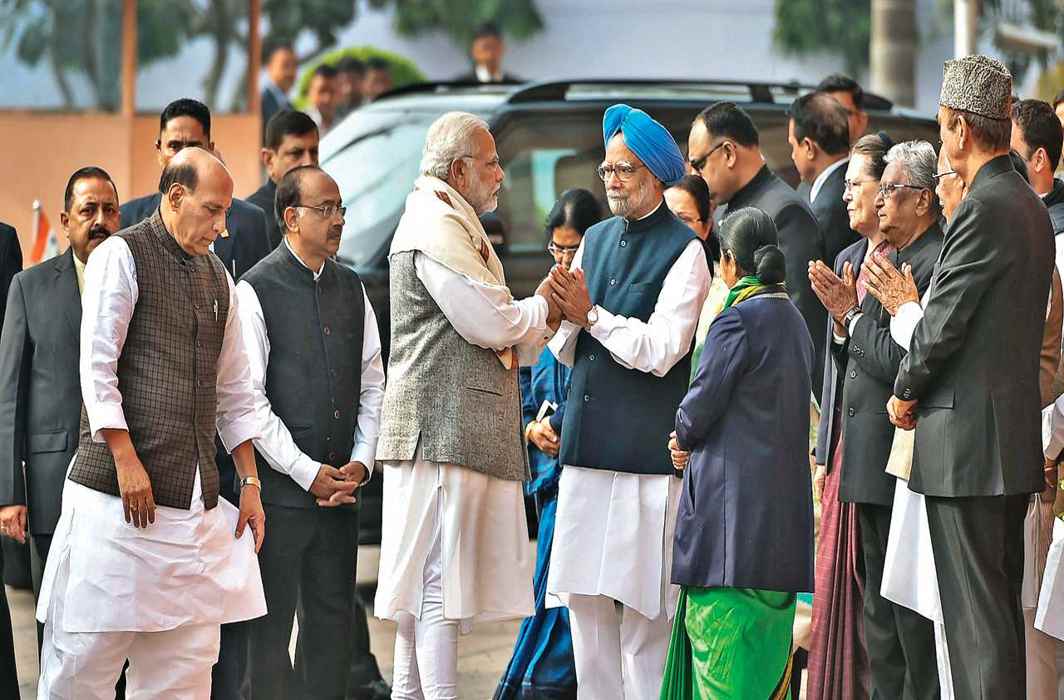
BJP goes on the defensive to broker peace with Congress-led Opposition, apologises on behalf of Modi while distancing from Hegde’s comments

 An end to the protests that have stalled Parliament proceedings, particularly in the Rajya Sabha, ever since the winter session began on December 15, was in sight on Wednesday. Union finance minister Arun Jaitley told the Upper House that Prime Minister Narendra Modi did not mean to question his predecessor, Dr Manmohan Singh, or former Vice President Hamid Ansari’s commitment to the nation.

 The submission by Jaitley, who is also the Leader of the House in Rajya Sabha, comes after Opposition members forced a wash out of the past six sittings of the Upper House demanding an apology from Prime Minister Narendra Modi for suggesting during the election campaign for Gujarat Assembly that Dr Singh, Ansari and the Congress party was ‘conspiring with Pakistan’ to oust the BJP from Gujarat.

 Modi’s statement – unsubstantiated as it was – had been squarely slammed by Dr Singh, who had accused the Prime Minister of “spreading falsehoods and canards”. Other dignitaries who were present at the said meeting – a dinner hosted at the residence of suspended Congress leader Mani Shankar Aiyar on December 6 for former Pakistan foreign minister Khurshid Kasuri – too had rubbished Modi’s allegation and said that there was no discussion on the Gujarat polls at the event.

 Modi’s studied silence on the controversy had only agitated the Opposition members further and they protested, demanding an apology from the Prime Minister, when the Parliament’s winter session began on December 15. The uproar had led to a logjam that has already consumed six sittings of the curtailed winter session which only has 15 working days to transact its legislative business.

 On Wednesday, the Treasury Benches facing heat from the Opposition over another controversial remark – Union Skill Development Minister Anant Kumar Hegde’s claim of the BJP being elected to power “to change the Constitution” and his assertion that “secularists do not know their parentage” – were forced to go on the defensive.

 With the Opposition resolute in its demand for an apology from Modi for his comments against Dr Singh and for the resignation of Hegde from the Union council of ministers, the Centre finally gave in.

 Union minister of state for parliamentary affairs, Vijay Goel told the Rajya Sabha that his party and its government was “committed to uphold the Constitution” and that Hegde’s comments found no resonance in the saffron fold – a view later also reiterated by his senior minister Ananth Kumar in the Lok Sabha. Jaitley came to the Rajya Sabha when it reconvened – after multiple adjournments earlier in the day – at 2pm and tendered his ‘half-apology’ on behalf of Modi.

 “Prime Minister in his speeches didn’t question, nor meant to question the commitment to this nation of either former PM Manmohan Singh or former Vice President Hamid Ansari, any such perception is erroneous, we hold these leaders in high esteem, as well as their commitment to India,” Jaitley told the Rajya Sabha.

 That the thaw was now ending was evident in Leader of Opposition in the Rajya Sabha, Ghulam Nabi Azad’s response to Jaitley. “I thank the Leader of the House for (the) clarification on what has been an issue of contention. I, on behalf of my party, say that we disassociate from any comments made by any member during elections that may have hurt the PM’s dignity… also we don’t want any such thing to be said in the future,” Azad said.

 Azad’s mention of “disassociating” from comments made by Congress leaders against Modi during the Gujarat election campaign was a veiled reference to Mani Shankar Aiyar’s contentious jibe directed at the Prime Minister, who he had called a “neech kisam ka insaan” (low-level human). Aiyar’s comment had drawn an immediate rebuke from Congress president Rahul Gandhi, who had asked him to apologise for the statement hours before the Congress suspended Aiyar from primary membership of the party. Aiyar’s comment, many believe, had cost the Congress dear in the Gujarat polls – which it lost narrowly to the BJP – after Modi chose to use it in his favour by alleging that the Congress veteran had mocked him for belonging to a “neech jaati” (low caste).

 With Jaitley issuing his half-apology and Azad accepting it, the stalemate seemed to have ended, at least in the Rajya Sabha. The Upper House then began debating the Indian Forest (Amendment) Bill, 2017 which was moved for consideration and passing.

 In the Lok Sabha, however, the stalemate continued longer with Congress-led Opposition parties demanding an apology from Hegde. The Lower House of Parliament, in which the BJP enjoys a brute majority, did manage to pass the crucial National Capital Territory of Delhi Laws (Special Provisions) Second (Amendment) Bill, 2017 amid din much to the chagrin of Opposition members who even criticised Lok Sabha Speaker Sumitra Mahajan for condoning the practice of allowing the Treasury Benches to have key Bills passed without proper discussion and amid uproar.

India News

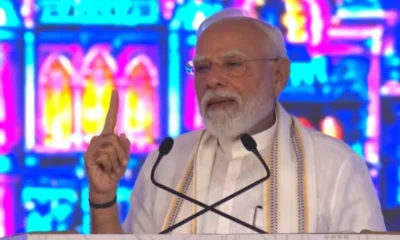
PM Modi assures no discrimination in women’s quota, delimitation debate intensifies in Parliament

PM Narendra Modi has assured that women’s reservation will be implemented without discrimination, amid a heated debate over delimitation in Parliament.

Published

on

PM modi

Prime Minister Narendra Modi has assured that there will be no discrimination in the implementation of women’s reservation, as Parliament witnessed a sharp debate over the proposed linkage between the quota and delimitation exercise.

During the ongoing special session, the government reiterated its commitment to ensuring fair representation while addressing concerns raised by opposition parties regarding the timing and structure of the legislation.

The proposed framework aims to reserve 33 percent of seats for women in the Lok Sabha and state assemblies. However, its implementation is tied to a fresh delimitation exercise, which is expected after the next census.

Opposition questions timing and intent

Opposition leaders have raised concerns that linking the women’s quota to delimitation could delay its implementation. They argue that the process of redrawing constituencies may push the actual rollout further into the future.

The issue has triggered a broader political confrontation, with multiple parties questioning whether the move could alter representation across states.

Some critics have also alleged that the delimitation exercise could disproportionately benefit certain regions based on population, a charge the government has rejected.

Government reiterates commitment to fair implementation

Responding to these concerns, the Centre has maintained that the reforms are necessary to ensure accurate and updated representation based on population data.

Leaders from the ruling side have repeatedly emphasized that the process will be carried out transparently and without bias. The assurance that there will be “no discrimination” is aimed at addressing fears among states and opposition parties.

The debate marks a key moment in Parliament, with both sides engaging in intense exchanges over one of the most significant electoral reforms in recent years.

Continue Reading

India News

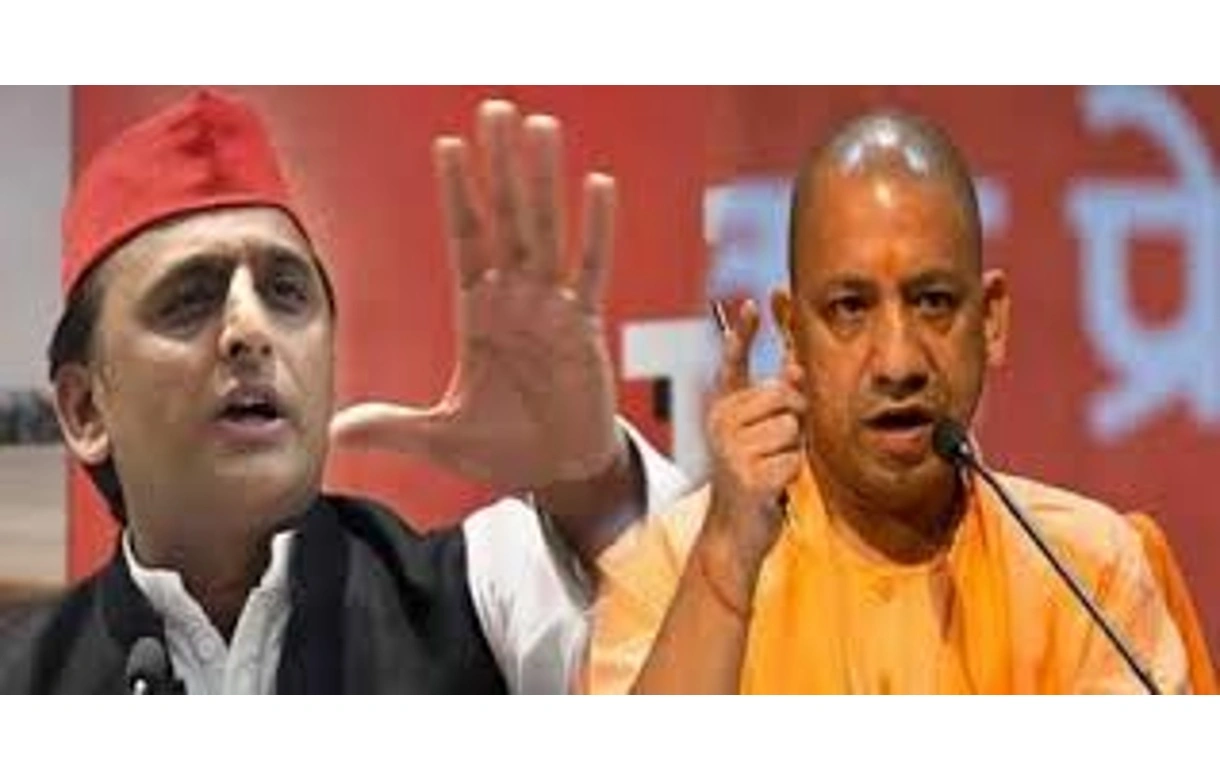
Give all tickets to Muslim women, Amit Shah says, attacking Akhilesh Yadav on sub-quota demand

A sharp exchange between Amit Shah and Akhilesh Yadav in Parliament over sub-quota for Muslim women highlights key divisions on women’s reservation implementation.

Published

on

A heated exchange broke out in Parliament during discussions on the women’s reservation framework, with Union Home Minister Amit Shah and Samajwadi Party chief Akhilesh Yadav locking horns over the demand for a sub-quota for Muslim women.

The debate unfolded as the government pushed forward key legislative measures to implement 33% reservation for women in the Lok Sabha and state assemblies.

Akhilesh Yadav argued that the proposed reservation must ensure representation for women from marginalised communities, including Other Backward Classes (OBCs) and Muslim women. He said that without such provisions, large sections could remain excluded from political participation.

He also questioned the timing of the bill, alleging that the Centre was avoiding a caste census. According to him, a census would lead to renewed demands for caste-based reservations, which the government is reluctant to address.

Government rejects religion-based quota

Responding to the demand, Amit Shah made it clear that reservation based on religion is not permitted under the Constitution.

He stated that any proposal to provide quota to Muslims on religious grounds would be unconstitutional, firmly rejecting the idea of a separate sub-quota for Muslim women within the broader reservation framework.

The government has maintained that the existing framework already includes provisions for Scheduled Castes (SC) and Scheduled Tribes (ST) women within the overall reservation structure.

Wider political divide over implementation

The issue of sub-categorisation within the women’s quota has emerged as a major flashpoint, even as most opposition parties broadly support the idea of women’s reservation.

Samajwadi Party leaders reiterated that their support for the bill depends on inclusion of OBC and minority women, while the government continues to defend its constitutional position.

The debate is part of a broader discussion during the special Parliament session, where multiple bills linked to delimitation and implementation of the women’s quota are being taken up.

Continue Reading

India News

Raghav Chadha’s security withdrawn by Punjab amid AAP rift, Centre steps in with cover

Punjab withdraws Raghav Chadha’s security amid party tensions, Centre offers fresh protection.

Published

on

The Punjab government has withdrawn the Z+ category security cover provided to Raghav Chadha, amid an ongoing rift within the Aam Aadmi Party.

According to sources, the security personnel deployed by Punjab Police have been asked to report back, marking a significant development in the political dispute involving the Rajya Sabha MP.

The move comes shortly after Chadha was removed from his position as deputy leader of the party in the Rajya Sabha, signalling deepening differences between him and the party leadership.

Centre offers fresh security arrangement

Soon after the withdrawal, the Ministry of Home Affairs stepped in to provide security cover to Chadha.

Sources indicate that he will now receive Z-category security in Delhi and Punjab, while a Y-category cover may be provided in other parts of the country.

This shift ensures continued protection for the MP despite the withdrawal of state-provided security.

Fallout linked to political disagreement

The development is part of a broader fallout between Chadha and his party. He was recently replaced as deputy leader in the Rajya Sabha, with the party reportedly expressing dissatisfaction over his political approach and conduct in Parliament.

Chadha, however, has denied the allegations, calling them baseless and asserting that his focus has been on raising public issues rather than engaging in political confrontation.

Growing divide within party ranks

Once considered a close associate of Arvind Kejriwal and a prominent face of the party, Chadha’s recent removal from key roles and the withdrawal of his security underline a widening internal divide.

He is among the few leaders in the party who have recently found themselves at odds with the leadership, indicating shifting dynamics within the organisation.

Continue Reading

Trending

© Copyright 2022 APNLIVE.com