English हिन्दी
Connect with us

India News

Yogi Adityanath to meet PM Modi in Delhi today on new cabinet, new names surface for Deputy CMs

The BJP has prepared a basic list for the post of Deputy CM, in which, the names of Swatantra Dev Singh, Baby Rani Maurya, Brijesh Pathak and Keshav Prasad Maurya were included. The list was included probable deputy CMs and ministers on the basis of qualification, caste and regional equations.

Published

on

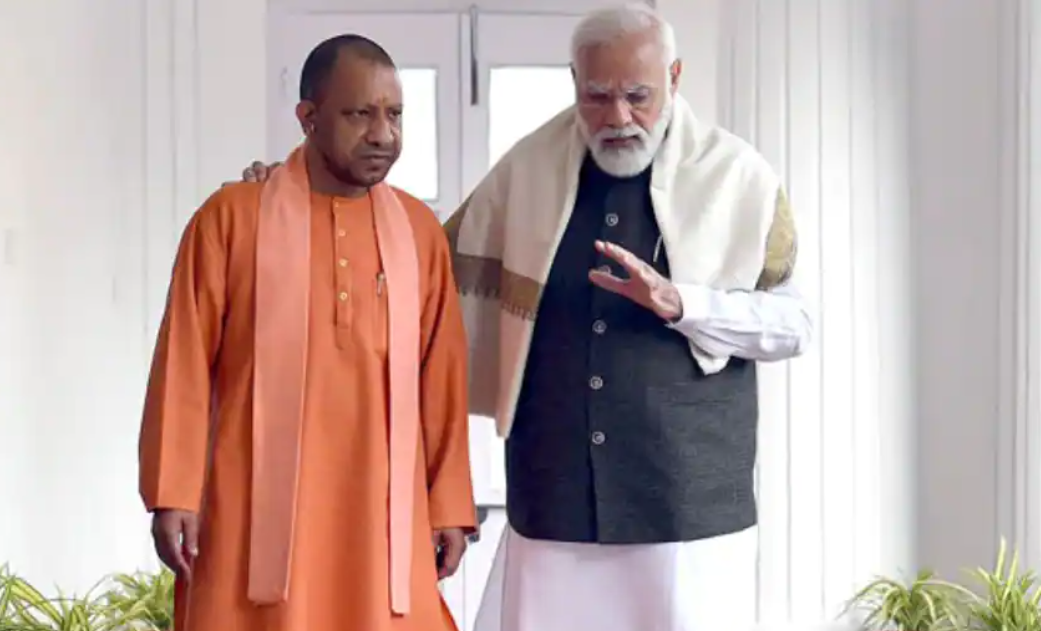
Days after the BJP’s massive victory in Uttar Pradesh, Chief Minister Yogi Adityanath will arrive in Delhi to meet Prime Minister Narendra Modi at 5 pm to discuss UP’s new cabinet. The BJP President JP Nadda, Home Minister Amit Shah, Vice President M Venkaiah, Defence Minister Rajnath Singh and party General Secretary BL Santosh will also attend the BJP’s top brass’ crucial meeting in Delhi. The swearing-in ceremony date will also be discussed in the meeting.

Adityanath will be accompanied by state president Ratan Dev Singh, Minister Sunil Bansal, state in-charge Radha Mohan Singh.

The BJP leadership has prepared a basic list for the post of Deputy CM, in which, the names of Swatantra Dev Singh, Baby Rani Maurya, Brijesh Pathak and Keshav Prasad Maurya were included. The list was included probable deputy chief Ministers and ministers on the basis of qualification, caste and regional equations. The BJP’s top leadership will take the decision on the list.
Apart from this list, the BJP is looking to consider some new faces in UP’s new cabinet. Besides the new faces, old leaders like Suresh Khanna, Brijesh Pathak and Keshav Prasad Maurya could also be part of the cabinet.

There were also talks of including two former police officers Rajeshwar Singh and Asim Arun in the new cabinet of Yogi Adityabnath 2.0 government.

Dr Rajeshwar Singh, a newly-elected MLA from Lucknow’s Sarojini Nagar seat, was an officer of Uttar Pradesh Police while the BJP MLA Aseem Arun, who won from Kannauj Sadar seat, was an ADG rank officer.

The Defence Minister Rajnath Singh’s son Pankaj Singh, who has won from Noida with a massive margin of 1.8 lakh votes, could also become a minister in Yogi Adityanath’s cabinet.

It was another challenge for the BJP to give chance to its allies Apna Dal and Nishad Party in the Yogi Adityanath’s new cabinet. The allies have won 12 and 6 seats respectively.

India News

US tariff cut to 18% is positive signal for Indian exporters, says Sitharaman

Nirmala Sitharaman says India’s exports could recover after the US reduced tariffs on Indian goods to 18%, restoring competitiveness in key sectors.

Published

on

Nirmala Sitharaman

India’s exports to the United States are expected to gain momentum following Washington’s decision to reduce tariffs on Indian goods to 18%, Finance Minister Nirmala Sitharaman said on Tuesday, describing the move as a “good auguring” for exporters.

Speaking in an interview to media, Sitharaman said the tariff reduction would help Indian exporters regain competitiveness in the US market, particularly after the sharp impact of punitive duties imposed last year.

“So, actually our exports will pick up now, that is my expectation,” she said, adding that exporters had also identified alternative markets during the period of elevated tariffs and would continue operating in them.

Tariff rollback brings relief after export setback

The US had imposed steep tariffs of up to 50% on Indian goods last year, which significantly raised landed costs and squeezed exporter margins. Several sectors, including steel, aluminium, textiles, engineering goods and certain agricultural products, were affected as US buyers diverted orders to other suppliers.

On Monday, US President Donald Trump announced a reduction in tariffs on Indian goods to 18% as part of a broader trade understanding. The agreement includes India lowering trade barriers and committing to stop purchases of Russian oil, instead sourcing energy from the US and potentially Venezuela.

On implementation, the revised tariff structure would bring duties on Indian exports broadly in line with other Asian economies, where rates range between 15% and 19%.

Improved competitiveness against regional rivals

The 18% tariff undercuts duties imposed on key regional competitors such as Vietnam and Bangladesh, which face tariffs of around 20%. This is expected to restore India’s price advantage in the US market.

Labour-intensive sectors such as apparel, footwear and jewellery are likely to see the most immediate benefit. These segments had witnessed a sharp fall in orders after the 50% tariffs imposed in August severely dented competitiveness.

Earlier in the day, Sitharaman described the development as “good news for #MadeInIndia products” in a social media post, noting that Indian goods would now face reduced duties in the US market.

Trade and capital flow impact

Earlier punitive tariffs had also weighed on bilateral trade. India’s trade surplus with the US shrank by an average of USD 2.5 billion per month between September and December 2025 compared to the January–August period, according to research cited in the report.

Investor sentiment had weakened as well, with foreign investors pulling out nearly USD 14 billion in equities since July 2025.

The rollback of the additional 25% punitive tariff linked to Russian oil purchases effectively lowers the applied tariff on Indian exports from 50% to 18%, offering significant relief to exporters and improving prospects for a recovery in trade flows.

Continue Reading

India News

Rahul Gandhi, Centre clash over Ladakh deepens as eight Congress MPs suspended

The Lok Sabha saw repeated disruptions after Rahul Gandhi was denied permission to speak on the Ladakh issue, leading to protests and the suspension of eight Congress MPs.

Published

on

Chaos engulfed the Lok Sabha on Tuesday as tensions between the opposition and the ruling Bharatiya Janata Party intensified over Congress leader Rahul Gandhi’s attempt to raise the issue of the India-China military standoff in Ladakh. The disruption eventually led to the suspension of eight Congress MPs for the remainder of the parliamentary session.

The confrontation unfolded after the Leader of the Opposition tried, for the second consecutive day, to read out excerpts from an unpublished book by former Army chief General M.M. Naravane that refer to the 2020 Ladakh crisis. The Speaker denied permission, citing procedural rules, triggering protests from opposition members.

Several MPs protested by refusing to speak when called upon, expressing solidarity with Gandhi. The uproar forced repeated adjournments of the House and, according to reports, involved members throwing pieces of paper towards the Chair.

Following the disorder, eight Congress MPs — including Hibi Eden, Amarinder Raja Warring and Manickam Tagor — were suspended. Warring later questioned the action, saying the protests were in response to Gandhi being denied the opportunity to speak despite having authenticated the document and submitted it to the House.

The BJP strongly criticised the Congress leadership. Party MP Anurag Thakur accused Rahul Gandhi of undermining Parliament and insulting the armed forces, alleging that the opposition was attempting to distract from recent government actions, including the presentation of the Union Budget. He also said the BJP would move a formal complaint seeking strict action against the suspended MPs.

Outside Parliament, Gandhi accused the ruling party of trying to silence him, saying he was prevented from speaking on the sensitive issue of the India-China border. He argued that he had followed procedure by authenticating the content he wished to quote but was still denied permission.

What happened a day earlier

On Monday, the Speaker had also disallowed Gandhi from reading the excerpts, with senior ministers countering his remarks during the debate. Government sources later maintained that the Congress leader violated House rules by attempting to introduce unpublished material into the official record without prior approval.

When proceedings resumed on Tuesday, Gandhi again raised the matter, insisting that the information had been authenticated. As the Speaker moved on to other members, two opposition MPs from the Samajwadi Party and Trinamool Congress declined to speak, signalling their support for him.

Rahul Gandhi targets India-US trade deal

Separately, Gandhi also criticised Prime Minister Narendra Modi over what he described as a lack of transparency surrounding the India-US trade deal. He questioned how negotiations that had reportedly remained unresolved for months were concluded overnight and alleged that the agreement compromised the interests of Indian farmers, particularly in agriculture and dairy.

Government sources, however, rejected these claims, stating that sensitive sectors would remain protected and that the deal does not undermine farmers’ interests. They said contentious issues, including market access, had been carefully handled.

The opposition has demanded full disclosure of the terms of the agreement, even as both sides continue to trade sharp political accusations inside and outside Parliament.

Continue Reading

India News

Mamata Banerjee alleges mass voter deletions in Bengal, targets Election Commission

Mamata Banerjee has accused the Election Commission of deleting thousands of voter names without due process, raising questions over the timing of the exercise ahead of elections.

Published

on

Mamata Banerjee

West Bengal Chief Minister Mamata Banerjee on Monday intensified her attack on the Election Commission over voter roll revisions, alleging that a large number of names have been deleted without due process as the state heads towards elections.

Addressing party workers, Banerjee claimed that 40,000 voters’ names were removed from her constituency alone, alleging that the deletions were carried out unilaterally and without giving voters a chance to be heard.

“In my constituency they have deleted 40,000 voters’ names unilaterally… Even a murderer gets a chance to defend himself,” she said.

Allegations against election officials

The chief minister directly accused an election official, alleging political bias and irregular conduct in the revision process. She claimed that voter names were being removed while officials sat in Election Commission offices, calling the process illegal.

“They cannot do it, it is illegal. 58 lakh names have been unilaterally deleted,” she said, echoing claims earlier made by Trinamool Congress leader Abhishek Banerjee.

Banerjee also alleged that individuals described as “micro-observers” had been appointed illegally, claiming they had no role under the Representation of the People Act and were linked to the BJP.

‘Alive but marked dead’

In a dramatic moment during her address, the chief minister asked those present who had been marked as deceased in the voter lists to raise their hands.

“See, they are alive but as per the Election Commission they are dead,” she said.

She further alleged that names were being deleted under the category of “logical discrepancy,” adding that even noted economist and Nobel laureate Amartya Sen had earlier been questioned regarding the age of his mother.

Questions over timing of voter roll exercise

While stating that she did not oppose the Special Intensive Revision process in principle, Banerjee questioned the timing of the exercise.

“I have no problem with SIR, but why do it on the eve of elections? Why not after elections?” she asked.

Reiterating confidence in her party’s organisational strength, the chief minister said she was prepared to fight the issue politically and democratically.

Continue Reading

Trending

© Copyright 2022 APNLIVE.com