English हिन्दी
Connect with us

Top Stories

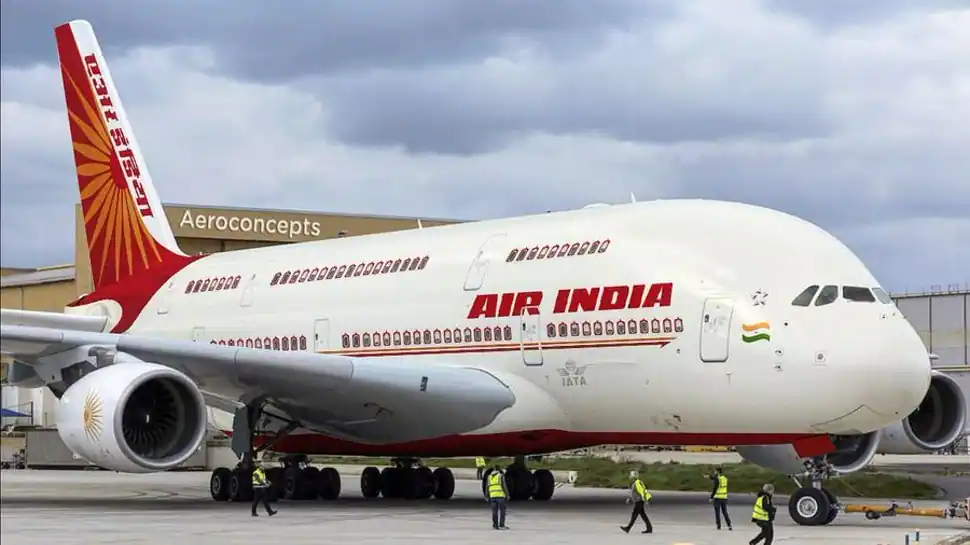
Air India flight makes emergency landing at Stockholm after oil leakage, says to send ferry plane to bring stranded passengers

Air India making headlines for all the wrong reasons lately. From leaving passengers behind to losing their path in mid-air, the airlines does it all recently.

Published

on

Air India flight

Air India making headlines for all the wrong reasons lately. From leaving passengers behind to losing their path in mid-air, the airlines does it all recently. Now, again the biggest carrier in the country reported yet another incident, where a Boeing 777-300 ER flight from America’s Newark to Delhi was diverted and had to make an emergency landing at Sweden’a capital Stockholm on Wednesday after it reported an old leakage from one of its engines.
Now, the firm has taken a big decision regarding the same. One of the spokespersons from Air India has said that it will send ferry flights to bring back stranded passengers. He said the ferry flight has been arranged and will be operated with Boeing 777 aircraft which will take off from Mumbai at around 2 pm and is expected to reach Stockholm at 11 pm (IST).

Read Also: Conman Sukesh Chandrasekhar in tears during raid in cell; authorities recover Rs 1.5 lakh Gucci sandals, jeans worth Rs 80K | WATCH

The Directorate General of Civil Aviation (DGCA ) also expressed concern in the matter and said the engine was shut down and the aircraft later made an emergency landing in Stockholm due to some technical fault and oil leakage. In a statement late Wednesday evening, an Air India spokesperson said the airline is in talks with the Swedish authorities to get immigration clearance approved for some of the passengers, who were still at the airport.

The report says that the plane was carrying 292 passengers on board the Newark-Delhi flight, including 8 infants, 15 cabin crew members, and 4 pilots. However, the flight had landed safely.

Meanwhile, this is not the first time such an incident has been reported by Air India. Earlier, a plane from New York to Delhi also diverted to London because of a medical emergency. Report said that soon after the landing, the person had to rush to the hospital at Heathrow airport which caused a delay of a few of hours before arriving at its final destination.  

Railways cancel over 450 trains, reschedule and divert around 100 trains, check full list here

Video of Delhi cop singing Bollywood song goes viral, singer Amaan Malik reacts | WATCH

India News

External Affairs Minister S Jaishankar and US Secretary of State Marco Rubio review global strategic partnership amid regional conflicts

n a high-stakes meeting in New Delhi, External Affairs Minister S Jaishankar defined India’s multi-alignment stance on West Asia, while US Secretary of State Marco Rubio declared the two nations as global strategic allies.

Published

on

S Jayshankar Marco Rubio meet

External Affairs Minister S Jaishankar and visiting US Secretary of State Marco Rubio held comprehensive delegation-level talks in New Delhi, emphasizing that the relationship between the two nations remains strong, strategic, and far-reaching. Addressing a joint press conference at Hyderabad House, both leaders rejected suggestions that the bilateral partnership has lost momentum, outlining instead a shared vision for global cooperation.

India outlines ‘multi-alignment’ stance on West Asia conflict

During the high-level discussions, the ongoing conflict in West Asia emerged as a key focal point. Addressing the media, External Affairs Minister S Jaishankar stated that India continues to maintain robust and stable relationships with all key stakeholders in the region, including the United States, Israel, Iran, and Gulf nations.

Jaishankar stressed that India approaches regional conflicts through a distinct policy of “multi-alignment”. He explicitly outlined India’s core operational priorities in West Asia:

  • Ensuring regional peace and stability
  • Safeguarding the welfare of the vast Indian diaspora living and working in the region
  • Maintaining lower energy prices to shield the domestic economy
  • Securing safe and uninterrupted maritime commerce through vital sea lanes

Global strategic allies extending beyond the region

Secretary Rubio strongly backed the depth of the partnership, asserting that the ties between Washington and New Delhi set themselves apart from standard global relationships.

“The US and India aren’t just allies. We are strategic allies and that’s of critical importance,” Rubio stated. “We obviously work with countries all over the world on a variety of issues, but our strategic partnership is what sets this relationship apart because it’s not simply limited to the region, it extends to offer opportunities to cooperate globally in different regions of the world.”

Rubio further revealed that their high-level deliberations, which included a working dinner, covered potential avenues for joint India-US cooperation in the Western Hemisphere and other global theaters.

Clarifications on immigration reforms and visa concerns

The joint press conference also touched upon critical people-to-people and diplomatic friction points. Responding to concerns flagged by media regarding the new US immigration rules—which require certain legal immigrants to leave the US before applying for permanent residency—Rubio reassured the Indian public that the overhaul is a global modernization effort and is not targeted at India.

He acknowledged the profound economic contributions made by Indian professionals and corporations to the American economy. Rubio attributed the policy changes to the broader migration challenges confronting the US, noting that the administration is modernizing the system to regulate how many people enter and when, admitting that the transition period could cause “some bumps”.

When questioned on isolated instances of online racism or prejudice faced by Indians, Rubio took a firm stance alongside Jaishankar. Branding such instances as “dumb” commentary, the top US diplomat remarked, “Every country in the world has stupid people. I’m sure there are stupid people here; there are stupid people in the United States who make dumb comments all the time.” He re-emphasized that the US remains a highly welcoming country whose fabric has been significantly enriched by immigrants from across the world.

Continue Reading

India News

Congress high command steps in to resolve Karnataka leadership impasse with crucial Delhi meeting

The Congress leadership, including Mallikarjun Kharge and Rahul Gandhi, is holding a vital meeting in Delhi with Karnataka Chief Minister Siddaramaiah to find a definitive solution to the state’s prolonged leadership impasse.

Published

on

The top leadership of the Congress party is scheduled to hold a high-level meeting at its headquarters in the national capital today morning to address the long-standing leadership dispute in Karnataka. Senior leaders, including party president Mallikarjun Kharge and MP Rahul Gandhi, will lead the discussions aimed at resolving the continuous friction between Chief Minister Siddaramaiah and Deputy Chief Minister DK Shivakumar.

The ongoing power struggle over the state’s top position has persisted since the party’s electoral victory in 2023. For the current session, only Chief Minister Siddaramaiah has been called to join the discussions in Delhi. When questioned about the agenda by reporters, the Chief Minister stated that he was unaware of the specific subjects to be discussed, noting that political speculation is inevitable.

Background of the internal division

The internal friction intensified significantly in November 2025 when the state government completed its two-and-a-half-year mark in office. Supporters of the Deputy Chief Minister pointed to a purported unacknowledged internal arrangement suggesting a rotational chief ministership split equally across the five-year term. Despite multiple prior interventions by central party leadership to manage the internal friction, a permanent resolution has remained elusive.

While Deputy Chief Minister DK Shivakumar has not been invited to this morning’s initial session, indications suggest that separate individual discussions and a potential joint meeting involving both leaders are planned as part of the broader resolution process. Observers note that several state ministers and legislators have also traveled to the national capital as the party leadership aims to settle the administrative roadmap and finalise leadership plans before the next assembly elections.

Continue Reading

Latest world news

US hits Iranian missile sites and mine-laying boats near Strait of Hormuz amid peace talks

US Central Command executed targeted strikes against Iranian missile launch sites and mine-laying vessels near Bandar Abbas, testing a fragile ceasefire even as high-stakes diplomatic talks continue in the region.

Published

on

In a major development testing a fragile regional ceasefire, the United States military carried out targeted strikes in southern Iran on Monday. The operation hit missile launch sites and vessels allegedly attempting to lay mines near the crucial Strait of Hormuz, according to statements from the US Central Command (CENTCOM).

The military action took place near Bandar Abbas, a prominent southern port city hosting a primary Iranian naval base. Media reporting indicated that explosions were heard across multiple coastal locations, including Sirik and Jask.

Focus on ‘Self-Defense’ Amid Active Ceasefire

A spokesperson for CENTCOM, Capt. Tim Hawkins, confirmed that the engagement was defensive in nature. “US forces conducted self-defense strikes in southern Iran today to protect our troops from threats posed by Iranian forces,” Hawkins stated. He noted that the operational targets included active missile launch sites alongside Iranian boats attempting to emplace naval mines. Despite the escalation, CENTCOM emphasized that it continues to exercise restraint under the parameters of the ongoing ceasefire brokered in early April.

According to media reports, the tactical response was triggered when two Islamic Revolution Guard Corps (IRGC) boats were detected laying mines in the strategic shipping lane. Additionally, a surface-to-air missile site reportedly targeted American warplanes, prompting US forces to neutralize both the vessels and the missile installations. Media channels citing local updates indicated that four individuals were killed in the strikes, though the complete casualty figures remain unverified.

Diplomatic Dialogue Continues in Parallel

The strikes coincide with a critical phase of diplomatic negotiations aimed at extending the current truce. Top Iranian negotiators traveled to Qatar early this week to discuss a potential 60-day extension of the ceasefire, alongside provisions to keep the Strait of Hormuz fully operational for global trade.

US officials maintain that the military action does not signal an end to the active truce. A senior administration source clarified that the specific operations are “over for now”. US Secretary of State Marco Rubio, speaking from India, affirmed that diplomatic channels remain open and active. Rubio stated that intensive language discussions regarding the initial documents are ongoing, reiterating that the opening of the strategic strait remains a core objective.

Meanwhile, political leaders in Washington have separately reiterated demands for the secured disposal or international transfer of enriched uranium stockpiles as part of any comprehensive long-term agreement.

Continue Reading

Trending

© Copyright 2022 APNLIVE.com