English हिन्दी
Connect with us

Top Stories

No more A for apple, B for boy: Telangana school’s new version to learn the alphabet

Published

on

A news has been reported from Telangana’s Hyderabad, where a school ditched the usual teaching of the Alphabet A for Apple, B for Ball and introduced an Indian version of it. For Vidya Bharathi High School, A is no longer Apple. Instead, they are teaching students to learn A for Arjuna, B for Balram, and C for Chanakya, D for Dhruva, E for Eklavya, F stands for Four Vedas, G for Gayatri, H for Hanuman, I for Indra and so on.

A Twitter user name Piyush Rai shared the alphabet chart, reportedly created by the school management on his official handle. In his post, the user also shared a caption where he wrote UP’s Lucknow has made some changes to how the alphabet will be taught in school. No more A for Apple. However, many tweeple corrected him in his post, saying the watermark in the photos clearly indicates the photos have been generated from Telangana’s Hyderabad, not UP’s Lucknow.

Take a look at the viral images of Telangana school where students are being taught A for Arjuna, B for Balram

In the post, it can be seen that the school management not only created a chart of alphabet meanings with mythical and historic figures but also gave a small description of them so that students understand better.

When the latest rule of teaching students the alphabet went viral on the internet, the school’s principal released a statement where he said that students do not have enough knowledge about Indian culture. In order to teach them the country’s culture, the school management decided to take this unique step to enhance their knowledge.

Seeing the new way of teaching, many Twitter users reshared the post and wrote their opinions about the same in the comment section. One of the users wrote that a divine intervention was needed to save Indian education. Another user wrote incredible Indian education system rocks again. While the third user showed concern about all 26 alphabets.

Latest world news

Iranian President Pezeshkian at UN says Iranians have been victims of US terrorism

Iranian President Masoud Pezeshkian said at the UN General Assembly that Iranians had been victims of US terrorism and insisted that Iran had acted in self-defence.

Published

on

Iranian President Masoud Pezeshkian accused the United States of subjecting Iranians to what he described as terrorism while addressing the United Nations General Assembly on Wednesday.

Pezeshkian said Iran had defended itself against attacks and rejected the characterisation of the country as a terrorist actor. His remarks came during a rare wartime appearance at the UN as tensions between Iran and the United States remain high.

Pezeshkian accuses US and Israel of attacks

Speaking at the General Assembly, Pezeshkian said Iranian civilians had been targeted by attacks and described the actions against his country as aggression.

“We have only defended ourselves. We are not terrorists,” he said, according to the report.

Pezeshkian also accused the United States and Israel of attacking Iran, while maintaining that Tehran’s response was an act of self-defence.

The Iranian president displayed photographs of former Supreme Leader Ali Khamenei and more than 150 schoolchildren who, according to his account, were killed during the early days of the conflict.

Iran’s message at the UN

Pezeshkian’s address came against the backdrop of the ongoing conflict between Iran and the United States and heightened tensions in the region.

Iranian officials had indicated ahead of the UN visit that they intended to highlight what Tehran considers attacks against its people and raise concerns over the international response to the conflict.

The Iranian delegation’s visit to New York also comes amid restrictions imposed by the United States on the delegation’s movement and other aspects of its stay, according to reporting ahead of the address.

Pezeshkian says Iran defended itself

Pezeshkian’s central message at the UN was that Iran’s military actions should be viewed as a response to attacks rather than terrorism.

His description of the conflict and the allegations against the United States and Israel represent the Iranian government’s position. They should therefore be attributed to Pezeshkian rather than presented as independently established facts.

Continue Reading

India News

BJP hits back at opposition over EC row, says disagreement is democracy

The BJP has defended reported differences among Election Commissioners, saying internal deliberations are part of a healthy democratic process.

Published

on

The BJP has defended the Election Commission amid a political row over reported differences among Election Commissioners concerning decisions linked to the Special Intensive Revision (SIR) of electoral rolls.

BJP MP Sambit Patra said discussions and exchanges of views within the poll panel should be seen as part of the democratic process rather than as evidence of institutional dysfunction.

According to the BJP’s position, disagreement during official deliberations reflects the fact that members of an institution are able to put forward their views before decisions are taken.

BJP defends EC deliberations

Patra said that if the three Election Commissioners discuss and debate issues among themselves, such exchanges should not be characterised as dictatorship. He described such deliberations as a sign of a healthy democracy.

The BJP’s response came amid reports that Election Commissioners Sukhbir Singh Sandhu and Vivek Joshi had raised objections on multiple occasions over decisions and orders associated with the SIR exercise and electoral rolls.

The Election Commission has said that differences in views and observations are a normal part of deliberations within an institution. It has maintained that decisions, including those related to SIR, were taken unanimously.

Row centres on SIR process

The controversy comes against the backdrop of the ongoing political debate over the Special Intensive Revision of electoral rolls.

Opposition parties have raised concerns over the reported differences within the poll panel, while the BJP has sought to counter those arguments by pointing to the role of discussion and deliberation in institutional decision-making.

Patra also said the BJP’s understanding of the matter was based on media reports rather than access to the Election Commission’s internal documents. He said the documents, as reported, indicated that the SIR process was finalised after democratic deliberations and consensus.

What the Election Commission has said

The Election Commission has rejected the suggestion that the reported objections indicate a breakdown in its functioning.

It has maintained that differing opinions during deliberations are part of normal institutional functioning and that the decisions eventually taken by the commission were unanimous.

Continue Reading

Latest world news

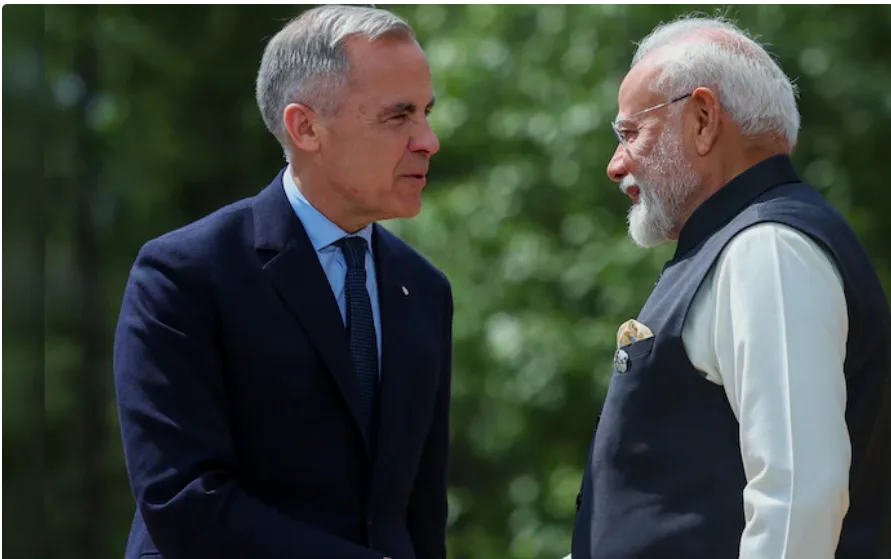
PM Modi’s Canada visit could help wrap trade talks, says Canada PM Mark Carney

Canadian PM Mark Carney said he is looking forward to hosting PM Narendra Modi, with both countries aiming to conclude their ongoing trade negotiations.

Published

on

Canadian Prime Minister Mark Carney has said he is looking forward to hosting Prime Minister Narendra Modi, as India and Canada continue efforts to advance their bilateral relationship and conclude ongoing trade negotiations.

The two countries have been working towards a Comprehensive Economic Partnership Agreement (CEPA), with both sides previously setting a target to conclude the negotiations in 2026.

Carney and Modi have held discussions on strengthening economic ties between India and Canada, including trade and investment. Their engagement has gained momentum following Carney’s visit to India earlier this year.

India-Canada trade talks

India and Canada formally resumed efforts towards a broader trade agreement after a period of strained bilateral ties. The two sides have committed to advancing negotiations on a CEPA covering their economic relationship.

In June, Carney and Modi reviewed progress in bilateral economic cooperation during their meeting on the sidelines of the G7 Summit in France. They expressed satisfaction with the progress in CEPA negotiations and reaffirmed their shared objective of concluding the talks in 2026.

During Carney’s visit to India in March, the two leaders had also agreed to accelerate negotiations on the CEPA and work towards finalising the agreement during 2026.

Modi’s proposed Canada visit

Carney had invited PM Modi to visit Canada in 2026, and the two leaders agreed to remain engaged through diplomatic channels to work towards a mutually convenient date for the visit.

The proposed visit comes as New Delhi and Ottawa seek to build on renewed diplomatic and economic engagement, with trade negotiations remaining a key part of the relationship.

The focus on completing the trade talks comes as both countries look to expand commercial ties and establish a broader economic framework through the proposed CEPA.

Continue Reading

Trending

© Copyright 2022 APNLIVE.com