
Latest world news
Canada rejects allegations on support to Sikh separatists


Calls Outlook story ridiculous
Canadian government was on Wednesday in “damage control mode” when its Indian born Defence Minister Harjit Sajjan called Outlook magazine’s accusations as “ridiculous” and “offensive” that Canada was complicit in rising the Sikh terrorism.
The controversy has triggered at a time when Canadian PM Justin Trudeau is scheduled to visit India from February 17 to 23. During his six day long trip, he will also visit Agra, Amritsar, Ahmedabad and Mumbai. Apart from his meetings with Indian leadership, he will participate in several business roundtables to promote trade and investment between the two countries.
The Canadian Defence Minister Harjit Sajjan and another Sikh minister Amarjit Sohi have made it clear that they neither sympathize with, nor espouse the Sikh nationalist movement demanding for a separate country called Khalistan within India’s Punjab region.
Sajjan said that the accusation is “ridiculous” and Canada is being “sucked into” internal Indian politics. He reportedly said on Wednesday, “I’ve been a police officer, I’ve served my country and any allegation like that is absolutely ridiculous and I find it extremely offensive as well.”
Outlook magazine, in its February 12 edition features a photo of Trudeau and a headline on the cover that reads, “Khalistan-II: Made in Canada.”
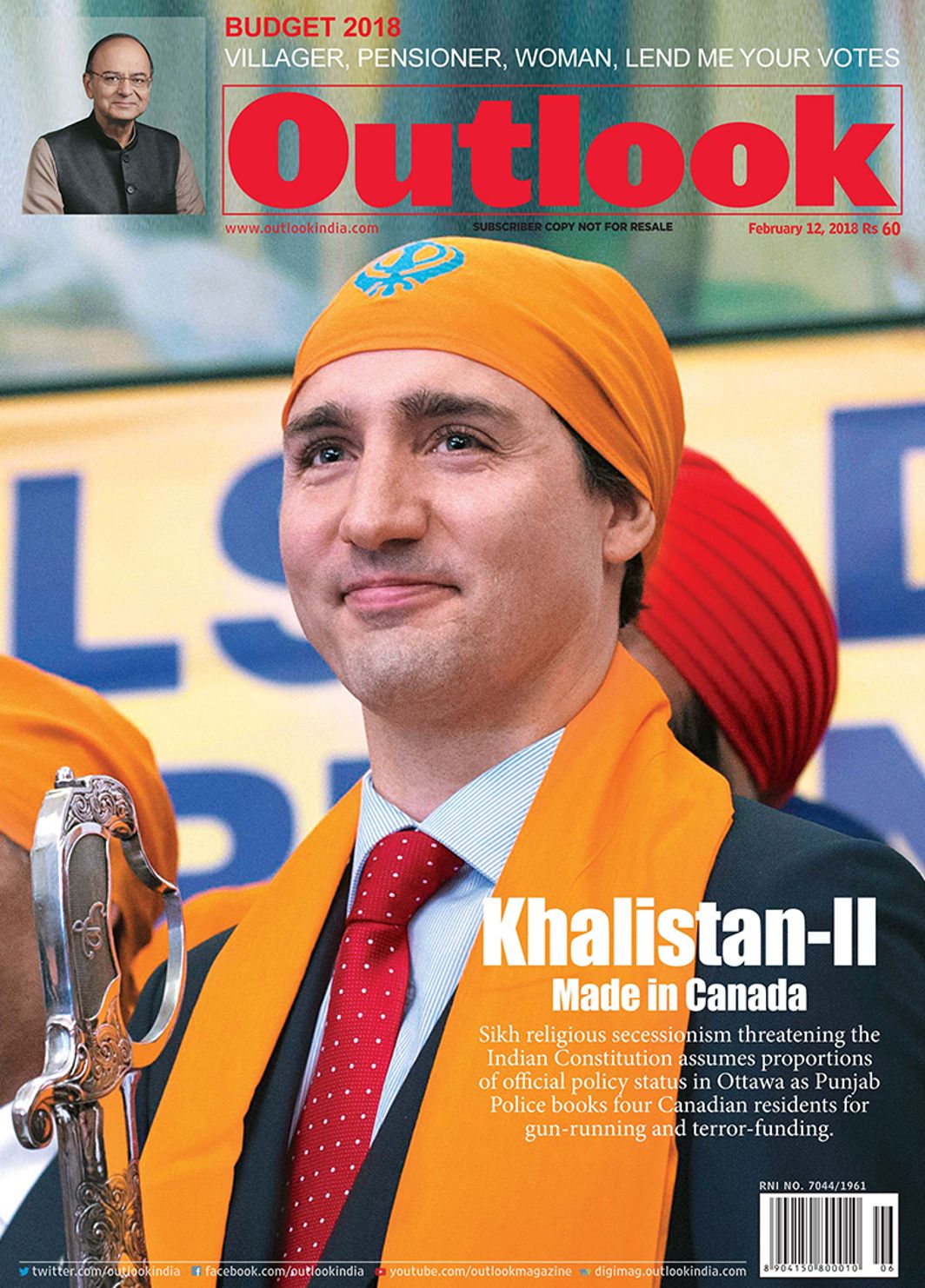 The magazine, through its articles, has described the alleged connections between Canada and the Sikh movement and accused Canadian Sikh community of exploiting country’s political system and blame free speech for allowing fundamentalist language to flourish.
Amarjit Sohi, the infrastructure minister has also clarified that he does not sympathize with the cause, nor does he hear much talk about it in the Sikh community.
“If there is a small segment of people in Canada who talk about separation, who talk about the creation of Khalistan, if they do that in a peaceful way that is their right to do so but this is not an issue that I hear in the community,” Sohi said.
“From my point of view this is not an issue for the Canadian population, this is not an issue for the Indo-Canadian community within Canada, and I don’t feel it necessary to be engaging in something that is completely irrelevant from a Canadian’s point of view,” he added.
There are about 4.7 lakh Sikhs in Canada where 16 MPs of Sikh origin were elected in 2015. There are four Sikhs in the federal cabinet, including Sajjan and Sohi.
Outlook blames Canada’s allowance for free speech about human rights for giving “free reign” to more fundamentalist language that has led to the “radical capture of key Gurdwaras.”
CBC News reports that an unnamed source in the Canadian Prime Minister’s Office has played down the impact the issue is going to have on Trudeau’s India trip. He said that it will come up but will not be a focus during the visit.
The source further said that if pressed, Trudeau — who leaves for India next week — will “stand up for free speech and also reiterate Canada’s policy in favour of a united India.”






Latest world news
S Jaishankar says India is a natural option for Russia amid Europe tensions
External Affairs Minister S Jaishankar said India remained a natural option for Russia as Moscow increasingly turned towards Asia amid strained relations with Europe. He highlighted the continuity of India-Russia ties and their significance for the balance of power in Asia.


Latest world news
Putin praises PM Modi, says he has very good ideas on Ukraine war
Russian President Vladimir Putin has praised Prime Minister Narendra Modi for repeatedly raising the need to end the Ukraine war, describing his ideas for a settlement as “very good”.

Latest world news
S Jaishankar calls Pakistan a “serial practitioner of terrorism” at UN
S Jaishankar criticised Pakistan at the UN General Assembly, referring to a “serial practitioner of terrorism” and warning against attempts to normalise terrorism.


Dhruv Rathee gets fresh summons in 2018 BJP IT cell video case

Nobody can browbeat judiciary, Chief Justice warns over Rahul Gandhi’s march

India-US trade deal first phase finalised, drafting underway

Election Commission orders voter roll revision in 17 states, UTs

Actor Imran Khan asked to leave India after CJP protest

Delhi Police offers 11-person limit for CJP’s Connaught Place protest
Actor Imran Khan asked to leave India after CJP protest
Election Commission orders voter roll revision in 17 states, UTs
India-US trade deal first phase finalised, drafting underway
Nobody can browbeat judiciary, Chief Justice warns over Rahul Gandhi’s march

Afghan Men Try To Hang With The Jet Engine Of The Aircraft in Kabul- Afghanistan News – Kabul News
Trending Top 10 News: 10000 Crore Fine on Flipkart, Apple to Launch Unique Feature, Hdfc Bank Job Ad

Trending Top 10 News: Nokia 6310, Apple sales, Bachpan ka Pyar Video Kid, Dainik Bhaskar IT Raid

Trending Top 10 News: Canada bans Indian flights, Rain in Delhi NCR, AIMIM Twitter hacked, Raj Kundra case

Trending Top 10 News: Shein India, Apple New Service, Pocket Oxygen, Oppo Launched New Phone
-
 India News17 hours ago
Dhruv Rathee gets fresh summons in 2018 BJP IT cell video case
-
 India News13 hours ago
Nobody can browbeat judiciary, Chief Justice warns over Rahul Gandhi’s march
-
 India News9 hours ago
India-US trade deal first phase finalised, drafting underway
-
 India News7 hours ago
Election Commission orders voter roll revision in 17 states, UTs
-
 India News6 hours ago
Actor Imran Khan asked to leave India after CJP protest
-
 India News5 hours ago
Delhi Police offers 11-person limit for CJP’s Connaught Place protest
