
Latest world news
Cuba: Over 100 killed in deadly air crash, three survive


In a worst air disaster in nearly three decades, more than 100 people were killed in Cuban capital Havana when a Boeing passenger plane crashed soon after taking off on Friday. Miraculously four live passengers were taken to hospital. One of them died while three are being treated.
The ill feted Boeing 737 operated by Cubana de Aviacion crashed into a field near Havana’s Jose Marti airport, sending a thick column of acrid smoke into the air. It was operating a domestic flight to Holguin, a popular tourist destination with pristine beaches, in eastern Cuba. It crashed at 12:08 p.m. (1608 GMT).
Blackened wreckage of Flight CU972 was strewn over the crash site, 20 km (12 miles) south of Havana, the report said.
Five of the passengers and the crew were foreign nationals, two Argentine citizens and an unspecified number of Mexicans were among the dead. This was confirmed by Argentine and Mexican governments.
 Cuban President Miguel Diaz-Canel said in broadcast that a high number of people appeared to have been killed. “There has been an unfortunate aviation accident. The news is not very promising, it seems that there is a high number of victims,” Diaz-Canel said after his visit to the crash site.
He said the fire from the crash had been extinguished and authorities were identifying the bodies of the victims. Authorities were investigating the cause of the crash. He said nine crew members were believed to have been on board, in addition to the passengers.
The 58-year-old Miguel Diaz-Canel, who succeeded Raul Castro as the island’s leader last month, appeared aghast as he surveyed the recovery efforts. He was seen wearing a short sleeved green shirt and surrounded by officials.
Cuban government declared two days of official mourning period. The national flag would be flown at half-mast outside state and military institutions.
Former Cuban president Raul Castro, 86, the head of country’s ruling Communist Party, offered his condolences to the families of the victims. Currently he is recovering from a hernia operation. This was the first time Cuba reported on Castro’s health condition, who handed over the reins of power to his right-hand man Miguel Diaz Canel last month.
State television said the airliner was operated by a foreign crew. European airline Blue Panorama had been leasing a 737-400 plane to Cubana de Aviacion for several months.
In July 1997, Cuba witnessed major airline crash when an Antonov-24 passenger plane fell into the sea off Santiago de Cuba, killing all 44 on aboard. A small Antonov-2 plane was crashed while flying domestic, killing 16 people on board in March 2002.


Latest world news
Magnitude 7 earthquake strikes Tibet after floods
A magnitude 7 earthquake struck northern Tibet on Thursday, October 22. The tremor came weeks after deadly flash floods and landslides hit the mountainous region near the Nepal-China border. Initial reports did not confirm casualties or damage from the earthquake.


Latest world news
Macron rejects Trump’s immigration claims over France riots
French President Emmanuel Macron criticised Donald Trump and other foreign leaders over their comments on France’s recent unrest. Macron rejected claims that the country was being overrun by migrants and Islamists, calling such assertions false.

Latest world news
Marco Rubio says India and US share extraordinary alignment on key issues
US Secretary of State Marco Rubio said India and the United States share an extraordinary alignment on core issues, even though disagreements between the two countries may arise.


Punjab strike hits public services as 3 lakh employees and roadways workers protest

Two election commissioners complained against senior poll officer, RTI reveals

Om Prakash Mathur sworn in as Keralam Governor

PM Modi to inaugurate Rs 169-crore RBI data centre in Odisha on October 25

Delhi High Court rejects Neha Bora’s plea against peace bond notice

MEA responds after ITBP chief flags ongoing face-offs with China in Arunachal
Delhi High Court rejects Neha Bora’s plea against peace bond notice
PM Modi to inaugurate Rs 169-crore RBI data centre in Odisha on October 25
Om Prakash Mathur sworn in as Keralam Governor
Two election commissioners complained against senior poll officer, RTI reveals

Afghan Men Try To Hang With The Jet Engine Of The Aircraft in Kabul- Afghanistan News – Kabul News
Trending Top 10 News: 10000 Crore Fine on Flipkart, Apple to Launch Unique Feature, Hdfc Bank Job Ad

Trending Top 10 News: Nokia 6310, Apple sales, Bachpan ka Pyar Video Kid, Dainik Bhaskar IT Raid

Trending Top 10 News: Canada bans Indian flights, Rain in Delhi NCR, AIMIM Twitter hacked, Raj Kundra case

Trending Top 10 News: Shein India, Apple New Service, Pocket Oxygen, Oppo Launched New Phone
-
 India News18 hours ago
Punjab strike hits public services as 3 lakh employees and roadways workers protest
-
 India News18 hours ago
Two election commissioners complained against senior poll officer, RTI reveals
-
 India News7 hours ago
Om Prakash Mathur sworn in as Keralam Governor
-
 India News6 hours ago
PM Modi to inaugurate Rs 169-crore RBI data centre in Odisha on October 25
-
 India News5 hours ago
Delhi High Court rejects Neha Bora’s plea against peace bond notice
-
 India News5 hours ago
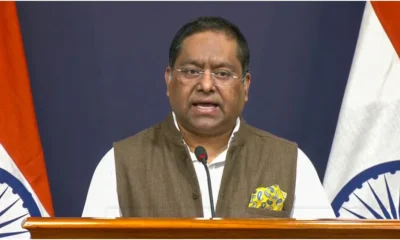
MEA responds after ITBP chief flags ongoing face-offs with China in Arunachal
