English हिन्दी
Connect with us

Latest world news

India rejects Dutch PM’s remarks on press freedom, minority rights during Modi visit

India strongly rejected remarks linked to press freedom and minority rights made during PM Narendra Modi’s Netherlands visit, calling them based on a lack of understanding of India’s democracy.

Published

on

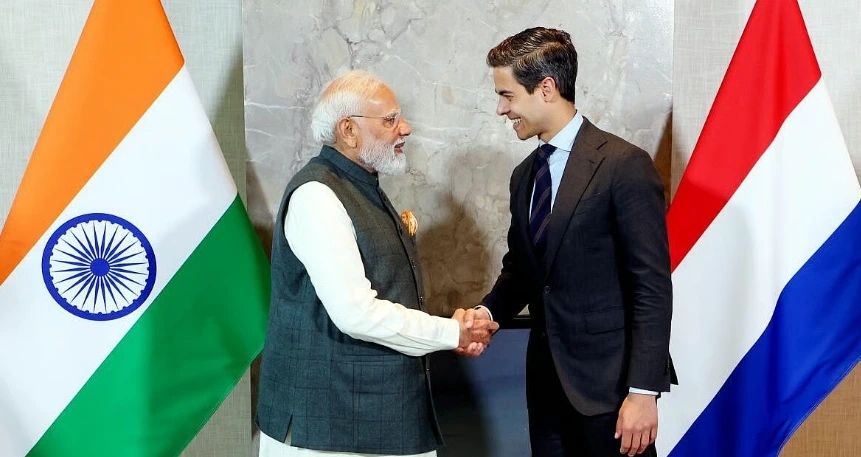
Prime Minister Narendra Modi’s visit to the Netherlands witnessed a diplomatic exchange after reported remarks by Dutch Prime Minister Rob Jetten on press freedom and minority rights in India drew a sharp response from New Delhi.

India rejected the comments, with Ministry of External Affairs Secretary (West) Sibi George saying the concerns reflected a “lack of understanding” about India’s democratic system and social structure.

Addressing the issue during a media briefing in the Netherlands, the Indian diplomat described India as a “vibrant democracy” and pointed to the country’s electoral participation and diversity as evidence of democratic strength. He noted that recent elections in India saw voter participation crossing 90 per cent in some regions.

According to reports, the Dutch Prime Minister had raised concerns linked to press freedom and the condition of minority rights in India before his meeting with PM Modi in The Hague. However, sources indicated that the matter was not formally discussed during the bilateral talks between the two leaders.

India also underlined that people from different faiths coexist peacefully in the country and highlighted the nation’s democratic institutions and constitutional protections.

The exchange came during PM Modi’s visit aimed at strengthening ties between India and the Netherlands across sectors including trade, technology, energy and strategic cooperation. The two countries also discussed expanding bilateral partnerships during high-level meetings in The Hague.

Latest world news

Vladimir Putin backs India’s independent foreign policy, warns against sanctions pressure

Russian President Vladimir Putin said sanctions threats against India would boomerang, praising PM Narendra Modi’s leadership and India’s commitment to pursuing its national interests.

Published

on

Vladimir Putin

Russian President Vladimir Putin has said that any sanctions threats directed at India would ultimately backfire, asserting that New Delhi has consistently acted in accordance with its national interests and is unlikely to change course under Prime Minister Narendra Modi’s leadership.

Speaking about India-Russia relations and New Delhi’s foreign policy approach, Putin praised India’s independent decision-making and emphasized that attempts to pressure the country over its ties with Moscow would not achieve the desired outcome. He suggested that any such measures would have negative consequences for those imposing them.

The Russian leader described India as a reliable partner and highlighted the strength of bilateral ties between the two countries. He also indicated that Russia does not view India’s growing engagement with other nations, including the United States, as a threat to its relationship with New Delhi.

Putin further praised India’s economic progress and reiterated confidence in the country’s ability to pursue policies based on its own priorities. His remarks come amid continuing global discussions over sanctions, geopolitical alignments and international partnerships.

The comments underscore Moscow’s efforts to reinforce its strategic partnership with India while highlighting Russia’s support for New Delhi’s independent foreign policy stance.

Continue Reading

Latest world news

UK Foreign Secretary Yvette Cooper visits India to strengthen bilateral partnership

UK Foreign Secretary Yvette Cooper held high-level meetings in New Delhi during her first official visit to India, underscoring efforts to deepen cooperation in trade, security, technology and regional stability.

Published

on

UK Foreign Secretary Yvette Cooper visited New Delhi for her first official trip to India since assuming office, holding key meetings with Prime Minister Narendra Modi and External Affairs Minister S. Jaishankar as both countries seek to deepen cooperation across trade, security and strategic sectors.

The visit comes at a significant time in India-UK relations, with both governments working toward the implementation of their recently concluded trade agreement while also expanding collaboration in areas such as technology, climate action, supply chains and regional security.

Focus on trade and strategic cooperation

During her engagements in New Delhi, Cooper discussed ways to strengthen the comprehensive strategic partnership between the two countries. Conversations also touched on accelerating the implementation of the India-UK trade agreement and enhancing economic cooperation.

Her visit followed recent discussions between Indian Commerce Minister Piyush Goyal and UK Business and Trade Secretary Peter Kyle regarding the rollout of the bilateral trade pact.

New initiatives announced

India and the UK also announced fresh cooperation initiatives during the visit, including the launch of a Critical Minerals Global Supply Chain Observatory aimed at strengthening collaboration on critical minerals and supply-chain resilience.

Officials described the initiative as an important step in expanding cooperation in emerging strategic sectors and supporting resilient global supply chains.

Addressing global challenges

Apart from bilateral issues, discussions covered wider global concerns, including regional stability, economic disruptions arising from international conflicts and maritime security. The visit reflects the growing importance both countries attach to their strategic partnership amid evolving geopolitical challenges.

India and the UK have increasingly broadened cooperation across defence, technology, innovation, clean energy and people-to-people ties, with both sides aiming to further strengthen engagement in the coming years.

Fact-check assessment

The core angle—Yvette Cooper’s first official visit to India, meetings with PM Modi and S. Jaishankar, focus on trade, security, strategic cooperation and the launch of new bilateral initiatives—is supported by multiple current reports and appears factually sound.

Continue Reading

Latest world news

Trump says India-US trade deal likely soon, calls PM Modi a good friend

Donald Trump has expressed confidence that India and the United States will soon finalize a trade agreement, while praising Prime Minister Narendra Modi and highlighting ongoing bilateral negotiations.

Published

on

Donald Trump statement

US President Donald Trump has expressed confidence that the United States and India will reach a trade agreement in the near future, even as discussions continue amid concerns over potential new tariffs. Trump also praised Prime Minister Narendra Modi, describing him as a good friend and highlighting the strong relationship between the two leaders.

Speaking to reporters at the White House, Trump said he expects the two countries to finalize a deal and pointed to his personal rapport with Prime Minister Modi. He said the relationship between Washington and New Delhi remains strong and that ongoing negotiations are moving toward an agreement.

The remarks come shortly after a US trade delegation concluded discussions in India on an interim bilateral trade arrangement. According to Indian officials, the talks were conducted in a cooperative atmosphere, with both sides reaffirming their commitment to a mutually beneficial agreement aimed at strengthening economic ties.

During the interaction, Trump also repeated his criticism of India’s past tariff policies, arguing that India had imposed high duties on American goods for many years. He claimed recent US trade measures were intended to address what he views as an imbalance in the trading relationship.

His comments come days after the US administration proposed additional tariffs on imports from India and several other economies under a separate trade investigation related to forced-labour concerns. The proposal remains under review and has become one of the issues running alongside broader trade negotiations between the two countries.

Despite the tariff dispute, both governments have continued negotiations. Recent statements from officials on both sides suggest that substantial progress has already been made on several aspects of the proposed agreement, with discussions focused on resolving the remaining issues.

The United States is one of India’s largest trading partners, and a bilateral agreement is expected to further expand trade and investment flows between the two countries. Trump’s latest remarks are being seen as a sign that both sides remain committed to finding common ground despite ongoing trade disagreements.

Continue Reading

Trending

© Copyright 2022 APNLIVE.com