English हिन्दी
Connect with us

Latest world news

India a critical anchor to maintain balance of power in regional security, says top US official

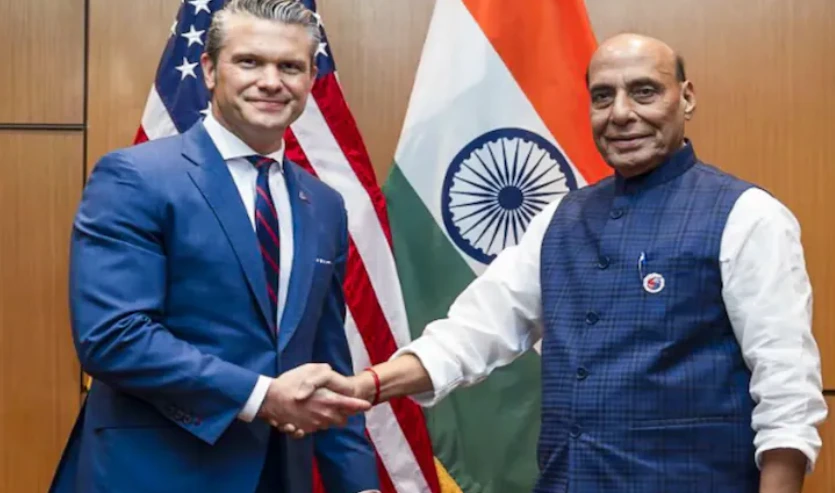
Speaking at the Shangri-La Dialogue, top US official Pete Hegseth praised India as a critical anchor holding the line in South Asia, noting its heavy industrial capacity to sustain high-end military operations.

Published

on

In a major statement highlighting the growing strategic alignment between Washington and New Delhi, top US official Pete Hegseth described India as a critical pillar of regional stability. Speaking on the second day of the Shangri-La Dialogue in Singapore, Hegseth noted that New Delhi’s ongoing military modernisation directly serves the shared objective of preserving a balance of power across the Indo-Pacific.

“In South Asia, India is a critical anchor to hold the line,” the top official said while addressing delegates from 44 nations. “A powerful India acting in its own self-interest advances our shared goal of maintaining a balance of power across the region.”

Growing logistics and maritime capabilities

The US administration heavily praised New Delhi’s defence industrial advancements, particularly highlighting its expanding operations in the Indian Ocean region. According to media reports, the official observed that India is modernising its armed forces to carry its share of the security burden in these crucial maritime corridors.

Furthermore, the official emphasized that New Delhi is successfully building out a heavy industrial and logistics capacity capable of sustaining high-end military operations. This expanding domestic infrastructure includes the ability to repair and maintain shared defence platforms, as well as supporting allied naval vessels operating forward in the regional theatre.

Strategic co-production and regional readiness

The partnership between the two nations is translating into tangible operational steps. The official revealed that Washington has firmly committed to pursuing joint production initiatives with New Delhi. Among these initiatives is the co-production of advanced capabilities, including Javelin anti-tank guided munitions, aimed at improving the collective readiness of their forces.

“This kind of industrial muscle isn’t just a long-term goal, it’s an immediate operational imperative,” the official stated, linking New Delhi’s defence manufacturing strength to a broader collective strategy.

Global defense spending and alliance priorities

The address also outlined Washington’s massive domestic military manufacturing mobilisation under President Donald Trump. Following a defence expenditure of USD 1 trillion last year, plans are underway for a historic generational investment of USD 1.5 trillion this year to expand military dominance and weaponry production at scale and speed.

While noting that relations between Washington and Beijing are currently better than they have been in many years, the official maintained that no state can be allowed to impose hegemony or compromise regional security.

Calling upon global partners to match this resolve, the administration indicated it expects allies to hit a defence spending target of 3.5 per cent of their GDP. Moving forward, Washington intends to prioritize and fast-track cooperation with “model allies”—defined as nations that are capable, clear-eyed, and ready to stand up for their national interests.

Latest world news

US-Iran deal text released: Strait of Hormuz reopening, $300 billion fund and no-nuclear pledge among key provisions

The newly released US-Iran agreement includes provisions for reopening the Strait of Hormuz, launching a proposed $300 billion reconstruction fund and advancing negotiations on Iran’s nuclear programme.

Published

on

The memorandum of understanding sets out a roadmap for restoring maritime trade, advancing nuclear negotiations and supporting Iran’s economic recovery through a proposed reconstruction fund.

The United States has released the text of a memorandum of understanding (MoU) with Iran, laying out the framework for ending months of conflict and opening the door to broader negotiations on Tehran’s nuclear programme and economic future. The agreement includes commitments on reopening the Strait of Hormuz, a pledge from Iran not to pursue nuclear weapons, and the creation of a proposed $300 billion reconstruction and development fund.

According to the released text, Iran has agreed to ensure the restoration of commercial shipping through the Strait of Hormuz, one of the world’s most important energy transit routes. The US, in turn, has committed to lifting its naval blockade and refraining from imposing new sanctions during a 60-day negotiation period aimed at reaching a broader and more comprehensive agreement.

Hormuz reopening central to agreement

A major component of the deal focuses on restoring maritime traffic in the Persian Gulf and Gulf of Oman. The memorandum calls for the reopening of the Strait of Hormuz to safe commercial navigation, a move expected to ease concerns in global energy markets after months of disruption.

The agreement also outlines cooperation between both sides to reduce tensions in the region and maintain freedom of navigation through the strategic waterway.

Iran reiterates no-nuclear weapons commitment

The released document states that Iran has reaffirmed its commitment not to develop or acquire nuclear weapons. It also provides for cooperation with the International Atomic Energy Agency (IAEA) and further discussions on the future of Iran’s enriched uranium stockpiles as part of upcoming negotiations.

While the MoU establishes broad principles, several key nuclear issues are expected to be addressed during the 60-day negotiation process that follows the signing of the framework agreement.

$300 billion reconstruction fund proposed

One of the most significant economic elements of the agreement is a proposed $300 billion Reconstruction and Development Fund intended to support Iran’s recovery and investment needs. US officials have said the fund would be financed by private-sector investors and international partners rather than American taxpayers.

Officials have also stressed that access to the fund and broader economic benefits would depend on Iran meeting its commitments under the agreement, including compliance with nuclear-related obligations.

Next phase of negotiations

The memorandum establishes a 60-day period for negotiations on a final agreement covering sanctions, nuclear issues and broader regional security concerns. Both countries have pledged to avoid escalation during this period while working toward a longer-term settlement.

The deal is being viewed as an important step toward reducing tensions in the Middle East, though significant negotiations remain before a permanent agreement can be reached.

Continue Reading

Latest world news

Trump announces interim Iran agreement as peace talks move forward

US President Donald Trump has announced an interim agreement with Iran that seeks to maintain the ceasefire and establish a path toward broader peace negotiations in the Middle East.

Published

on

Donald Trump statement

US President Donald Trump has announced that the United States and Iran have signed an interim agreement intended to reduce tensions and support ongoing efforts to end the conflict that has destabilised parts of the Middle East.

According to officials familiar with the development, the agreement is designed to extend the current ceasefire and establish a framework for future negotiations between the two countries. The move is being viewed as a significant diplomatic step after months of heightened regional tensions.

Agreement focuses on ceasefire and future negotiations

Officials said the arrangement is aimed at maintaining stability while both sides work toward a broader and more permanent settlement. The agreement reportedly includes provisions intended to support continued dialogue and reduce the risk of renewed hostilities.

While the development has been welcomed as a positive breakthrough, reports indicate that several key issues remain unresolved and will require further negotiations. As a result, the current understanding is being described as an interim framework rather than a final peace treaty.

Long-term settlement still under discussion

Diplomatic efforts are expected to continue in the coming weeks as negotiators seek to address outstanding concerns and work toward a more comprehensive agreement.

The announcement comes amid international calls for de-escalation in the region and renewed efforts to secure lasting stability through diplomatic engagement.

Analysts say the interim agreement could provide an opportunity for both sides to pursue further talks while reducing immediate security concerns. However, the success of the initiative will largely depend on progress made during future negotiations.

As discussions continue, global attention remains focused on whether the agreement can lead to a durable settlement and contribute to broader peace and stability across the Middle East.

Continue Reading

Latest world news

Trump calls PM Modi a total killer and tough trader during G7 bilateral talks

US President Donald Trump praised Prime Minister Narendra Modi during their G7 Summit meeting, calling him a tough trader and saying India and the United States are continuing discussions on trade agreements.

Published

on

Donald Trump statement

Prime Minister Narendra Modi and US President Donald Trump held a bilateral meeting on the sidelines of the G7 Summit in France on Wednesday, marking an important engagement between the two leaders amid ongoing discussions on trade, security and strategic cooperation.

During interactions around the meeting, Trump praised Modi in unusually warm terms, describing the Indian Prime Minister as a “tough trader” and highlighting his negotiating abilities. He also referred to Modi as a “total killer” while complimenting his leadership style and effectiveness in dealing with complex issues.

The meeting was the first face-to-face interaction between the two leaders in several months and came at a time when New Delhi and Washington are working toward advancing a bilateral trade agreement. Officials from both sides have indicated that discussions on trade remain a priority, although a final deal is still under negotiation.

Focus on trade and strategic cooperation

Speaking after the meeting, Trump said he had a “very good” conversation with Modi and noted that the two countries were continuing efforts to reach trade agreements. He also described the Indian leader as a strong negotiator and expressed interest in visiting India in the future.

Trade issues have been a major area of discussion between India and the United States, with both sides seeking progress on market access, tariffs and broader economic cooperation.

Maritime security also discussed

The bilateral meeting took place against the backdrop of wider global security concerns. During G7 engagements, Modi raised issues related to maritime security and the safety of Indian seafarers, stressing the importance of secure shipping routes and uninterrupted global trade.

The leaders’ talks were closely watched as India and the United States continue to deepen cooperation across trade, defence and strategic affairs.

Continue Reading

Trending

© Copyright 2022 APNLIVE.com