English हिन्दी
Connect with us

Latest world news

7.6 magnitude earthquake hits Japan; tsunami warning issued

The Japanese government has set up a special emergency centre to gather information on the quakes and tsunami and relay them speedily to residents to ensure safety.

Published

on

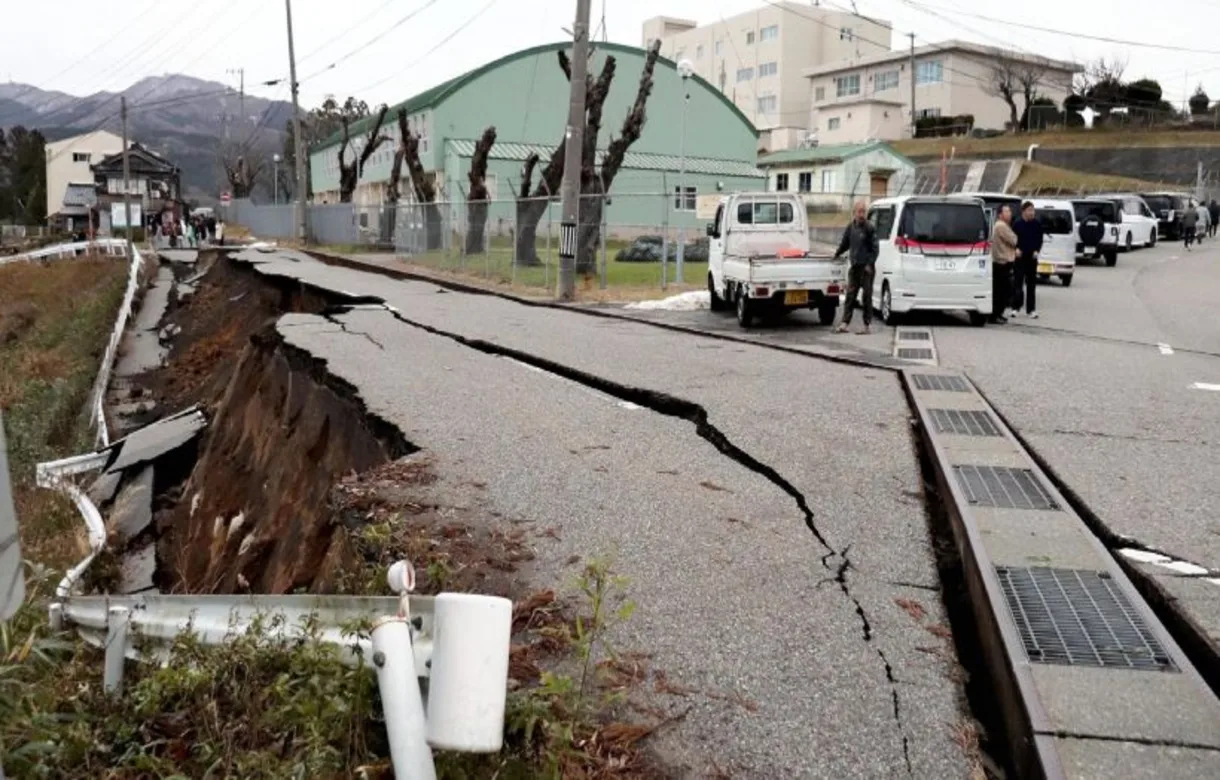
On New Year, an earthquake with a preliminary magnitude of 7.6 hit north central Japan on Monday. Following the earthquake, Japan issued tsunami alerts and told people to evacuate seaside areas after a series of 21 strong quakes on its western coastline on Monday.

The Japan Meterological Agency reported quakes off the coast of Ishikawa and nearby prefectures shortly after 4 p.m., one of them with a preliminary magnitude of 7.6. The meteorological department also issued a major tsunami warning for Ishikawa and lower-level tsunami warnings or advisories for the rest of the western coast of Japan’s main island of Honshu.

Japan government spokesman Yoshimasa Hayashi told the media that nuclear plants in the area had not reported any irregularities but it was critical for people in coastal areas to get away from the oncoming tsunami. He also urged people to evacuate to a safe area immediately.

Japan Public Broadcast media, NHK reported that a tsunami of about 3 metres (about 10 feet) high was expected to hit Niigata and other prefectures on the western coast of Japan. It added that smaller tsunami waves were already confirmed to have reached the coastline. Owing to the earthquake, bullet trains in the area were halted and parts of the highway were also closed, and water pipes had burst.

The Meteorological department also warned that more major quakes could hit the area over the next week, especially in the next two or three days. Furthermore, Tsunami warnings were also issued for Japan’s northernmost main island of Hokkaido and for parts of North Korea and Russia. Russian officials also issued a tsunami alert for the island of Sakhalin, warning that areas across the island’s west coast could be affected by the waves.

In South Korea, the weather agency urged residents in some eastern coastal towns to watch for possible changes in sea levels. It added that tsunami waves that hit later can be bigger than the initial ones.

Meanwhile, the Japanese government has set up a special emergency centre to gather information on the quakes and tsunami and relay them speedily to residents to ensure safety. Prime Minister Fumio Kishida also reiterated the warning for immediate evacuation in affected areas.

Latest world news

Nepal seeks climate compensation from India, China and US for deadly floods

Nepal has sought climate compensation from India, China and the US after a devastating flash flood killed more than 1,100 people and left nearly 4,500 missing.

Published

on

Nepal has sought climate-related compensation from India, China and the United States following the devastating flash floods that struck the country last week.

Nepal Foreign Minister Shishir Khanal said the country wants its diplomatic approach to move beyond conventional disaster aid towards what he described as justice and compensation. He argued that major greenhouse gas emitters have a responsibility towards vulnerable countries facing severe climate-related losses.

The flash flood struck the Bhotekoshi River basin on August 26 after a high-altitude glacial collapse along the Tibet-Nepal border. The disaster sent water, rocks and debris downstream, affecting villages across at least three districts.

More than 1,100 bodies have been recovered, while nearly 4,500 people remain missing, according to the report.

Nepal seeks accountability from major emitters

Khanal said Nepal’s contribution to global greenhouse gas emissions is “virtually negligible”, yet the country is facing severe consequences associated with global warming, including glacier melt and extreme mountain disasters.

He said Nepal considers the response to such climate-related losses a matter of “legal and moral liability” rather than charity.

According to Khanal, Nepal intends to raise the issue at international forums and seek compensation for climate-related losses suffered by vulnerable countries.

He also highlighted the importance of Himalayan glaciers for South Asia’s water security, saying their disappearance could have consequences for billions of people dependent on rivers including the Ganges and Trishuli.

Nepal’s finance ministry has also sent a formal climate compensation claim letter to its international partners, Khanal said.

India has backed climate equity

India has consistently highlighted the principle of climate equity and pointed to its relatively low per capita greenhouse gas emissions.

New Delhi has argued that climate responsibilities should consider countries’ historical emissions, development requirements and respective capacities. India has also supported efforts to address loss and damage suffered by vulnerable developing countries.

India maintains that developed nations should provide financial resources to countries dealing with the effects of climate change.

Nepal approaches loss and damage fund

Nepal has formally approached the board of the Fund for Responding to Loss and Damage for urgent financial assistance following the August 26 flash flood.

The fund was established at COP27 in 2022 and operationalised at COP28.

A letter jointly signed by Nepal’s Finance Minister Swarnim Wagle and Forests and Agriculture Minister Geeta Chaudhary sought an urgent response to the disaster, citing extensive loss of life, displacement and destruction of homes and critical infrastructure.

The letter said the full extent of the economic and non-economic losses was yet to be determined, but preliminary information indicated that the impact had exceeded Nepal’s immediate response capacity.

Continue Reading

Latest world news

Bank of America VP Erin Piacenti killed in New York stabbing

Bank of America vice-president Erin Piacenti, 32, was fatally stabbed in an apparently random attack in New York’s Times Square.

Published

on

Bank of America vice-president Erin Piacenti was fatally stabbed in New York City’s Times Square in what authorities described as a random and unprovoked attack.

Piacenti, 32, was among two people stabbed in the incident near West 42nd Street and Seventh Avenue on August 31. She was taken to a hospital but later died from her injuries. The other victim, a 68-year-old man, survived and was reported to be in stable condition.

Who was Erin Piacenti?

Piacenti worked as a vice-president at Bank of America in its business selection and conflicts unit. She was also a graduate of the University of Pennsylvania and Fordham Law School.

According to reports, Piacenti was a new mother and had recently returned to work following maternity leave. She had also recently marked her second wedding anniversary with her husband.

Bank of America expressed shock and sadness over her death, describing Piacenti as a valued colleague and extending condolences to her family and loved ones.

What happened in Times Square?

The stabbing took place at around 4:24 pm local time, according to the New York Police Department.

Police identified the alleged attacker as 49-year-old Pamela Cisneros. Authorities said she was carrying two large knives and attacked two people before confronting responding officers.

Police attempted to stop Cisneros, including using Tasers, but she continued advancing towards officers with the knives. Officers then opened fire, and Cisneros was later pronounced dead.

New York Police Commissioner Jessica Tisch said the attack appeared to be random and unprovoked. Police also said Cisneros had a documented history of mental health issues. The motive remains under investigation.

Bank of America reacts to employee’s death

Bank of America said it was “shocked and deeply saddened” by Piacenti’s death and said she would be greatly missed.

The bank’s security teams are also supporting the police investigation and addressing security concerns involving its offices and employees.

Piacenti’s death has left her family, colleagues and friends mourning the loss of a young professional who had recently returned to work after becoming a mother.

Continue Reading

India News

US begins strikes on Iran, Trump warns of bigger attack

The US has begun strikes against IRGC targets in Iran after attempted attacks on commercial shipping and American service members.

Published

on

The United States has begun strikes against Islamic Revolutionary Guard Corps (IRGC) targets in Iran, following what the US military described as attempted attacks on commercial shipping in the Strait of Hormuz and American service members deployed in the Middle East.

US Central Command said US forces began the strikes at 12 pm ET on Tuesday, which was 9:30 pm IST. The announcement came as tensions continued to rise between Washington and Tehran.

Iranian state media, meanwhile, reported that four projectiles hit areas in the Chabahar and Konarak counties, east of the Strait of Hormuz. No information about damage from those projectiles was specified.

Iran warns of retaliation

IRGC spokesman Hossein Mohebi warned that Washington would regret the latest attacks and said severe punishment awaited the aggressors.

The Strait of Hormuz remains closed, while the US continues its counter naval blockade of Iranian ports, according to the report.

The latest US strikes followed an earlier attack on Iran’s Larak Island on Sunday. The US said it targeted Iranian rocket launchers there to prevent Iran from planting further mines in the shipping lane.

Iran subsequently launched missiles at US bases in Jordan, which were intercepted. The United Arab Emirates also said it had stopped an Iranian drone over its waters.

Trump warns of ‘biggest attack’

US President Donald Trump warned Iran against retaliating for the latest strikes.

Trump said Iran would face attacks at a “much harder and higher” level if it responded, adding that the latest action would not be the biggest attack planned by the US.

Trump had earlier said that US and Israeli bombardment had left Iran’s leadership dead, its military devastated and its economy in ruins. He nevertheless indicated that further strikes could be carried out.

US weighs economic pressure on Iran

The renewed fighting comes after Trump had shifted attention last month towards economic pressure on Iran.

The US president had announced an “economic D-Day” strategy involving sanctions against Iran, with his administration arguing that targeting the country’s economy could push Tehran towards a breaking point.

At the same time, the report noted concerns over diminishing US stockpiles of advanced weapons and the domestic political impact of the war ahead of the November midterm elections.

Continue Reading

Trending

© Copyright 2022 APNLIVE.com