
Latest world news
Nicholas Sarkozy detained for campaign funding by Gaddafi


Brice Hortefeux, one of his top ministers was also questioned
In an interesting development, former French President Nicholas Sarkozy has been taken into police custody and was questioned about allegations on alleged financing of his 2007 election campaign by Libya’s late leader Muammar Gaddafi.
AFP quoting unnamed sources say that prosecution claims Sarkozy spent nearly double the legal limit of $24m on his lavish campaign, using false billing from a public relations firm called Bygmalion.
He was detained early on Tuesday morning and was being questioned by prosecutors specialising in corruption, money laundering and tax evasion at their office in the Parisian suburb of Nanterre.
The 63-year-old leader had until now refused to respond to all summons for questioning in the case since he left office after one term in 2012.
Sarkozy’s detention was first reported by the Mediapart investigative news site and French daily Le Monde. Brice Hortefeux, one of the top minister during Sarkozy’s presidency, was also questioned on Tuesday.
Former French President has been a focus of the inquiry which began in 2013 about the claims by late Libyan ruler Muammar Gaddafi and his heir apparent Engineer Seif al-Islam that they provided funds for Sarkozy’s election effort.
The French leader had dismissed the allegation saying the claims were of vindictive nature because Libyan regime was furious over French participation in the US-led military intervention causing fall of Gaddafi’s 41-year rule which led to his death.
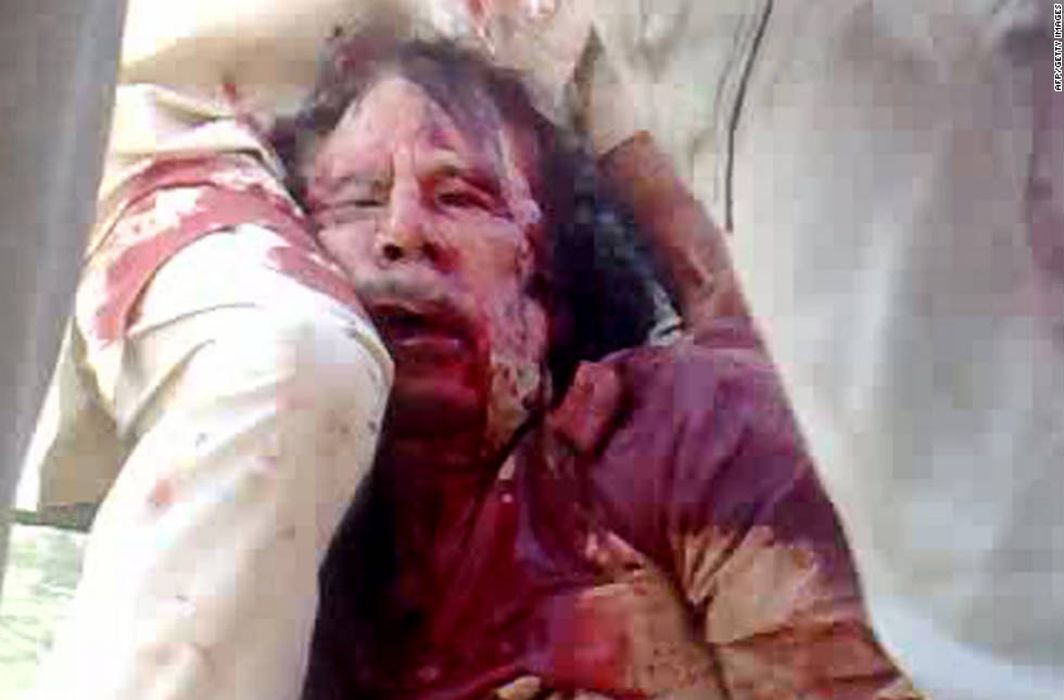
Muammar Gaddafi, the deposed leader of Libya, was captured and killed on 20 October 2011 in his hometown Sirte by National Transitional Council forces. He governed Libya as Revolutionary Chairman of Libyan Arab Republic, then as “Brotherly Leader” from 1977 to 2011.
 In November 2016, the issue was highlighted when a Franco-Lebanese businessman Ziad Takieddine admitted delivering three cash-stuffed suitcases from the Libyan leader as contributions towards Sarkozy’s first presidential run. He claimed that he travelled thrice from Tripoli to Paris in late 2006 and early 2007 with cash for Sarkozy’s campaign.
He further said that each time he carried a suitcase containing 1.5-2 million euros in 200-euro and 500-euro notes. He was given the money by Gaddafi’s military intelligence chief Abdallah Senussi.
Sarkozy was taken into custody after a former associate, Alexandre Djouhri, a 59-year-old Swiss businessman, was arrested in London in January this year. Later Djouhri was released temporarily on bail but returned to pre-trial detention in February. He also refused to respond to the summons for questioning in Paris.
Nicholas Sarkozy served as President of France from 16 May 2007 until 15 May 2012. Earlier he served as Minister of the Budget under Prime Minister Edouard Balladur and Minister of Interior during Jacques Chirac’s presidency.
Sarkozy had unsuccessfully tried to contest Presidential elections in November 2016 . Since then he has stepped back from frontline politics, although he remains a powerful figure behind the scenes in the Republicans party.
If tried, Sarkozy will be the second former president after Jacques Chirac – who was tried in France’s Fifth Republic, which was founded in 1958. Chirac was give a two-year suspended jail term in 2011 over a fake jobs scandal.








Latest world news
Magnitude 7 earthquake strikes Russia’s Kamchatka Peninsula
A magnitude 7 earthquake struck Russia’s Kamchatka Peninsula region on Friday. The initial report placed the earthquake at a depth of 140 kilometres.


Latest world news
S Jaishankar says India is a natural option for Russia amid Europe tensions
External Affairs Minister S Jaishankar said India remained a natural option for Russia as Moscow increasingly turned towards Asia amid strained relations with Europe. He highlighted the continuity of India-Russia ties and their significance for the balance of power in Asia.

Latest world news
Putin praises PM Modi, says he has very good ideas on Ukraine war
Russian President Vladimir Putin has praised Prime Minister Narendra Modi for repeatedly raising the need to end the Ukraine war, describing his ideas for a settlement as “very good”.


Election Commission orders voter roll revision in 17 states, UTs

Delhi Police offers 11-person limit for CJP’s Connaught Place protest

Actor Imran Khan asked to leave India after CJP protest

Magnitude 7 earthquake strikes Russia’s Kamchatka Peninsula

Mallikarjun Kharge’s ‘Your Friends’ jab at Rahul Gandhi over congress exits

Mallikarjun Kharge seeks all-party meeting with PM Modi on delimitation

Abhijeet Dipke detained ahead of CJP’s national flag march in Delhi
Magnitude 7 earthquake strikes Russia’s Kamchatka Peninsula

Delhi deploys 25,000 personnel, installs CCTV cameras ahead of CJP march
Mallikarjun Kharge’s ‘Your Friends’ jab at Rahul Gandhi over congress exits

Afghan Men Try To Hang With The Jet Engine Of The Aircraft in Kabul- Afghanistan News – Kabul News
Trending Top 10 News: 10000 Crore Fine on Flipkart, Apple to Launch Unique Feature, Hdfc Bank Job Ad

Trending Top 10 News: Nokia 6310, Apple sales, Bachpan ka Pyar Video Kid, Dainik Bhaskar IT Raid

Trending Top 10 News: Canada bans Indian flights, Rain in Delhi NCR, AIMIM Twitter hacked, Raj Kundra case

Trending Top 10 News: Shein India, Apple New Service, Pocket Oxygen, Oppo Launched New Phone
-
 India News24 hours ago
Election Commission orders voter roll revision in 17 states, UTs
-
 India News22 hours ago
Delhi Police offers 11-person limit for CJP’s Connaught Place protest
-
 India News23 hours ago
Actor Imran Khan asked to leave India after CJP protest
-
 Latest world news10 hours ago
Magnitude 7 earthquake strikes Russia’s Kamchatka Peninsula
-
 India News11 hours ago
Mallikarjun Kharge’s ‘Your Friends’ jab at Rahul Gandhi over congress exits
-
 India News10 hours ago
Delhi deploys 25,000 personnel, installs CCTV cameras ahead of CJP march
-
 India News1 hour ago
Abhijeet Dipke detained ahead of CJP’s national flag march in Delhi
-
 India News6 mins ago
Mallikarjun Kharge seeks all-party meeting with PM Modi on delimitation
