English हिन्दी
Connect with us

Latest world news

Syria: US, Russia continue nursing interests amidst bloodshed

Published

on

Syria: US, Russia continue nursing interests amidst bloodshed

Amidst conflicting reports about developments in Eastern Ghouta, US and Russia were critical of each other’s policies and perceptions. Russian President Vladimir Putin has warned that his patience with militant attacks is not indefinite as terrorist groups stationed in the Damascus suburbs continue to shell the capital indiscriminately while the US representative at UN has accused Russia and Syrian of violating ceasefire.

Rusian President Vladimir Putin, while responding to a question posed by TASS news agency about situation in Eastern Ghouta, during joint press conference with Austrian Federal Chancellor Sebestian Kurz in Moscow on Wednesday said, “As is known – in any case, we in Russia know this well enough – some shells crash even on the territory of the Russian embassy and trade mission. Are we going to tolerate this indefinitely? Of course, not.”

Read Also:- UN Security Council passes resolution for ceasefire in Syria

Putin pointed out that in the region there were quite a few extremist forces and members of terrorist organisations that had been included in the corresponding UN lists and the latest resolution by the UNSC that the struggle against these organisations must go on. He was quoted saying, “Bombardments from there continue unabated. On some days missile and mortar strikes reach 50-60.”

Russian President recalled that in his latest conversations with Germany’s Federal Chancellor Angela Merkel and French President Emmanuel Macron it was agreed to open a humanitarian corridor to let children, injured and all those in need of assistance leave the conflict zone.

Read Also:- Russia-US conflicting perception on Syria cause more death

Meanwhile, US representative at UN Kelley Currie, while speaking at UNSC meeting on Wednesday, condemned the Syrian government’s continued aerial bombardment on Eastern Ghouta, that has been under opposition control since 2013.

She asserted, “Despite the unanimous call for a ceasefire, the regime’s attacks continued unabated. Hundreds of Syrians have been killed or injured since we passed the resolution on Saturday.”

She further said, “Such an attack demonstrates Syria’s complete and utter contempt for this council and the United Nations.”

Read Also:- Russia warns US to consider Moscow-Ankara-Tehran efforts on Syria

Meanwhile, Russian Ambassador to UN Vassily Nebenzia, has told UNSC that Russia is doing everything it can to ensure the effectiveness of the daily five-hour humanitarian pauses.

However, he blamed rebel forces for targeting the corridors designated for humanitarian operations with mortar shelling. “We trust that the opposition leaders have a serious-minded approach and that their words will be met with deeds,” he added.

Nebenzia further clarified, “We understand that terrorists remain a legitimate target for military operations and that there will be no ceremonial approach for them.”  He further said that efforts must be made to “effectively neutralise” the presence of the al-Qaeda offshoot in Eastern Ghouta, Jabhat Fateh al-Sham, earlier known as Nusra Front.

On Monday, Russia had said that it will implement five-hour “humanitarian pauses” to allow for the evacuation of civilians and the entrance of aid convoys.

Aljazeera reports that despite the UNSC resolution, shelling and air strikes did not stop and have resulted in the deaths of at least four people. Residents of the enclave said government warplanes launched several attacks in early hours of Wednesday. A resident who wanted to remain unidentified, was quoted saying, “There have been no evacuations whatsoever- not medical, not humanitarian, nothing.”

Osama bin Javaid, Aljazeera correspondent stationed at Syria-Turkish border said “The second day of this so-called truce or pause went away without any major developments on the ground. No aid convoys went inside because the United Nations and other aid workers have been saying that this is too short of a window without any guarantees of whether they would be able to make it back.”

US representative at UN Currie described Russia’s five-hour “humanitarian pause” as “cynical, callous and in flagrant defiance of the demands of (UNSC resolution) 2401”.

Read Also:- UN: North Korea provides material for Syrian chemical weapons

Latest world news

US ends oil sanctions waiver for Iran and Russia, impact likely on India’s energy imports

The US decision to end the Iran and Russia oil waiver may impact India’s oil imports, fuel prices and global energy markets.

Published

on

US oil tanker

The United States has decided not to extend a temporary sanctions waiver that allowed limited trade in Iranian and Russian oil, marking a shift towards stricter enforcement of economic restrictions.

The waiver, introduced in March 2026, had permitted the sale of oil already loaded on ships to stabilise global supply during heightened geopolitical tensions. However, it is now set to expire around mid-April without renewal.

US officials have indicated that the move is part of a broader strategy to increase pressure on both Iran and Russia amid ongoing conflicts and geopolitical tensions.

What the waiver did and why it mattered

The short-term waiver allowed millions of barrels of oil—estimated at around 140 million barrels—to enter global markets, helping ease supply shortages and prevent sharp price spikes.

It also enabled countries like India to purchase discounted crude oil from Russia and resume limited imports from Iran after years of restrictions.

Impact on India

India, one of the world’s largest oil importers, is expected to feel the impact of the decision in several ways:

  • Reduced access to discounted oil
    India had been buying cheaper Russian crude and recently resumed Iranian imports under the waiver. Its end may limit these options.
  • Potential rise in fuel costs
    With fewer discounted supplies available, India may need to rely more on costlier sources, which could increase domestic fuel prices.
  • Supply diversification pressure
    India may need to explore alternative suppliers in the Middle East, Africa, or the US to maintain energy security.
  • Geopolitical balancing challenge
    The move adds pressure on India to align with US sanctions while managing its own economic interests.

Global energy market concerns

The end of the waiver comes at a time when global oil markets are already under stress due to conflict in West Asia and disruptions in key routes like the Strait of Hormuz.

Analysts warn that tightening sanctions could:

  • Reduce global oil supply
  • Increase price volatility
  • Intensify competition among major buyers like India and China

Bigger picture

The US decision reflects a broader shift from temporary relief measures to stricter enforcement of sanctions, even if it risks tightening global energy markets.

For India, the development highlights a recurring challenge—balancing affordable energy access with geopolitical realities.

Continue Reading

Latest world news

Sanctioned tanker fails to breach US blockade, turns back near Strait of Hormuz

A US-sanctioned tanker failed to cross the Hormuz blockade and turned back, underscoring rising tensions and disruption in global shipping routes.

Published

on

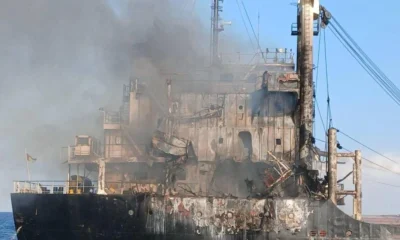
A US-sanctioned oil tanker failed to break through a newly imposed American naval blockade and was forced to turn back near the Strait of Hormuz, highlighting growing tensions in the region.

The vessel, identified as the Rich Starry, reversed its course after attempting to exit the Gulf, according to shipping data. The development comes just days after the United States enforced restrictions on ships linked to Iranian ports.

The blockade was announced by Donald Trump following the collapse of recent diplomatic talks with Iran. The move aims to restrict maritime traffic associated with Iranian trade.

Officials said that during the first 24 hours of enforcement, no vessel successfully crossed the blockade. Several ships, including the sanctioned tanker, complied with instructions from US forces and turned back toward regional waters.

The tanker is reported to be linked to a Chinese company previously sanctioned for dealing with Iran. It was carrying a cargo of methanol loaded from the United Arab Emirates at the time of the incident.

The situation underscores the rising risks in one of the world’s most critical oil transit routes. The Strait of Hormuz typically handles a significant share of global energy shipments, but traffic has sharply declined due to ongoing geopolitical tensions.

The blockade, which applies specifically to vessels travelling to or from Iranian ports, has added further uncertainty for shipping companies, insurers and global energy markets.

Continue Reading

Latest world news

Jaishanakar discusses Middle East crisis with Kuwait and Singapore counterparts, focus on Indian community

Jaishankar holds talks with Kuwait and Singapore counterparts on West Asia tensions, highlights Indian community safety.

Published

on

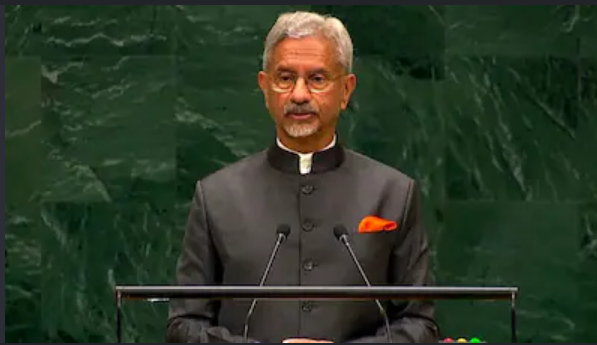
India’s External Affairs Minister S. Jaishankar held discussions with his counterparts from Kuwait and Singapore amid the ongoing crisis in West Asia, focusing on regional developments and the safety of Indian nationals.

In separate telephonic conversations, Jaishankar exchanged views with Kuwait’s Foreign Minister Sheikh Jarrah Jaber Al-Ahmad Al-Sabah and Singapore’s Foreign Minister Vivian Balakrishnan. The discussions come at a time of heightened tensions in the Middle East region.

According to details shared by the minister, his conversation with the Kuwaiti counterpart primarily revolved around the evolving regional situation and the well-being of the Indian community residing in Kuwait.

He described the interaction as a constructive exchange, highlighting India’s continued attention to the safety and interests of its citizens abroad during the crisis.

In a separate interaction with Singapore’s foreign minister, Jaishankar said the two sides discussed the ongoing conflict in West Asia and its broader implications.

The talks reflect India’s ongoing diplomatic engagement with key global partners as tensions in the Middle East continue to escalate, impacting regional stability and international concerns.

The latest outreach is part of a series of high-level communications by India aimed at closely monitoring developments in the region while safeguarding its strategic and humanitarian interests.

Continue Reading

Trending

© Copyright 2022 APNLIVE.com