
Latest world news
Trump meets Saudi Crown Prince MBS, sells weapons


Senators oppose American support to Saudi Arabia for Yemen war crimes
In a remarkable development, US President Donald Trump and Saudi Crown Prince Mohammed Bin Salman have discussed defence deals, security cooperation and investment in US, while a group of senators attempted to force a vote on a bill to curb American support to Saudi-led military intervention in Yemen.
Trump gave a warm welcome at White House to the powerful Crown Prince and credited US defence sales to the Saudis boosting American jobs. Both the leaders praised the strength of US-Saudi ties, which had grown sour during Obama administration because of different perceptions about Iran.
The body language of President Trump was of a successful businessman when he said, “Saudi Arabia is a very wealthy nation, and they’re going to give the United States some of that wealth, hopefully, in the form of jobs, in the form of the purchase of the finest military equipment anywhere in the world.”
Trump held up a printed pictorial chart describing different defence deals. Giving details of the already concluded deals of worth $12.5 billion, Trump pampered MBS saying “This is pea-nut for you”. Prince laughed on the way Trump was describing the defence deals between the two countries.
President Trump further tried to express his personal fondness to the Crown Prince saying, “I thought your father made a very wise decision. And I miss your father – a special man.” King Salman is scheduled to visit the United States later this year.
While addressing the media persons, Trump said, “[…] the relationship, now, is probably as good as it’s really ever been, and I think will probably only get better. Tremendous investments made in our country. And that means jobs for our workers, jobs for our people,”
Crown Prince, spoke at least ten sentences without break in English language. He reiterated Saudi pledge for $200 billion in investments that would end up at $400 billion when fully implemented. He said a ten year window for implementing the deal was under way. The official translators with the two leaders were looking surprised.
The Crown Prince said, “We are the oldest ally of America from the Middle East with more than 80 years of alliance and big interests – politically, economically, security. The foundation of the relation is really huge and deep.”
He further said, “And, as you know, Mr. President, from day one you’ve reached this office, we’ve planned to tackle $200bn for opportunities in the next four years, but it end up with $400bn for opportunities.”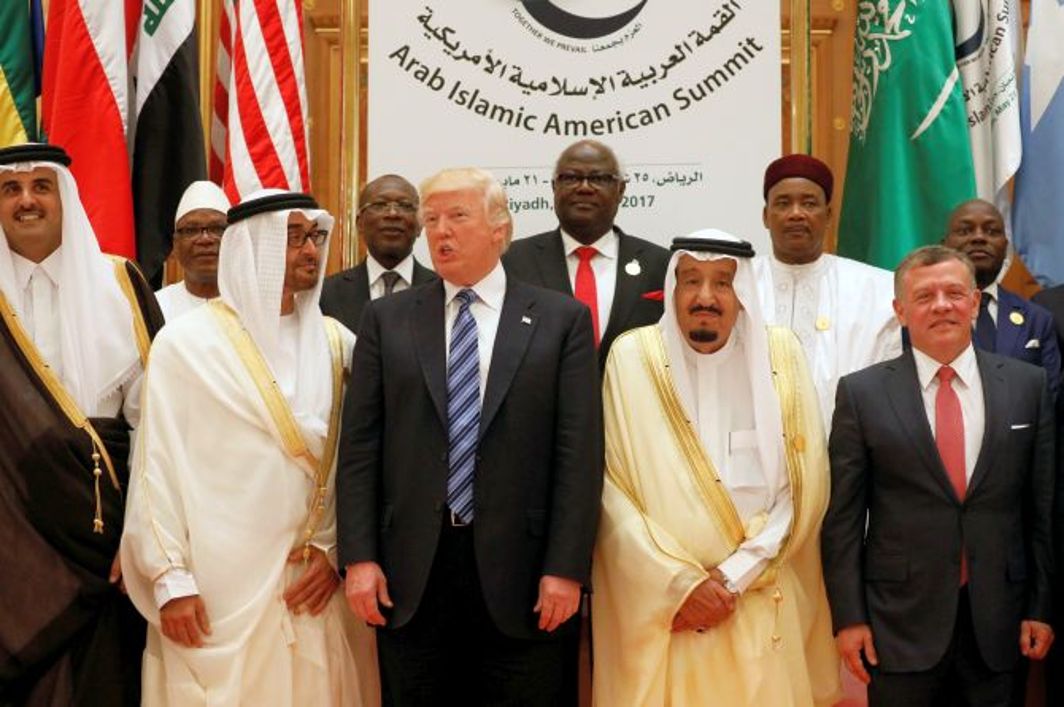
Meanwhile Washington Post “Today’s World View” column written by Ishan Tharoor, say that at the time of the meeting between the two leaders “a storm was brewing on Capitol Hill. A bipartisan group of senators attempted to force a vote on a bill that would curb American support to Saudi-led military intervention in Yemen, as well as asserting more broad congressional oversight of American’s wars.”
Read More: Now Israel want Saudi Crown Prince MBS to visit Tel Aviv
He further said that after hours of debate, opponents of the legislation narrowly won a vote to table the resolution, effectively killing it for the time being. “Still, it was a sign to the Saudis, who have places all their eggs in the Trump administration’s basket, that not all of Washington is on their side”.
A senior aide to Senator Bernie Sanders, one of the co-sponsors of the bill, was quoted saying to Today’s WorldView, “The intended message is that Congress is taking its constitutional role much more seriously in matters of war. Allies should understand that U.S. support is not open-ended and that Congress will intervene when there is evidence of rights abuses and war crimes violations.”
In May last year, US President Donald Trump, in his first visit overseas, travelled to Saudi Arabia where Riyadh organised a Muslim states Summit attended by over fifty heads of States. The two countries finalised $110 billion defence deals.
Read More: Coming soon, a new Trump version: A friend of Saudi Arabia
Qatar crisis erupted within days after Trump’s Riyadh visit when Saudi Arabia, UAE, Bahran and Egypt severed their ties with Doha, in early June, alleging it was supporting terrorist groups.
Read More: Trump calls Saudi Arabia to resolve Qatar crisis
A Senior analyst associated with Aljazeera Marwan Bishara has said that MBS reception in the Oval Room was a “tragicomedy”. He said, “On the political level, the American president is trying to sell the crown prince to the American public, when Saudi Arabia’s image is really bad.”
“Certainly the crown prince is coming in to pay up at least in part his commitments to the United States in terms of commercial deals and buying arms,” he added.
During his two and a half week sojourn to US, Saudi Crown Prince MBS will also travel to New York, Boston, Seattle, Los Angeles, San Francisco and Houston to cultivate investments.




Latest world news
S Jaishankar says India is a natural option for Russia amid Europe tensions
External Affairs Minister S Jaishankar said India remained a natural option for Russia as Moscow increasingly turned towards Asia amid strained relations with Europe. He highlighted the continuity of India-Russia ties and their significance for the balance of power in Asia.


Latest world news
Putin praises PM Modi, says he has very good ideas on Ukraine war
Russian President Vladimir Putin has praised Prime Minister Narendra Modi for repeatedly raising the need to end the Ukraine war, describing his ideas for a settlement as “very good”.

Latest world news
S Jaishankar calls Pakistan a “serial practitioner of terrorism” at UN
S Jaishankar criticised Pakistan at the UN General Assembly, referring to a “serial practitioner of terrorism” and warning against attempts to normalise terrorism.


Supreme Court stays defamation case against Rahul Gandhi over PM Modi remarks

Rahul Gandhi hosts high tea for INDIA bloc after Gyanesh Kumar protests

L Murugan quits Union ministry to strengthen BJP in Tamil Nadu

Amit Shah attacks Rahul Gandhi over Congress poll losses, questions SIR row

BJP focuses on religion as opposition pushes BDM strategy in UP

PM Modi speaks to Mark Carney as India and Canada push to strengthen ties

S Jaishankar says India is a natural option for Russia amid Europe tensions

CJP leaders Saurav Das, Ashutosh Ranka, Ajinkya Shinde sent to 5-day judicial custody
BJP focuses on religion as opposition pushes BDM strategy in UP
L Murugan quits Union ministry to strengthen BJP in Tamil Nadu

Afghan Men Try To Hang With The Jet Engine Of The Aircraft in Kabul- Afghanistan News – Kabul News
Trending Top 10 News: 10000 Crore Fine on Flipkart, Apple to Launch Unique Feature, Hdfc Bank Job Ad

Trending Top 10 News: Nokia 6310, Apple sales, Bachpan ka Pyar Video Kid, Dainik Bhaskar IT Raid

Trending Top 10 News: Canada bans Indian flights, Rain in Delhi NCR, AIMIM Twitter hacked, Raj Kundra case

Trending Top 10 News: Shein India, Apple New Service, Pocket Oxygen, Oppo Launched New Phone
-
 India News23 hours ago
Supreme Court stays defamation case against Rahul Gandhi over PM Modi remarks
-
 India News15 hours ago
Rahul Gandhi hosts high tea for INDIA bloc after Gyanesh Kumar protests
-
 India News15 hours ago
L Murugan quits Union ministry to strengthen BJP in Tamil Nadu
-
 India News15 hours ago
Amit Shah attacks Rahul Gandhi over Congress poll losses, questions SIR row
-
 India News13 hours ago
BJP focuses on religion as opposition pushes BDM strategy in UP
-
 India News3 hours ago
CJP leaders Saurav Das, Ashutosh Ranka, Ajinkya Shinde sent to 5-day judicial custody
-
 Latest world news3 hours ago
S Jaishankar says India is a natural option for Russia amid Europe tensions
-
 India News2 hours ago
PM Modi speaks to Mark Carney as India and Canada push to strengthen ties
