English हिन्दी
Connect with us

Latest world news

US economist Richard Thaler wins Nobel economic prize for integrating economics and psychology

Published

on

US economist Richard Thaler wins Nobel economic prize for integrating economics and psychology
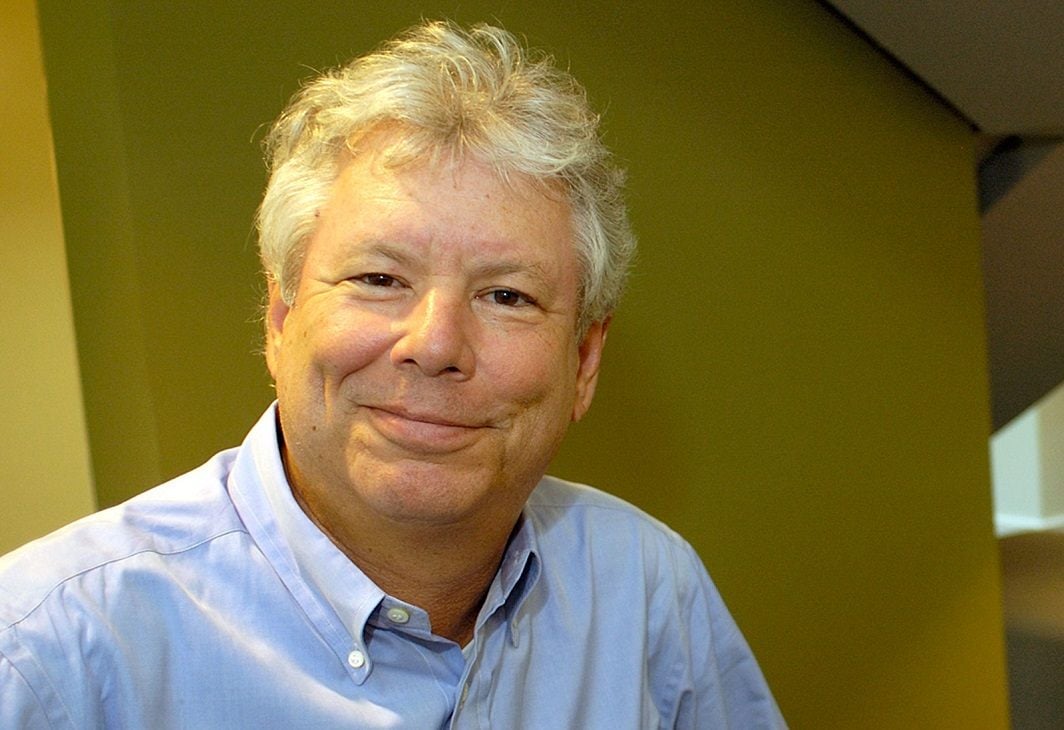
[vc_row][vc_column][vc_column_text]The 2017 Nobel prize for economics has been awarded to American economist Richard H Thaler for showing that economic financial decision-making is not always rational, but mostly human. The award was announced by the Royal Swedish Academy of Sciences on Monday.[/vc_column_text][vc_raw_html]JTNDYmxvY2txdW90ZSUyMGNsYXNzJTNEJTIydHdpdHRlci10d2VldCUyMiUyMGRhdGEtbGFuZyUzRCUyMmVuJTIyJTNFJTNDcCUyMGxhbmclM0QlMjJlbiUyMiUyMGRpciUzRCUyMmx0ciUyMiUzRUpPSU4lMjBVUyUyMElOJTIwQ09OR1JBVFVMQVRJTkclMjBSSUNIQVJEJTIwSC4lMjBUSEFMRVIlMjElM0NiciUzRUp1c3QlMjBhd2FyZGVkJTIwdGhlJTIwUHJpemUlMjBpbiUyMEVjb25vbWljJTIwU2NpZW5jZXMlMjAlMjZxdW90JTNCZm9yJTIwaGlzJTIwY29udHJpYnV0aW9ucyUyMHRvJTIwYmVoYXZpb3VyYWwlMjBlY29ub21pY3MlRTIlODAlOUQuJTIwJTNDYSUyMGhyZWYlM0QlMjJodHRwcyUzQSUyRiUyRnQuY28lMkZqVWFvYk82Y0E5JTIyJTNFcGljLnR3aXR0ZXIuY29tJTJGalVhb2JPNmNBOSUzQyUyRmElM0UlM0MlMkZwJTNFJTI2bWRhc2glM0IlMjBUaGUlMjBOb2JlbCUyMFByaXplJTIwJTI4JTQwTm9iZWxQcml6ZSUyOSUyMCUzQ2ElMjBocmVmJTNEJTIyaHR0cHMlM0ElMkYlMkZ0d2l0dGVyLmNvbSUyRk5vYmVsUHJpemUlMkZzdGF0dXMlMkY5MTczMzI2MjYwNzk0NDQ5OTYlM0ZyZWZfc3JjJTNEdHdzcmMlMjU1RXRmdyUyMiUzRU9jdG9iZXIlMjA5JTJDJTIwMjAxNyUzQyUyRmElM0UlM0MlMkZibG9ja3F1b3RlJTNFJTBBJTNDc2NyaXB0JTIwYXN5bmMlMjBzcmMlM0QlMjIlMkYlMkZwbGF0Zm9ybS50d2l0dGVyLmNvbSUyRndpZGdldHMuanMlMjIlMjBjaGFyc2V0JTNEJTIydXRmLTglMjIlM0UlM0MlMkZzY3JpcHQlM0U=[/vc_raw_html][vc_column_text]”Richard H. Thaler has incorporated psychologically realistic assumptions into analyses of economic decision-making. By exploring the consequences of limited rationality, social preferences, and lack of self-control, he has shown how these human traits systematically affect individual decisions as well as market outcomes,” Royal Swedish Academy of Sciences said in a press release.

The award-giving body also announced a prize-money of 9 million Swedish crown ($1.1 million) for Thaler.

“Well, I was pleased,” Thaler told the Nobel committee by video conference after winning the award. “I think the most important recognition is that economic agents are human, and economic models have to incorporate that,” he said.

Born on September 12, 1945, Thaler was one of the founders of the field of behavioural finance which studies how cognitive limitations influence financial markets.  He is also the founder of asset management firm Fuller & Thaler Asset Management.

His work had even earned him a cameo appearance in the 2015 movie “The Big Short”. The movie based on credit and housing bubble collapse that led to the 2008 global financial crisis was nominated for the Best Picture award at the Oscar.

Thaler is currently a professor of Behavioural Science and Economics at the University of Chicago’s Booth School of Business.

India’s former Reserve Bank of India governor Raghuram Rajan was also in the race for the prestigious award.[/vc_column_text][/vc_column][/vc_row]

Latest world news

Trump calls PM Modi a great man, hints at India visit in 2026 amid ongoing trade talks

Donald Trump praised PM Modi and hinted at a possible India visit next year while addressing ongoing trade and energy discussions between the two nations.

Published

on

Modi and Trump

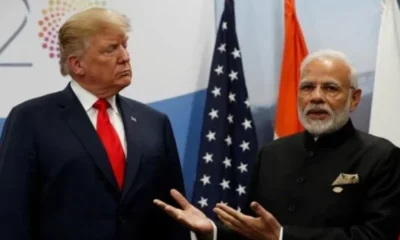
Former US President Donald Trump praised Prime Minister Narendra Modi, describing him as “a great man” and “a friend”, while suggesting he may visit India next year to strengthen bilateral trade relations between the two countries.

Speaking at a White House press briefing after unveiling a new plan to cut prices of weight loss drugs, Trump said his talks with PM Modi were “going great”. He added, “He (PM Modi) largely stopped buying from Russia. He is a friend of mine, and we speak, and he wants me to go there. We will figure that out; I will go… Prime Minister Modi is a great man, and I will be going.” When asked if the visit could take place in 2026, Trump responded, “It could be, yes.”

Trade negotiations and India’s energy stance

Trump’s remarks come amid ongoing trade discussions between India and the US following Washington’s decision to impose additional tariffs, including a 25 per cent duty, over India’s continued imports of Russian oil. The move came months after reports suggested Trump had dropped plans to attend the Quad Summit following tariff tensions.

Earlier this week, White House Press Secretary Karoline Leavitt reaffirmed Trump’s commitment to strengthening ties with New Delhi, noting that he had spoken directly with PM Modi during Diwali celebrations at the Oval Office.

India’s Ministry of External Affairs responded to Trump’s comments, reiterating that New Delhi’s energy decisions are based on “national interests and consumer welfare.” MEA spokesperson Randhir Jaiswal said India prioritises “stable prices and secured supplies through diversified sourcing” and noted ongoing efforts to deepen energy cooperation with the US.

Continue Reading

Latest world news

Zohran Mamdani creates history as New York’s first Indian-American Muslim mayor

Democrat Zohran Mamdani has made history by becoming the first Indian-American Muslim and youngest mayor of New York City in over 100 years.

Published

on

Zohran Mamdani

In a landmark political moment, Democrat Zohran Mamdani has been elected as the new mayor of New York City, marking multiple historic firsts. At 34, Mamdani will become the city’s youngest mayor in over a century and the first Muslim and Indian-American of South Asian heritage to hold the office.

Historic victory for a new generation

Mamdani’s win, achieved against heavyweight contenders like former governor Andrew Cuomo and Republican Curtis Sliwa, represents a generational shift in New York politics. His progressive platform—focusing on affordable housing, public transport, and social equity—struck a chord with voters.

Born in Kampala, Uganda, on October 18, 1991, to Ugandan scholar Mahmood Mamdani and Indian filmmaker Mira Nair, Zohran Mamdani spent his early years in Uganda and South Africa before moving to New York. A graduate of Bowdoin College with a degree in Africana Studies, he co-founded a Students for Justice in Palestine chapter during his university years.

The campaign and vision ahead

Mamdani’s grassroots campaign called for a rent freeze on stabilised units, universal childcare, tuition-free education, and fare-free buses. He also proposed building two lakh public housing units and city-run grocery stores. His plan to raise the minimum wage to $30 by 2030, funded through higher taxes on millionaires and corporations, drew both praise and criticism.

Despite facing ideological opposition and being branded as “too radical” by his rivals, Mamdani’s authenticity and mass connect drove one of the highest voter turnouts in five decades, with over 2 million ballots cast.

Now, as he prepares to assume office on January 1, the young leader faces the challenge of transforming his ambitious promises into policy amid scrutiny from conservatives and the business community alike.

Continue Reading

Latest world news

Trump orders US to test nuclear weapons, cites Russia, China, N Korea, Pakistan are at it

US Energy Secretary Chris Wright says tests won’t include explosions

Published

on

By

New tests of the US nuclear weapons system ordered up by US President Donald Trump will not include nuclear explosions, Energy Secretary Chris Wright has said.

It was the first clarity from the Trump administration since the president took to social media last week to say he had “instructed the Department of War to start testing our Nuclear Weapons on an equal basis”. Trump had said Russia, China, North Korea and Pakistan were still continuing to test nuclear weapons and saw no reason why the US should stick to following the no-nuclear test moratorium.

“I think the tests we’re talking about right now are system tests,” Wright said in an interview on Fox News’ “Sunday Briefing”. “These are not nuclear explosions. These are what we call noncritical explosions.”

Wright, whose agency is responsible for testing, added that the planned testing involves “all the other parts of a nuclear weapon to make sure they deliver the appropriate geometry and they set up the nuclear explosion.”

The confusion over Trump’s intention started minutes before he held a critical meeting in South Korea with Chinese President Xi Jinping.

Trump took to his Truth Social platform and appeared to suggest he was preparing to discard a decades-old US prohibition on testing the nation’s nuclear weapons.

Later that day, as he made his way back to Washington, Trump was coy on whether he really meant to say he was ordering the resumption of explosive testing of nuclear weapons — something only North Korea has undertaken this century — or calling for the testing of US systems that could deliver a nuclear weapon, which is far more routine.

He remained opaque on Friday when asked by reporters about whether he intended to resume underground nuclear detonation tests.

“You’ll find out very soon,” Trump told reporters aboard Air Force One on Friday, as he headed to Florida for a weekend stay.

The US military regularly tests its missiles that are capable of delivering a nuclear warhead, but it has not detonated the weapons since 1992.

The Comprehensive Nuclear Test Ban Treaty, which the US signed but did not ratify, has been observed since its adoption by all countries possessing nuclear weapons, North Korea being the only exception.

Trump announced his plans for nuclear tests after Russia announced it had tested a new atomic-powered and nuclear-capable underwater drone and a new nuclear-powered cruise missile.

Russia responded to Trump’s nuclear testing comments by underscoring that it did not test its nuclear weapons and has abided by a global ban on nuclear testing.

The Kremlin warned though, that if the US resumes testing its weapons, Russia will as well — an intensification that would restart Cold War-era tensions.

—AP/PTI

Continue Reading

Trending

© Copyright 2022 APNLIVE.com