
Latest world news
Yemen: UN calls all fighting sides to keep Hudaidah port open


Houthi leader vow to make Hudaidah quagmire for invaders
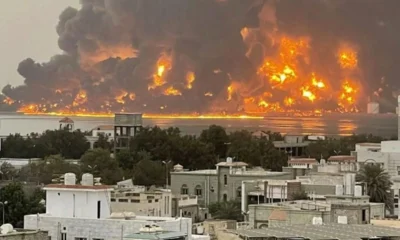
Amidst reports of Houthis’ tough response to the Saudi led aggression on port of Hudaidah, the UN Security Council has called on all sides involved in fighting to keep the port open to allow the delivery of aid and other essentials.
Saudi led coalition along with Emirati forces began their offensive to capture the port city from Houthi’s control three days ago, raising fears for its 600,000 civilian population and over the safety of its port. Hudaidah port handles 70 percent of imports into Yemen.
Russian Ambassador VassilyNebenzia, who holds the council presidency, said, that during a closed-door meeting, members of the Security Council expressed their “deep concern about the risks to the humanitarian situation”.
The council rejected Swedish proposal for a freeze to the military operation to allow time for talks on Houthi’swithdrawal from the Red Sea port city.
Read More: Saudi-led coalition launch fresh offensive in Yemen
Meanwhile Sana’a based Arabic language al-Masirah network reports that HouthileaderAbdulmalik al-Houthi, in a televised address on Thursday, has promised to turn the West Coast into a quagmire for the invaders. “With the help of God and the determination of our people, the West Coast will turn into a great swamp that overwhelms the invaders and oppressors,” he said.
 He further said, “We need today the sense of responsibility to face the campaigns of aggression in occupying our country. We have to move to fronts during the Eid. People must move to support the fronts”.
He asserted that our battle today is with “America and Israel, which see the control of the coast as a strategic target at the regional level.” He continued that the “UAE and the mercenaries are a tool and soldiers of the American, British and Israeli” governments.
Read More: Saudi Arabia hits MSF Cholera center in Yemen
US-Saudi supported Hadi’s government based in Riyadh, which is still recognized internationally, has earlier said that negotiations had failed to force Houthis from Hudaidah, and a grace period for UN-led peace efforts was over.
Adana Dieng, UN special adviser on the Prevention of Genocide, said in a statement on Thursday that the attack on Hudaida could heighten the risk of famine. He said, “The Yemeni portis a lifeline for the delivery of aid and the Coalition’s air attacks can kill many more people over time through famine and hunger when damaging such civilian infrastructure.”
According to UN estimates, more than 22 million people in Yemen are in need of aid, including 8.4 million who are at risk of starvation. It considers Yemen to be the world’s worst humanitarian crisis.
The current offensive on Hudaidah, the third largest city in Yemen, is the biggest battle in the three-year war between the Saudi led coalition and HouthiAnsarullah movement.
The reports say that at least 39 people, including 30 Houthi rebels and nine pro Hadi government troops have been killed during Hudaidah offensive. Houthis have claimed of destroying Emirati battleship before it could reach the port. Moreover, Houthis have instructed civilians to move away from the outskirts of the city and towards the city center.
Saudi Arabia’s official Al-Arabia net reports that the Yemeni army (loyal to Hadi government) announced on Thursday that it has advanced and reached the surroundings of the Hudeidah Airport.
Read More: Israeli jets flying over Yemen, alleges Houthi leader
Abu Zaraa al-Mahrami, the commander of the west coast front (loyal to virtually ousted AbdrabuhMansoorHadi government), has claimed that the Yemeni army and resistance forces are “only meters away from the Hudeidah Airport” after they’ve seized several areas and inflicted heavy losses on the Houthis.
However, Tehran based Press TV has quoted YahyaSharaf al-Din, the deputy chairman of Yemen’s Red Sea Ports corporation, saying that Hudaidah port is operating normally despite an Emirati-led push to capture the strategic coastline. He has also rejected reports about a halt in the services of the port due to UAE-led offensive.








Latest world news
S Jaishankar says India is a natural option for Russia amid Europe tensions
External Affairs Minister S Jaishankar said India remained a natural option for Russia as Moscow increasingly turned towards Asia amid strained relations with Europe. He highlighted the continuity of India-Russia ties and their significance for the balance of power in Asia.


Latest world news
Putin praises PM Modi, says he has very good ideas on Ukraine war
Russian President Vladimir Putin has praised Prime Minister Narendra Modi for repeatedly raising the need to end the Ukraine war, describing his ideas for a settlement as “very good”.

Latest world news
S Jaishankar calls Pakistan a “serial practitioner of terrorism” at UN
S Jaishankar criticised Pakistan at the UN General Assembly, referring to a “serial practitioner of terrorism” and warning against attempts to normalise terrorism.

Meerut murder: Muskaan Rastogi and Sahil Shukla get death sentence

Rahul Gandhi joins India Gate protest by Ankita Bhandari’s parents

Supreme Court questions EC over missing records in Sringeri election dispute

Dhruv Rathee gets fresh summons in 2018 BJP IT cell video case

Nobody can browbeat judiciary, Chief Justice warns over Rahul Gandhi’s march

India-US trade deal first phase finalised, drafting underway
Nobody can browbeat judiciary, Chief Justice warns over Rahul Gandhi’s march
Dhruv Rathee gets fresh summons in 2018 BJP IT cell video case
Supreme Court questions EC over missing records in Sringeri election dispute
Rahul Gandhi joins India Gate protest by Ankita Bhandari’s parents

Afghan Men Try To Hang With The Jet Engine Of The Aircraft in Kabul- Afghanistan News – Kabul News
Trending Top 10 News: 10000 Crore Fine on Flipkart, Apple to Launch Unique Feature, Hdfc Bank Job Ad

Trending Top 10 News: Nokia 6310, Apple sales, Bachpan ka Pyar Video Kid, Dainik Bhaskar IT Raid

Trending Top 10 News: Canada bans Indian flights, Rain in Delhi NCR, AIMIM Twitter hacked, Raj Kundra case

Trending Top 10 News: Shein India, Apple New Service, Pocket Oxygen, Oppo Launched New Phone
-
 India News24 hours ago
Meerut murder: Muskaan Rastogi and Sahil Shukla get death sentence
-
 India News23 hours ago
Rahul Gandhi joins India Gate protest by Ankita Bhandari’s parents
-
 India News22 hours ago
Supreme Court questions EC over missing records in Sringeri election dispute
-
 India News10 hours ago
Dhruv Rathee gets fresh summons in 2018 BJP IT cell video case
-
 India News7 hours ago
Nobody can browbeat judiciary, Chief Justice warns over Rahul Gandhi’s march
-
 India News2 hours ago
India-US trade deal first phase finalised, drafting underway
