
English हिन्दी
Connect with us

Economy news

Importance of Money | What is the importance of Money?

Money isn’t all that matters, yet Money is something significant. Past the essential needs, cash causes us accomplish our life’s objectives and supports — the things we care about most profoundly — family, training, medical care, good cause, experience and fun.

Published

on

Importance of Money

Money isn’t all that matters, yet Money is something significant. Past the essential needs, cash causes us accomplish our life’s objectives and supports — the things we care about most profoundly — family, training, medical care, good cause, experience and fun. It causes us get a portion of life’s intangibles — opportunity or autonomy, the occasion to benefit as much as possible from our aptitudes and gifts, the capacity to pick our own course throughout everyday life, monetary security. With cash, much good should be possible and much superfluous enduring evaded or disposed of.

However, Money has its own constraints as well. It can give us an opportunity to value the basic things in life all the more completely, however not the soul of guiltlessness and marvel important to do as such. Cash can give us an opportunity to build up our blessings and abilities, yet not the mental fortitude and control to do as such.

Money can enable us to have any kind of effect in the lives of others, yet not the longing to do as such. It can give us an opportunity to create and sustain our connections, however not the affection and caring important to do as such. It can simply make us tainted, idealist, narrow minded, and forlorn. What amount do you need? What is it going to cost you to get it? It is remembering these two inquiries that gives us a genuine feeling of cash’s relationship to satisfaction. In the event that we have not as much as what we need, or if what we have is costing us to an extreme, we can never be cheerful. We need Money to eat, rest, dress, work, play, relate, mend, move about, and appreciate solaces. We ought to recall in picking our style that it accompanies a sticker price.

Proof of the mental and otherworldly neediness of the rich and acclaimed fills our papers, magazines, tabloids, and TV programs and barely needs rehashing here. “We generally think in the event that we just had somewhat more cash, we’d be more joyful,” says Catherine Sanderson, a brain science teacher at Amherst College, “however when we arrive, we’re most certainly not.” “When you get fundamental human needs met, much more Money doesn’t make significantly more joy,” notes Dan Gilbert, a brain research educator at Harvard University and the writer of the new book Stumbling on Happiness.

Truly, we get a rush from the start from costly things. However, we before long become acclimated to them, a condition of running set up that financial specialists call the ‘gluttonous treadmill’. The issue isn’t cash, it’s us. For profound situated mental reasons, with regards to going through Money, we will in general esteem merchandise over encounters.

Moey can assist us with discovering more satisfaction, inasmuch as we probably am aware exactly what we can and can’t anticipate from it. Numerous investigates propose that looking for easy street at a store is a costly pointless activity. Cash can get us some joy, yet just on the off chance that we go through our cash appropriately. We should purchase recollections.

Read Also: What are the best ways to money investment?

How much Money it costs isn’t the issue, however how much the cash costs us is significant. Cash ought not cost us our spirit, connections, poise, wellbeing, knowledge and delight in basic things of life. Individuals who sort out what they really esteem and afterward adjust their cash to those qualities have the most grounded feeling of budgetary and individual prosperity.

Economy news

ITR filing last date today: What taxpayers must know about penalties and delays

The deadline for ITR filing ends today, September 15. Missing it may lead to penalties, interest charges, refund delays, and loss of tax benefits.


Published

on

Income Tax Return

The deadline to file Income Tax Returns (ITR) for most taxpayers, including salaried individuals, pensioners, and small businesses not requiring audit, ends today, September 15. Those who miss the due date face penalties, interest charges, and loss of certain tax benefits.

Penalties for late filing

If the return is not filed by the deadline, taxpayers can still file a belated return until December 31. However, under Section 234F of the Income Tax Act, late filing attracts penalties.

  • For income up to Rs5 lakh: penalty is capped at Rs1,000.
  • For income above Rs5 lakh: penalty increases to Rs5,000.

Additionally, if any tax remains unpaid, Section 234A imposes an interest of 1% per month (or part thereof) until the return is filed.

Consequences of missing deadline

  • Loss of certain tax benefits: Belated filers cannot carry forward specific losses such as business or capital losses.
  • Restrictions on tax regime change: Taxpayers lose the option to switch between old and new tax regimes after the deadline.
  • Refund delays: Those eligible for refunds will face delays compared to timely filers.

Steps to file before time runs out

  • Gather documents: Form 16, Form 26AS, Annual Information Statement (AIS), bank interest certificates, and proofs of investments or deductions.
  • Use the e-filing portal: File immediately to avoid last-minute portal congestion.
  • Verify your return: Ensure the ITR is verified electronically or physically for it to be considered valid.

Continue Reading

Economy news

India’s GDP surges 7.8% in Q1, outpaces estimates and China

India’s GDP surged 7.8% in Q1 2025-26, the highest in five quarters, driven by strong services and agriculture sector growth, according to NSO data.
Published

on

GDP Growth

India’s economy recorded a sharp growth of 7.8% in the April-June quarter (Q1) of 2025-26, surpassing the earlier estimate of 6.5% and outpacing China’s 5.2% growth in the same period. The figure also marks a notable rise from the 6.5% growth in the corresponding quarter last year, making it the fastest expansion in the last five quarters.

Strong performance across key sectors

According to data released by the National Statistical Office (NSO), the surge was driven primarily by the services sector, which expanded 9.3% compared to 6.8% a year ago, and the agriculture sector, which rose 3.7% against 1.5% last year.

The construction sector, however, witnessed a slowdown, growing 7.6% compared to 10.1% in the same quarter of the previous fiscal.

RBI’s earlier forecast

Earlier this month, the Reserve Bank of India (RBI) had projected a more modest Q1 growth of 6.5%, with overall real GDP growth for 2025-26 expected at 6.5%. RBI Governor Sanjay Malhotra attributed the positive outlook to favorable conditions, including a good monsoon, lower inflation, and strong government capital expenditure.

He said, “The above normal southwest monsoon, lower inflation, rising capacity utilisation and congenial financial conditions continue to support domestic economic activity. The supportive monetary, regulatory and fiscal policies, including robust government capital expenditure, should also boost demand. The services sector is expected to remain buoyant, with sustained growth in construction and trade in the coming months.”

India remains fastest-growing major economy

With China reporting 5.2% growth in April-June, India has retained its position as the world’s fastest-growing major economy. The latest figures highlight resilience in the face of external pressures, including recent US tariffs on Indian imports.

Continue Reading

Economy news

Sensex falls 600 points, nifty slips 180 as US tariffs hit Indian markets

Indian equity markets witnessed sharp declines as US tariffs on Indian imports took effect. Sensex dropped over 600 points, while Nifty fell nearly 180 points in early trade.
Published

on

Stock market crash

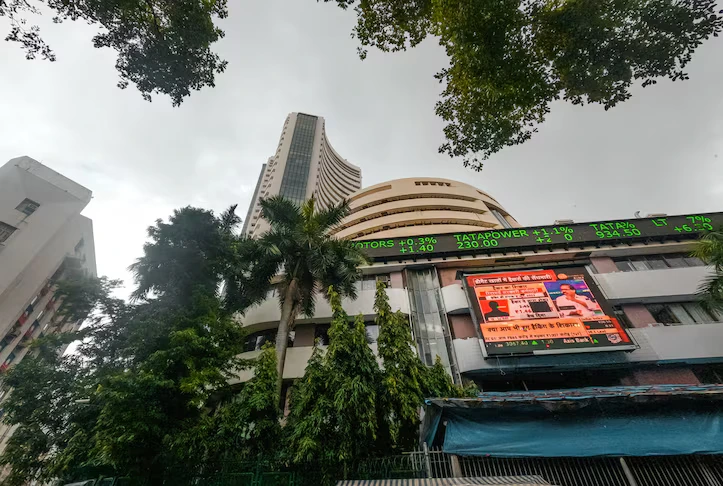
Indian stock markets opened lower on Thursday, reeling under the pressure of fresh US tariffs imposed on Indian goods.

At 9:17 am, the BSE Sensex dropped over 600 points to trade at 80,315, while the Nifty 50 declined nearly 180 points to 24,583. This comes a day after Washington enforced an additional 25% duty on Indian imports, raising the total tariff to 50%.

Broad-based sell-off across sectors

Market sentiment remained weak with 14 of the 16 major sectors posting losses. Small-cap and mid-cap indices also dipped, losing 0.2% and 0.1%, respectively.

The fall follows a steep correction earlier this week. On Tuesday, before the tariff announcement, both Nifty and Sensex fell by around 1% — their sharpest single-day decline in three months. Domestic markets remained closed on Wednesday for a local holiday.

Analysts warn of near-term pressure

According to market experts, Indian equities are likely to witness further volatility as investors digest the impact of the US action. The tariffs were imposed in retaliation for India’s continued crude oil imports from Russia, a move that has escalated trade tensions between the two nations.

Continue Reading

Trending

© Copyright 2022 APNLIVE.com











