English हिन्दी
Connect with us

India News

What is Education? | What is the definition of Education?

Education is importance inside society. It’s the reason for the prolongation of culture, for the guidance of people, for the advancement of society and for different purposes.

Published

on

education

Education is importance inside society. It’s the reason for the prolongation of culture, for the guidance of people, for the advancement of society and for different purposes.

In numerous spots, education is separated into levels and modalities. In the USA a couple of instances of levels are preschool, secondary school, auxiliary school and college. Remember that every nation has its own education framework and there are numerous varieties.

Modalities, then again, might be:

  • School training
  • Proficient and innovative education
  • Schooling for youth and grown-ups
  • Separation schooling
  • Among others.

The school education methodology, which contains the conventional sort we’re comfortable with (essential and school education), hasn’t gone through numerous progressions over the long haul.

Notwithstanding, advanced change has been making critical changes all through schooling. In this post, you’ll find out about the effects of these progressions and their advantages for education and understudies.

What is the idea of schooling?

Education is an instructing and learning framework expecting to mingle people and expand their turn of events.

In spite of the fact that it might be normally connected to information, these two terms ought not be confounded. Schooling is identified with moral standards, while information is more extensive than that.

In spite of being connected to moral principles, it doesn’t speak to them in itself. Accordingly, schooling is viewed as a broad framework, with various techniques, methods and apparatuses.

Taching in schooling is a central issue of this assortment, look at it underneath!

Teaching techniques

As you’ve seen, there are many showing techniques inside education.

We should become familiar with a touch more about the most widely recognized ones!

  • School education: Is our general public’s conventional education, wherein all people need to go to during their adolescence and young years. It is partitioned into levels: essential and school.
  • Custom curriculum: A methodology focused on individuals with inabilities or psychological maladjustment.
  • Proficient and mechanical education: Focused on labor force preparing. It permits understudies to create specialized information in a given proficient and aptitudes to help them in the employment market.
  • Education for Youth and Adults: Aimed at the individuals who didn’t finish their fundamental tutoring at the proper age. This methodology ought to be offered for nothing out of pocket by the educational frameworks.
  • Distance education: A methodology that got well known with the development of the computerized age and has been growing a great deal from that point forward. As the name says, this encouraging methodology happens online with the assistance of the web, ordinarily by methods for DE stages.

Education in the online age

Advances in innovation, the ascent of the computerized age and the web have influenced numerous regions, including schooling.

Around there, we can watch an expanding utilization of innovation in study halls and a total disturbance of the traditional educating models.

Establishments are progressively exploiting the accommodation and advantages of highlights, for example, the web, electronic gear, gamification and online stages so as to improve teaching.

In situations where these two models are utilized, we have what is called hybrid education.

Crossover showing stays up with the latest with innovative advances, standing out for students and reducing expenses while keeping up nearby education attributes.

Then again, numerous foundations are starting to incorporate online education completely and giving whole courses on the web, particularly with regards to advanced education.

Likewise, another developing territory inside separation schooling is casual courses. Since they offer preparing outside the scholarly circle, these courses are excluded from the idea of training, yet present a significant open door for the individuals.

What is distance education?

So as to pressure the clarification of the past theme, when managing nearby courses, we can discover advanced education courses (i.e., schooling model) and casual courses, which are not an instructive model, but rather are important for distance education.

To put it plainly, distance education is an instructive methodology dependent on classes that occur halfway or absolutely in a virtual climate.

All in all, teachers and understudies don’t have to meet face to face so as to pass on content. The classes can be transferred on particular stages through video classes and correlative substance.

So as to make distance education successful, the stage on which the courses are facilitated should offer a decent virtual learning climate (VLE), be adaptable, permit correspondence and backing different substance designs.

No issues up until now?

Presently, continue perusing and look at the principle DE structures, qualities and terms.

Online advanced education

Distance education in advanced education has been becoming consistently over the previous years and it’s required to continue developing.

In spite of the fact that it’s increasing a ton of fame and drawing in numerous individuals — particularly the individuals who don’t have the opportunity or wish to spend less so as to acquire a degree — , online school courses aren’t relevant to any school course.

Clinical school, for instance, has not been affirmed to be completely given online in many nations.

Regardless of this, online school courses present a significant advance and can be advantageous much of the time. For instance, with the goal for foundations to have more understudies and for understudies who don’t have some other choice to get a professional education.

Casual courses

Casual courses are online seminars regarding any matter that pass on information on the web.

They are typically given by Distance education stages that have the help to communicate the virtual exercises, correlative materials and have intelligent conditions.

They are searched after by the individuals who wish to supplement their essential schooling, increase additional information or create themselves actually.

Similarly as with online school courses, casual courses have likewise been introducing an enormous development as of late. All things considered, they present various focal points, which are:

  • Wide scope obviously subjects with clear, explicit and pragmatic targets
  • Effectively available
  • Minimal effort in examination with on location courses
  • Permit self-sufficiency and adaptability for understudies and educators
  • Many offer authentications that can be remembered for one’s resume.

Also what these courses speak to for the economy, since numerous individuals with a particular ability or information think that its simpler to transform this into work, making their own online course, regardless of whether this is your primary work or something to enhance your pay.

Distance Teacher

A DE educator’s job is like teachers in conventional educating. Educators must arrangement their classes, record the course, realize how to pass on the substance well, teach, inspire their understudies and create exercises.

The thing that matters is that in an online class, the substance will be passed on to a bigger number of understudies anyplace on the planet.

Also, web-based education presents favorable circumstances for educators that don’t exist in on-location teaching, for example,

  • Having the option to work from anyplace, even from home.
  • Having the steady help of a few computerized advancements in upgrading the classes.
  • Having the option to teach what you love.
  • Having the option to scale the course.

Furthermore, there’s additional. With the notoriety of casual courses and the simplicity of having your own business these days, any individual who wishes to share information can turn into an online educator.

DE guide

In separation training, another job rises, the guide. A Distance guide works with the teacher offering help to understudies, reaching them, responding to questions, amending assessments, and so on

Guides exist because of the multifaceted nature of online classes, since these classes can have a tremendous extent.

As we’ve clarified before, online courses can be given to a lot bigger number of individuals, and teachers for the most part can’t fulfill the entirety of understudies’ needs.

To take care of this issue, the coach’s assistance is significant so as to keep up the great nature of the online classes.

Contemplating on the web

One of the incredible worries of the individuals who are still new to the universe of separation training is whether this model truly works, particularly the individuals who wish to consider on the web, yet don’t have the foggiest idea whether they’ll progress admirably while examining on the web.

All things considered, as we referenced toward the start of this article, DE isn’t for everybody. However, the individuals who truly need it or are inspired to make it work can acquire great outcomes.

Since there are tips that make Distance education understudies’ life simpler.

  • Arranging: Having a reasonable objective, sorting out undertakings, and setting up objectives and rules.
  • Time the executives: Setting aside an ideal opportunity for reading and for course exercises.
  • Organizing: Making decisions that will be best for you and for your investigations at every second.
  • Saving a space for considering: Having your own peaceful spot, a work area, seat and the best possible gear.
  • Knowing your cutoff points: Not trying too hard and realizing how to adjust exercises.
  • Keeping away from interruptions: Focus just on the class, and leaving your mobile phone and different things for some other time.
  • Taking breaks: Remembering to take breaks to rest and eat.
  • Not delaying: Doing your activities at the correct time.
  • Posing inquiries and building up your insight: Don’t be embarrassed to pose inquiries, contact your educator and coach, and find other extra substance.
  • Besides, Distance has one extraordinary positive point for understudies: its noticeable quality.

In contrast to the conventional model, online courses have an authoritarian view that the homeroom is broken, and understudies are those really associated with the learning cycle. This qualities self-rule and is unquestionably additionally persuading for the individuals who are learning.

Read Also: What is the Importance of Women Education in India? Women Education.

Is distance education justified, despite all the trouble?

In the wake of improving comprehension of what education speaks to and how it has been renewed with distance education

India News

G RAM G bill replacing MGNREGA passes Parliament amid opposition walkout and protests

The G RAM G Bill replacing MGNREGA has been passed by Parliament after overnight debate in the Rajya Sabha, triggering protests and walkouts by opposition parties.

Published

on

Parliament

Parliament has cleared the Viksit Bharat Guarantee for Employment and Livelihood Mission (Rural) Bill, commonly referred to as the G RAM G Bill, paving the way for the replacement of the Mahatma Gandhi National Rural Employment Guarantee Act (MGNREGA). The legislation was passed within two days amid sharp political confrontation, walkouts and overnight protests by opposition parties.


The bill was approved by the Lok Sabha despite repeated disruptions and protests. In the Rajya Sabha, the debate stretched beyond midnight, with voting held around 12.15 am. The bill was eventually passed by a voice vote after opposition members staged a walkout, leaving the ruling alliance members present in the House.

Opposition objects to name change and provisions

The Congress and other opposition parties mounted a strong challenge to the bill, objecting both to the change in the scheme’s name and its revised framework. A key point of contention was the removal of Mahatma Gandhi’s name from the legislation, which opposition leaders said reflected an ideological shift rather than a policy necessity.

Congress president Mallikarjun Kharge launched a sharp attack during the Rajya Sabha debate, urging the government to withdraw the bill and warning that it would harm the rural poor. He accused the government of speaking in the name of welfare while undermining the interests of vulnerable communities, making an emotional appeal to reconsider the legislation.

Several opposition members initially demanded that the bill be referred to a standing committee for detailed scrutiny. When that demand was not accepted, they called for the bill’s withdrawal and later staged a walkout. Members of the Trinamool Congress and other parties subsequently sat on a dharna within Parliament premises.

Heated exchanges in the Upper House

The debate witnessed intense exchanges between the treasury benches and the opposition. Trinamool Congress MP Derek O’Brien linked the passage of the bill with developments in West Bengal, alleging that the Centre’s actions had consequences for the implementation of rural employment schemes in the state. He also referred to the state government’s decision to rename its employment initiative following the Lok Sabha vote.

As Rural Development Minister Shivraj Singh Chouhan rose to reply, opposition members raised slogans demanding the withdrawal of what they termed a “black bill”. When the protests continued, opposition MPs walked out, allowing the bill to be passed without their presence.

Responding sharply, Chouhan criticised the walkout and accused the opposition of refusing to engage in debate. He defended the government’s move, arguing that the earlier scheme had suffered from corruption and inefficiencies, and said the new law was drafted after consultations with stakeholders.

Government defends overhaul of rural employment scheme

The government has maintained that updating the two-decade-old MGNREGA framework was necessary to address structural shortcomings and align it with current rural needs. According to the provisions outlined, the new law increases the guaranteed days of work from 100 to 125 while retaining key elements of the earlier scheme.

However, critics have pointed out that employment under the new framework will be based on pre-approved plans rather than demand-driven applications at the gram panchayat level. The work categories have also been streamlined into four segments—water security, core rural infrastructure, livelihood-related assets, and climate resilience—raising concerns that local flexibility may be reduced.

Opposition leaders have argued that these changes dilute the original spirit of MGNREGA, which was designed as a rights-based, demand-driven employment guarantee programme.

Protests continue after passage

Following the bill’s passage, opposition parties reiterated their charge that the legislation weakens the guarantee, livelihood assurance and social security that formed the core of the original programme introduced in 2005. Despite these objections, the government’s numerical strength ensured the bill’s smooth passage through both Houses.

With parliamentary approval now secured, the G RAM G Bill is set to replace MGNREGA, marking a significant shift in India’s rural employment policy framework amid continuing political debate.

Continue Reading

India News

Priyanka Gandhi meets Nitin Gadkari over Kerala road projects, light moments mark discussion

Priyanka Gandhi met Nitin Gadkari in Parliament to discuss road projects in Kerala, with the meeting marked by humour, political remarks and an informal food tasting.

Published

on

Priyanka Gandhi meets Nitin Gadkari (1)

Congress MP Priyanka Gandhi Vadra on Thursday met Union Road Transport and Highways Minister Nitin Gadkari at his office in Parliament to raise issues related to road infrastructure projects passing through Kerala. The meeting combined formal discussions with lighter moments, including a humorous exchange and an unexpected food tasting session.

Kerala road projects discussed at Parliament meeting

Priyanka Gandhi, the Member of Parliament from Wayanad in Kerala, discussed six road projects that pass through the state. During the interaction, Nitin Gadkari clarified that some of these projects fall under the jurisdiction of the Kerala government and therefore cannot be directly handled by the Centre. However, he assured the Congress leader that the remaining proposals would be examined.

According to those present, the discussion remained cordial, with both sides acknowledging administrative limitations while exploring possible ways forward.

‘Bhai ka kaam ho gaya’ remark draws laughter

The meeting also saw a light-hearted moment when Gadkari referred to a recent interaction with Rahul Gandhi, the Leader of the Opposition in the Lok Sabha. He said Rahul Gandhi had met him earlier regarding road-related concerns in Rae Bareli.

In a humorous remark, Gadkari said that if work was done for the brother but not for the sister, it could lead to complaints. The comment prompted laughter from Priyanka Gandhi and others present in the room.

Congress confident of future action in Kerala

During the conversation, Priyanka Gandhi expressed confidence about the Congress party’s prospects in the upcoming Kerala Assembly elections. She indicated that proposals currently under the purview of the Left Front government in the state would be taken forward once Congress comes to power.

Her remarks reflected political confidence while keeping the focus on infrastructure needs in Kerala.

A homemade dish adds informal touch

Apart from policy discussions, the meeting included an informal culinary moment. Nitin Gadkari had prepared a rice-based dish after learning the recipe from online videos. Visitors to his office were offered rice balls served with chutney.

Gadkari encouraged Priyanka Gandhi to taste the dish, and she, along with Congress leader Deepender Singh Hooda, was seen sampling the food while continuing their conversation with the minister.

Continue Reading

India News

AAP dominates Punjab zila parishad polls, leads in most panchayat samiti zones

AAP has won 201 out of 317 declared zila parishad zones in Punjab so far and is leading in a majority of panchayat samiti seats, with counting still underway.

Published

on

Punjab Zila Parishad Polls

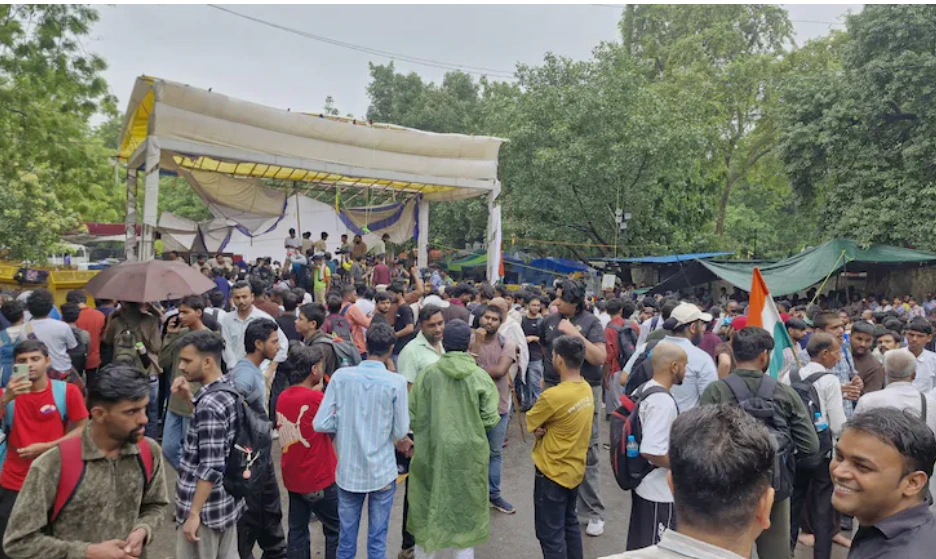
The ruling Aam Aadmi Party (AAP) has recorded a strong performance in the Punjab zila parishad elections and is leading in the majority of panchayat samiti zones, as per results declared so far on Thursday. The counting process is still underway and complete results are awaited, officials said.

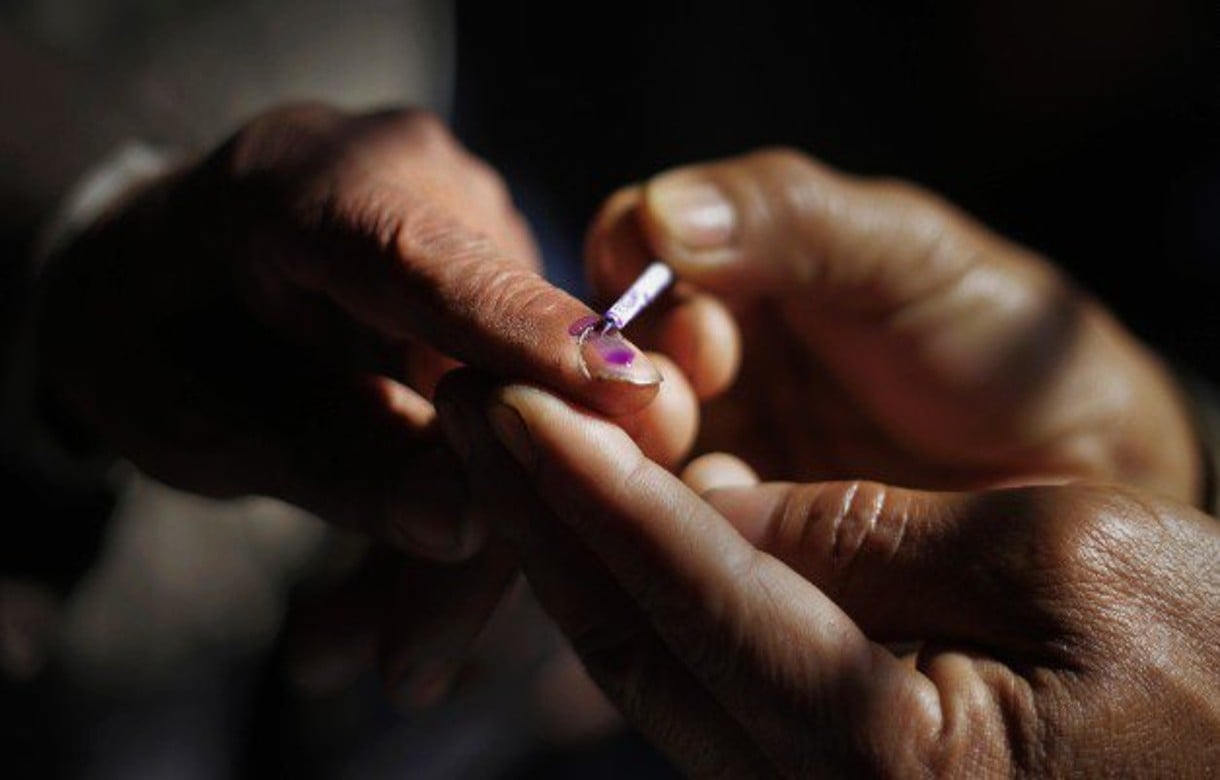
Polling for the rural local bodies was held on December 14 to elect representatives across 347 zones of 22 zila parishads and 2,838 zones of 153 panchayat samitis in the state.

AAP secures clear edge in zila parishads

According to the available results, outcomes have been declared for 317 zila parishad zones so far. Of these, the AAP has won 201 zones, placing it well ahead of other parties.

The Congress emerged second with victories in 60 zones, followed by the Shiromani Akali Dal (SAD) with 39 zones. The BJP won four zones, the BSP secured three, while independents claimed 10 zones.

District-wise data shows that the AAP won 22 zones in Hoshiarpur, 19 each in Amritsar and Patiala, 17 each in Tarn Taran and Gurdaspur, and 15 zones in Sangrur. The Congress registered its best performances in Gurdaspur and Ludhiana with eight zones each, followed by Jalandhar with seven zones. The SAD performed strongly in Bathinda with 13 zones, while the BJP managed to win four zones in Pathankot.

AAP leads in panchayat samiti results

In the panchayat samiti elections, trends declared so far indicate that the AAP is leading in a majority of zones. However, officials clarified that counting is ongoing and the final picture will be clear only after all ballot papers are tallied.

Kejriwal, Mann reject opposition allegations

Reacting to the trends, AAP supremo Arvind Kejriwal said the party’s performance reflected strong rural support for the Bhagwant Mann government’s work. Addressing the media in Mohali along with Chief Minister Bhagwant Mann, Kejriwal dismissed allegations of irregularities raised by opposition parties.

He said the elections were conducted in a fair and free manner and claimed that the results so far showed a clear wave in favour of the AAP in rural Punjab. Kejriwal stated that nearly 70 per cent of the zila parishad and panchayat samiti seats had gone in favour of the party.

Congress, SAD question poll conduct

The Congress and the Shiromani Akali Dal, however, accused the ruling party of misusing official machinery. Punjab Congress chief Amrinder Singh Raja Warring alleged that the AAP had “stolen” the rural mandate and claimed that the results did not reflect genuine public support.

Opposition parties had earlier also accused the AAP government of high-handedness during the polling process, allegations that the ruling party has strongly denied.

Continue Reading

Trending

© Copyright 2022 APNLIVE.com