English हिन्दी
Connect with us

India News

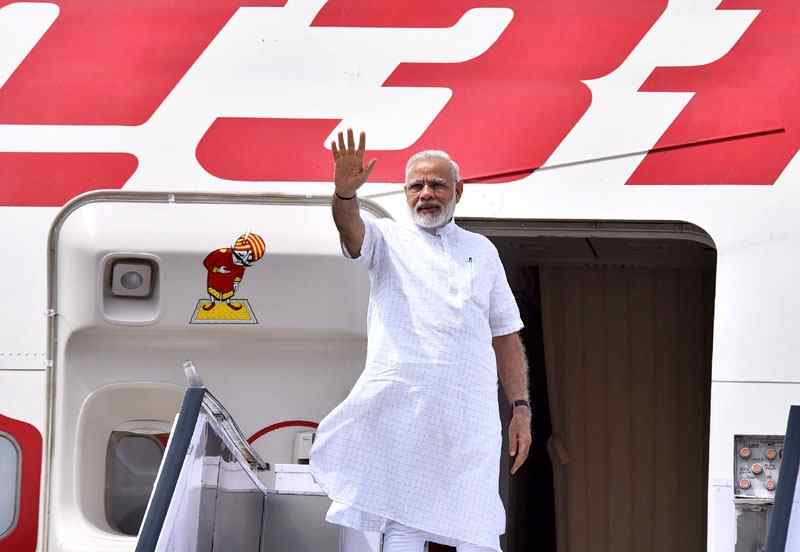
PM leaves for first ever Israel visit

Published

on

[vc_row][vc_column][vc_column_text]Haretz expects BJP will anchor ties with greater alacrity

Prime Minister Narendra Modi left for his three-day visit to Israel Tuesday morning, being the first Indian PM to land in that country. His Israeli counterpart Benjamin Netanyahu and his senior ministers and large number of dignitaries will receive him at Tel Aviv airport, the rare honor given to Pope and the US President.

At the end of his Israel visit, PM is scheduled to visit Hamburg in Germany from June 6 to 8 for attending G-20 Summit.

In a series of Facebook posts, Prime Minister said “I will be visiting Israel on 4-6 July, 2017 upon invitation of Prime Minister Benjamin Netanyahu. As the first Prime Minister to do so, I am greatly looking forward to this unprecedented visit that will bring two countries and people closer. This year India and Israel are marking 25 years of our diplomatic relations.”

While describing his priorities during the visit Prime Minister said, “I will have in-depth talks with Prime Minister Netanyahu on the full spectrum of our partnership and strengthening it in diverse fields for mutual benefit. We will also have the chance to discuss major common challenges like terrorism.”

He said, “I will visit the Yad Vashem memorial Museum to honor the memory of the victims of the holocaust that counts among the greatest tragedies in human history. Later, I will also pay my respects to the courageous Indian soldiers who laid down their lives during the liberation of Haifa in 1918.”

In one of his tweets PM expressed his enthusiasm for meeting his Israeli counterpart.[/vc_column_text][vc_raw_html]JTNDYmxvY2txdW90ZSUyMGNsYXNzJTNEJTIydHdpdHRlci10d2VldCUyMiUyMGRhdGEtbGFuZyUzRCUyMmVuJTIyJTNFJTNDcCUyMGxhbmclM0QlMjJlbiUyMiUyMGRpciUzRCUyMmx0ciUyMiUzRUklMjBsb29rJTIwZm9yd2FyZCUyMHRvJTIwaG9sZGluZyUyMGV4dGVuc2l2ZSUyMHRhbGtzJTIwd2l0aCUyMG15JTIwZnJpZW5kJTJDJTIwJTNDYSUyMGhyZWYlM0QlMjJodHRwcyUzQSUyRiUyRnR3aXR0ZXIuY29tJTJGSXNyYWVsaVBNJTIyJTNFJTQwSXNyYWVsaVBNJTNDJTJGYSUzRSUyMCUzQ2ElMjBocmVmJTNEJTIyaHR0cHMlM0ElMkYlMkZ0d2l0dGVyLmNvbSUyRm5ldGFueWFodSUyMiUzRSU0MG5ldGFueWFodSUzQyUyRmElM0UlMkMlMjB3aG8lMjBzaGFyZXMlMjBhJTIwY29tbWl0bWVudCUyMGZvciUyMHZpYnJhbnQlMjBJbmRpYS1Jc3JhZWwlMjB0aWVzLiUzQyUyRnAlM0UlMjZtZGFzaCUzQiUyME5hcmVuZHJhJTIwTW9kaSUyMCUyOCU0MG5hcmVuZHJhbW9kaSUyOSUyMCUzQ2ElMjBocmVmJTNEJTIyaHR0cHMlM0ElMkYlMkZ0d2l0dGVyLmNvbSUyRm5hcmVuZHJhbW9kaSUyRnN0YXR1cyUyRjg4MTg1MTQ5NDA2Mzk0MzY4NCUyMiUzRUp1bHklMjAzJTJDJTIwMjAxNyUzQyUyRmElM0UlM0MlMkZibG9ja3F1b3RlJTNFJTBBJTNDc2NyaXB0JTIwYXN5bmMlMjBzcmMlM0QlMjIlMkYlMkZwbGF0Zm9ybS50d2l0dGVyLmNvbSUyRndpZGdldHMuanMlMjIlMjBjaGFyc2V0JTNEJTIydXRmLTglMjIlM0UlM0MlMkZzY3JpcHQlM0U=[/vc_raw_html][/vc_column][/vc_row][vc_row][vc_column][vc_column_text]Before the arrival of PM Modi in Tel Aviv, Israel on Monday backed India on the issue of terror threat from Pakistan.  Mark Sofer, Deputy Director General in-charge of the Asia Pacific Division at Israeli foreign office told an Indian journalist on Monday, “Israel supports India on terrorism emanating out of Pakistan, hook, line and sinker. But we are not asking quid pro quo… the horrors coming from Pakistan…the Lashkar-e-Toiba, the rogue operations from Pakistan. We say India has the right to defend itself, just like Israel has right to defend itself. I don’t see difference between LeT and Hamas. A terrorist is a terrorist is a terrorist.”

The Israeli officials described Modi’s visit as “historic and special”. According to sources the groundwork was prepared by “seven pre-visits” from different ministries and departments from India.

Prime Minsiter Modi will skip visiting Palestinian territory during his Israel visit. Traditionally, most foreign dignitaries visit both sides of the rival territories. Recently, US President Donald Trump had also visited Ramallah, the headquarters of Palestinian Authority.

While discussing about Modi skipping visit to Palestinian territory, the Israeli official was quoted as saying there was “nothing sinister or special” about this. “Israel has de-hyphenated its relationship… and PM Modi’s visit is a bilateral visit”, he added.

Haaretz, an important Israeli newspaper, while discussing PM’s visit on Tuesday, analyzed as to how relations passed through different phases between the two countries. It said that the two leaders would mark a significant warming up of ties and express fulfillment of a long unrequited desire, dating back to the early days of the Jewish state, for close ties with, and recognition from, India.

Discussing the historical perspective, the daily said, “In those early days, David Ben-Gurion (primary founder and the first PM of Israel) and other key Zionist leaders made strenuous bids for political and diplomatic support from Indian nationalist leaders like Mahatma Gandhi and Jawaharlal Nehru.”

Referring to Albert Einstein’s letter to Jawaharlal Nehru pleading to establish ties with Israel written in the summer of 1947, the daily said, “But not even Einstein could convince Nehru. India voted against the UN partition plan of Mandate Palestine in 1947 and later, in 1950, extended recognition to the state of Israel but without establishing diplomatic relations.” In fact Ben-Gurion asked Albert Einstein to write letter to Nehru at that time.

Complaining about India’s attitude those days, the newspaper said, “In the absence of any ideological or diplomatic support from Gandhi for Zionism, or later from the Indian Republic for Israel, it was an unusual and difficult affection for Ben-Gurion to carry – much like a one-sided love affair.”

Haaretz further said that, “Self-determination for the Palestinian people was significant issue for Nehru, who gave them strong support and turned away from relations with Israel. There was a regional political consideration for India in the 1950s: the Kashmir dispute with Pakistan. India hoped for Arab support for the Indian case against Pakistan by extending its strong support to the Palestinians and not towards Israel.”

Discussing about the reasons for changed India’s policy towards Israel, the daily said, “First, the end of the Cold War and the collapse of Soviet Union created a new diplomatic matrix for India. Indian foreign policy was revised. Second, Israel was an excellent source of armaments and defense systems just as the Soviet Union and its associated weapons industries were crumbling. India’s poor military capabilities played a crucial role in opening relations with Israel.”

The daily revealed that during 1962 war with China, Nehru himself wrote a letter to Ben-Gurion asking for help in November that year.

While concluding its analysis, the daily said, “And India’s governing party, the Bharatiya Janata Party, a long time advocate of Israel in the Indian political system, is likely to anchor India’s ties with Israel with even great alacrity. That would indeed be a realization of Ben-Gurion’s long-held but frustrated hopes of decades ago.”

PM Modi travelled to Israel in 2006 while he was Gujarat Chief Minister. President Pranab Mukherjee travelled to Israel in 2015 and addressed Israeli Parliament.[/vc_column_text][/vc_column][/vc_row]

India News

Amit Shah counters delimitation concerns, says southern states to gain Lok Sabha seats

Amit Shah assures Parliament that southern states will gain Lok Sabha seats after delimitation, countering opposition criticism during the women’s reservation debate.

Published

on

Amit Shah

Union Home Minister Amit Shah on Thursday addressed concerns over the proposed delimitation exercise, asserting in the Lok Sabha that southern states will not lose representation but instead see an increase in their number of seats.

His remarks came during a heated debate linked to the implementation of women’s reservation, where opposition parties have raised fears that population-based delimitation could reduce the political weight of southern states.

Shah rejected these claims, calling them misleading, and said the proposed framework ensures fairness while expanding the overall strength of the Lok Sabha.

Seat count to rise with expansion of Lok Sabha

The government has indicated that the total number of Lok Sabha seats could increase significantly as part of the delimitation process. In this expanded House, the combined representation of southern states is expected to rise from 129 seats at present to around 195 seats.

Shah emphasised that no state will lose seats in absolute terms, and the exercise is designed to reflect population changes while maintaining balance across regions.

State-wise projections shared in Parliament

During his address, Shah also provided indicative figures for individual southern states, suggesting notable increases in representation. According to the projections:

  • Tamil Nadu could see its seats rise substantially
  • Kerala, Telangana, and Andhra Pradesh are also expected to gain additional seats
  • Karnataka’s representation may increase as well

These figures were presented to counter the argument that delimitation would disproportionately favour northern states.

Political debate intensifies over linkage with women’s quota

The delimitation exercise has been closely linked to the rollout of women’s reservation, which proposes one-third seats for women in Parliament and state assemblies.

Opposition leaders have questioned this linkage, arguing that tying reservation to delimitation could delay its implementation and raise federal concerns. Some leaders have also warned that the move could impact national unity if apprehensions among states are not addressed.

The government, however, maintains that the reforms are necessary to ensure equitable representation and to align the electoral system with demographic realities.

Centre dismisses ‘false narrative’ on southern states

Shah reiterated that concerns about southern states losing influence are unfounded. He said the delimitation process will increase representation across regions and described the criticism as a “false narrative” aimed at creating confusion.

The issue is expected to remain a key flashpoint as Parliament continues discussions on the women’s reservation framework and related legislative changes.

Continue Reading

India News

PM Modi assures no discrimination in women’s quota, delimitation debate intensifies in Parliament

PM Narendra Modi has assured that women’s reservation will be implemented without discrimination, amid a heated debate over delimitation in Parliament.

Published

on

PM modi

Prime Minister Narendra Modi has assured that there will be no discrimination in the implementation of women’s reservation, as Parliament witnessed a sharp debate over the proposed linkage between the quota and delimitation exercise.

During the ongoing special session, the government reiterated its commitment to ensuring fair representation while addressing concerns raised by opposition parties regarding the timing and structure of the legislation.

The proposed framework aims to reserve 33 percent of seats for women in the Lok Sabha and state assemblies. However, its implementation is tied to a fresh delimitation exercise, which is expected after the next census.

Opposition questions timing and intent

Opposition leaders have raised concerns that linking the women’s quota to delimitation could delay its implementation. They argue that the process of redrawing constituencies may push the actual rollout further into the future.

The issue has triggered a broader political confrontation, with multiple parties questioning whether the move could alter representation across states.

Some critics have also alleged that the delimitation exercise could disproportionately benefit certain regions based on population, a charge the government has rejected.

Government reiterates commitment to fair implementation

Responding to these concerns, the Centre has maintained that the reforms are necessary to ensure accurate and updated representation based on population data.

Leaders from the ruling side have repeatedly emphasized that the process will be carried out transparently and without bias. The assurance that there will be “no discrimination” is aimed at addressing fears among states and opposition parties.

The debate marks a key moment in Parliament, with both sides engaging in intense exchanges over one of the most significant electoral reforms in recent years.

Continue Reading

India News

Give all tickets to Muslim women, Amit Shah says, attacking Akhilesh Yadav on sub-quota demand

A sharp exchange between Amit Shah and Akhilesh Yadav in Parliament over sub-quota for Muslim women highlights key divisions on women’s reservation implementation.

Published

on

A heated exchange broke out in Parliament during discussions on the women’s reservation framework, with Union Home Minister Amit Shah and Samajwadi Party chief Akhilesh Yadav locking horns over the demand for a sub-quota for Muslim women.

The debate unfolded as the government pushed forward key legislative measures to implement 33% reservation for women in the Lok Sabha and state assemblies.

Akhilesh Yadav argued that the proposed reservation must ensure representation for women from marginalised communities, including Other Backward Classes (OBCs) and Muslim women. He said that without such provisions, large sections could remain excluded from political participation.

He also questioned the timing of the bill, alleging that the Centre was avoiding a caste census. According to him, a census would lead to renewed demands for caste-based reservations, which the government is reluctant to address.

Government rejects religion-based quota

Responding to the demand, Amit Shah made it clear that reservation based on religion is not permitted under the Constitution.

He stated that any proposal to provide quota to Muslims on religious grounds would be unconstitutional, firmly rejecting the idea of a separate sub-quota for Muslim women within the broader reservation framework.

The government has maintained that the existing framework already includes provisions for Scheduled Castes (SC) and Scheduled Tribes (ST) women within the overall reservation structure.

Wider political divide over implementation

The issue of sub-categorisation within the women’s quota has emerged as a major flashpoint, even as most opposition parties broadly support the idea of women’s reservation.

Samajwadi Party leaders reiterated that their support for the bill depends on inclusion of OBC and minority women, while the government continues to defend its constitutional position.

The debate is part of a broader discussion during the special Parliament session, where multiple bills linked to delimitation and implementation of the women’s quota are being taken up.

Continue Reading

Trending

© Copyright 2022 APNLIVE.com