English हिन्दी
Connect with us

Latest world news

Modi’s Israel Visit: Memories of a Journalist’s Visits To Jewish State

Published

on

Modi In Israel

[vc_row][vc_column][vc_column_text]By: Saeed Naqvi

Israel has been in the news in the context of the Prime Minister’s visit and I may be forgiven for a touch of nostalgia. I was the first Indian journalist to visit Israel after an Australian fanatic had set fire to the pulpit of the Al- Aqsa mosque in Jerusalem in August 1969. The Arab World was ablaze.

Indian passports in those days were not valid for South Africa, Israel and Southern Rhodesia. Under a special dispensation you could obtain a separate passport for travel to countries with which India did not have diplomatic ties. Israelis were more practical: they pinned a piece of paper for entry and exit which could be pulled out when travelling to other countries.

The reception I received at Ben Gurion airport was the stuff of fairytales for a reporter in his 20s. Never will Jerusalem Municipality have a public relations officer more beautiful than Bathsheba Herman.

Something that had not touched the Israelis then was arrogance. They came across as clever, wise, modest people, working diligently on their Kibbutz, the typically Jewish cooperatives, where inequalities were not discernable. It was possible to contemplate Fa Giladi, the exquisite Kibbutz in the shadow of Mt. Hermon, as the dream location for research on the Palestinian issue.

The simplicity of the people helped tone down shades of Zionism instilled in us and which was the bane of the Palestinian people. Ambassadors like John Kenneth Galbraith held Pandit Nehru in their thrall with their intellect. But during the Indira Gandhi years, changes were creeping across the diplomatic corps. There were various ways to gauge how well informed an Ambassador was. A simple test could be this: was the ambassador a regular fixture at the New Year eve party hosted by Indira Gandhi’s leftist adviser, editor of Seminar, Romesh Thapar. By this and several other criteria the trophy belonged to Clovis Maksoud, Arab League’s first ambassador, articulate, even bombastic, with an unerring eye for New Delhi’s well groomed ladies. His role in sensitizing the New Delhi elite to the intricacies of the Palestinian case must never be underestimated.

Nehru as leader of the Non-Aligned and Afro-Asian bloc obviously had a large constituency among left liberals and Muslims. His charm offensive even on the Arabs worked such magic that Raees Amrohvi, an Urdu poet from Pakistan, was moved to write a quatrain:

“Jup raha hai aaj mala ek Hindu ki Arab

Barhaman zaade mein shaane dilbari aisi to ho!

Hikmat e Pandit Jawaharlal Nehru ki qasam

Mar mitey Islam jispar, kafiri aisi to ho!”

(What a spell this Brahmin has cast on the Arabs

Who now chant his name on their beads.

Look at the magic of this kafir (non-believer);

Believers of the Arab world lie at his feet)

Until 1990s, it was anti intellectual to cast positive light on the Israeli case. When Rajiv Gandhi became Prime Minister in 1984, he was advised by Muslim Congressmen in his vicinity (but totally out touch with the community) not to upgrade relations with Israel because that would adversely affect the party’s Muslim support.

When I argued against this line in the Indian Express, Rajiv had it expanded into an official note. Muslim leaders, such as they were, and the Mullah had shackled the community with issues like Shah Bano, Salman Rushdie, Babri Masjid, Muslim character of Aligarh Muslim University and now relations with Israel. What any backward community needed was employment, education, entrepreneurial help, I wrote.

After Rajiv was assassinated, half way through the 1991 General Elections. P.V. Narasimha Rao upgraded relations with Israel in 1992. There was not a whimper from the community.

Initially, relations were more or less mechanically upgraded. Absence of any real content in the relationship invited Shimon Peres to quip in an interview with me:

“Indo-Israeli relations are like French perfume – to be smelt not drunk.”

The Israel Bathsheba Harman introduced me to soon after the 1967 war, had hardened by the 1993 Oslo accords. But even so one could salve one’s conscience with the thought that Oslo would atleast lead to a two-state solution.

 An episode firmed up my appraisal of the Israeli-Palestinian two-state process.

It was a Shabath lunch, at a friend’s house in Herzilia. Among this very small group happened to a person at one end of the lawn, wreathed in cigarette smoke, a glass of red wine in one hand, rapidly replenished, obviously reveling in the company of three well groomed ladies who had formed an admiring circle around him. It was Prime Minister Yitzhak Rabin, lighting one Kent after another, like Belmondo in a Godard film.

He came across at first a shy man but once he opened up, he was transparent and obviously trustworthy. His approach to Oslo was not at a variance from another loveable Israeli, Yossi Beilin, very much the author of the Oslo accords.

Obsession with survival and security had injected some iron in the Israeli soul, but the Jewish state became hard as nails after the 9/11 wars, Islamophobia, and Ariel Sharon, the Israeli Prime Minister who visited India on the first anniversary of 9/11, just when the war-on-terror rhetoric was being amplified here too.

Sensitive defence deals with Israel begun under Atal Behari Vajpayee were boosted by Manmohan Singh. The Palestinian issue, which was highest priority upto Indira Gandhi, dipped in saliency.

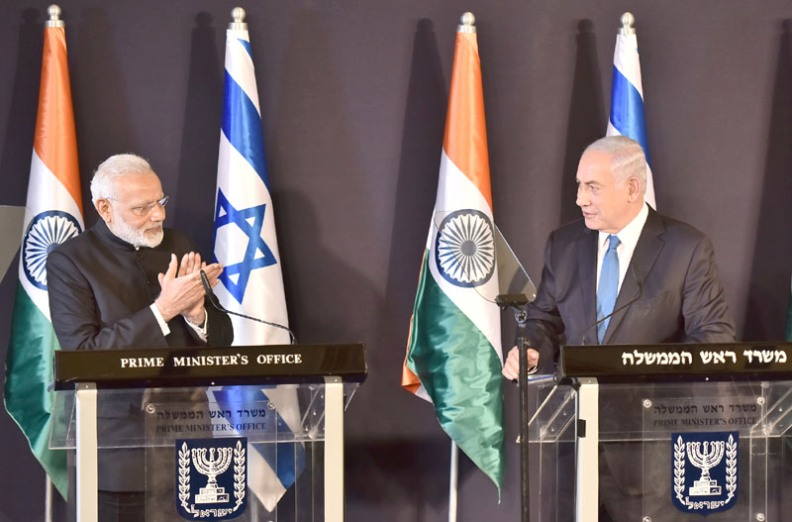
Prime Minister Narendra Modi’s visit, however, is fired by an atavistic Hindutva adoration for a small country on top of its mischievous Muslim neighbors. Ramallah has been bypassed, of course. But it should not be lost on the insiders that during the September non aligned summit in Venezuela the Indian delegation received instructions from South Block, to drop the routine reference to the Palestinian issue altogether. It was a tradition from the earliest days of NAM.

No, Ramallah was not just bypassed; Palestine has been downgraded to the level of irrelevance.[/vc_column_text][/vc_column][/vc_row]

Latest world news

Pakistan faces domestic backlash after India secures lower tariffs in US trade deal

India’s US trade agreement has sparked criticism in Pakistan after Islamabad ended up with higher tariffs despite sustained outreach to Washington.

Published

on

PM Shehbaz Sharif

India’s recently concluded trade agreement with the United States has triggered strong domestic criticism in Pakistan, where opposition leaders, journalists and commentators are questioning Islamabad’s diplomatic strategy after the country ended up with higher tariffs than India.

Under the agreement announced on February 2, US tariffs on Indian exports have been set at 18 per cent, while Pakistani goods will face a 19 per cent rate. The outcome has drawn sharp reactions in Pakistan, especially given what critics describe as sustained efforts by its leadership to engage Washington in recent months.

New Delhi, by contrast, is widely seen as having resisted pressure from US President Donald Trump and negotiated from a position of economic leverage rather than personal diplomacy.

Social media reactions highlight public anger

Following the announcement, Trump shared images related to India, including India Gate and a magazine cover featuring Prime Minister Narendra Modi alongside himself, before confirming the revised tariff rate for Indian goods. The optics did not go unnoticed in Pakistan, where social media users questioned why India secured better terms without overt displays of political deference.

One widely circulated post by Pakistan-based X user Umar Ali used sharp language and imagery to criticise Pakistan’s approach, reflecting growing frustration among sections of the public over what they see as an unequal outcome despite extensive outreach efforts.

Opposition leaders question foreign policy approach

Former Pakistan Tehreek-e-Insaf minister Hammad Azhar described the outcome as a failure of strategy rather than circumstance. He argued that modern foreign policy depends on economic strength, market access and tariffs, not symbolic gestures or personal relationships, pointing to India’s recent trade agreements with both the US and the European Union as examples.

Other opposition figures echoed similar views, saying India negotiated with “strategic autonomy” while Pakistan relied too heavily on personal engagement with US leadership.

Journalists warn of economic consequences

Journalists in Pakistan also weighed in, warning that the tariff decision could deepen the country’s existing economic challenges. Concerns were raised about declining exports, falling foreign investment and reduced bargaining power on the global stage.

Commentator Imran Riaz Khan criticised what he termed a failed lobbying strategy, arguing that symbolic gestures cannot replace economic leverage in international negotiations. Digital creator Wajahat Khan similarly framed the outcome as a reflection of unequal negotiating positions, stating that India approached the talks as a partner, while Pakistan did not.

India’s trade deals expected to boost exports

India’s back-to-back trade agreements with the European Union and the United States are expected to provide a significant boost to exports. Estimates suggest these deals could add up to $150 billion in exports over the next decade, strengthening India’s economic standing and reinforcing its negotiating position in future global trade talks.

Continue Reading

Latest world news

New Delhi free to buy oil from any source, Russia says amid US deal claims

Russia has said India is free to purchase oil from any country, dismissing claims that New Delhi has agreed to stop buying Russian crude under a US trade deal.

Published

on

New Delhi free to buy oil from any source, Russia says amid US deal claims

Russia has said that India is free to purchase crude oil from any country, responding to claims by US President Donald Trump that New Delhi has agreed to stop buying Russian oil as part of a recent trade deal with Washington.

The Kremlin said Russia is not India’s only energy supplier and noted that India has long sourced crude oil from multiple countries. It added that there is nothing new in India’s efforts to diversify its oil imports.

Kremlin spokesperson Dmitry Peskov said that energy experts are well aware that India purchases oil and petroleum products from various global suppliers. He added that Moscow does not see any change in India’s approach to sourcing crude.

No official word from India on halting imports

A day earlier, Peskov said Russia has not received any official statement from India regarding the cessation of Russian oil purchases. Russia’s Foreign Ministry echoed the view, saying the hydrocarbon trade between the two countries remains mutually beneficial.

Foreign Ministry spokesperson Maria Zakharova said India’s purchase of Russian hydrocarbons contributes to stability in the global energy market and that Moscow remains ready to continue close cooperation with New Delhi in the energy sector.

Russian media also noted that, unlike the US president, Prime Minister Narendra Modi has not made any public statement indicating an agreement to stop Russian oil imports.

India’s oil imports from Russia

India has continued to import Russian crude even after the US imposed tariffs on Indian goods. According to global trade data provider Kpler, India has been importing around 1.5 million barrels of Russian crude per day, making it the second-largest buyer of Russian oil and accounting for more than one-third of India’s total crude imports.

India buys about 88 per cent of its crude oil needs from overseas, with roughly one-third sourced from Russia. At its peak, imports from Russia crossed 2 million barrels per day, before falling to around 1.3 million barrels per day in December. The volume is expected to remain broadly stable in the near term.

However, imports declined further to about 1.1 million barrels per day in the first three weeks of January following higher tariffs imposed by the US, including levies linked to purchases of Russian energy.

Complete switch unlikely, experts say

Energy experts believe Indian refiners cannot fully replace Russian crude with American oil. Igor Yushkov of the National Energy Security Fund said US shale oil is lighter in grade, while Russian Urals crude is heavier and contains more sulphur.

He explained that replacing Russian oil would require blending different grades, increasing costs for refiners. He added that the US is unlikely to be able to supply the volume currently exported by Russia to India.

Yushkov also recalled that when Russia redirected its oil exports from Western markets to India in 2022, it reduced production by about one million barrels per day, contributing to a sharp rise in global oil prices and record fuel prices in the US.

Continue Reading

Latest world news

Moscow says no word from India on stopping Russian oil purchases

Russia says it has received no confirmation from India on stopping Russian oil purchases, despite Donald Trump’s claim that the move was part of a new India-US trade deal.

Published

on

Vladimir Putin

The Kremlin on Tuesday said it has not received any official communication from India regarding a halt in Russian oil purchases, following claims by US President Donald Trump that New Delhi had agreed to stop buying Russian crude as part of a trade agreement with Washington.

Kremlin spokesperson Dmitry Peskov told reporters that Moscow had not heard any confirmation from Indian authorities on the matter.

“So far, we haven’t heard any statements from New Delhi on this matter,” Peskov said, responding to Trump’s remarks linking reduced US tariffs on Indian goods to an alleged commitment by India to end Russian oil imports.

Russia stresses importance of ties with India

Peskov said Russia respects bilateral relations between India and the United States but underlined the strategic importance of ties between Moscow and New Delhi.

“We respect bilateral US-Indian relations,” he said, adding that Russia places equal importance on its strategic partnership with India.
“This is the most important thing for us, and we intend to further develop our bilateral relations with Delhi.”

What Trump claimed

Trump announced the India-US trade deal on Monday, stating that tariffs on Indian goods had been reduced from 50 per cent to 18 per cent. He claimed the reduction was linked to India agreeing to stop purchasing Russian oil.

According to Trump, India would instead buy more oil from the United States and potentially from Venezuela. He also suggested that the move would help bring an end to the war in Ukraine.

“He agreed to stop buying Russian oil and to buy much more from the United States and, potentially, Venezuela,” Trump said, referring to Prime Minister Narendra Modi.

India’s reliance on Russian crude

India has emerged as one of the largest buyers of Russian crude since the start of the Ukraine conflict. It currently imports around 1.5 million barrels of Russian oil per day, accounting for more than one-third of its total oil imports, according to global trade data.

India is the second-largest purchaser of Russian crude globally. Even after earlier US tariff measures on Indian goods, New Delhi continued its Russian oil imports, citing energy security concerns.

The Indian government has consistently maintained that securing affordable energy supplies is critical, given the country’s heavy dependence on oil imports.

Shift in energy ties after Ukraine war

Historically, India’s relationship with Russia was centred more on defence cooperation than energy trade, with Russia supplying a majority of India’s military equipment while contributing only a small share of its oil imports.

After the invasion of Ukraine, India significantly increased purchases of discounted Russian oil. The move helped India boost energy supplies while providing Russia with much-needed revenue amid Western sanctions.

As recently as December 2025, Russian President Vladimir Putin said during a visit to New Delhi that Moscow was ready to ensure uninterrupted fuel supplies to India despite pressure from the United States.

Earlier US push for Indian energy imports

Trump had earlier said, following a meeting with Prime Minister Modi in February last year, that India would begin buying more American oil and natural gas. However, those discussions did not lead to a major shift in India’s energy sourcing.

Subsequent US tariff measures also failed to significantly alter India’s stance on Russian oil imports.

Continue Reading

Trending

© Copyright 2022 APNLIVE.com