English हिन्दी
Connect with us

India News

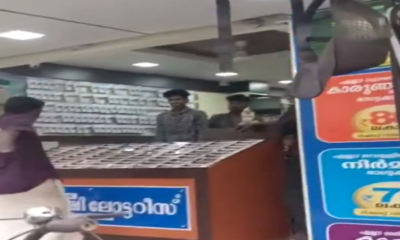
Kerala state lottery result out: Akshaya AK-529 winning list here, first prize winner grabs Rs 70 lakh | Know how to claim prize money

Kerala State Lottery Department has announced the lucky draw winners of the Akshaya AK-529 lottery ticket today at 3 pm. The winner of the first prize will fetch Rs 70 lakh.

Published

on

Kerala engineer swallows bribe money after being caught red-handed by vigilance department, admitted to hospital

Kerala State Lottery Department has announced the lucky draw winners of the Akshaya AK-529 lottery ticket today at 3 pm. The draw took place at Gorky Bhavan, near Bakery Junction, in the state capital Thiruvananthapuram. The winner of the first prize will fetch Rs 70 lakh while the second and third prize winner will get Rs 35 lakh and Rs 5 lakh respectively.

The lottery holders can check the winning list on the official website of Kerala Lotteries.

The winner of the first prize (Rs 70 lakh) is AR 960561 (NEYYATTINKARA)

The winner of the second prize (Rs 5 lakh) is AU 739708 (IRINJALAKUDA)

The winners of third prize (Rs 1 lakh) are AN 763635 (ATTINGAL) AO 480709 (KOLLAM) AP 557712 (VAIKKOM) AR 528134 (KATTAPPANA) AS 914784 (ADOOR) AT 107663 (PATTAMBI) AU 153946 (PALAKKAD) AV 921283 (KOTTAYAM) AW 788550 (THRISSUR) AX 120136 (KAYAMKULAM) AY 213340 (ERNAKULAM) AZ 916761 (KASARAGOD)

The winners of consolation prize (Rs 8,000) are AN 960561 AO 960561 AP 960561 AS 960561 AT 960561 AU 960561 AV 960561 AW 960561 AX 960561 AY 960561 AZ 960561

FOR THE TICKETS ENDING WITH THE FOLLOWING NUMBERS

The winners of fourth prize (Rs 5000) are 0376 0510 0842 0871 0924 2576 2815 4051 4470 4800 5133 6300 6781 6840 7119 8420 9876 9968

The winners of fifth prize (Rs 2000) are 0475 1766 3583 5104 5984 8963 9993

The winners of sixth prize (Rs 1000) 0432 0728 1912 2144 2223 2642 2709 2842 2883 2913 3040 3167 3398 4297 4601 5535 6764 6990 7329 7333 7590 8480 9396 9520 9685 9867

The winners of seventh prize (Rs 500) are 0072 0382 0415 0491 0567 1017 1073 1288 1354 1551 2121 2137 2199 2493 2827 2839 2853 2941 2943 2980 3376 3728 4259 4465 4474 4593 4716 5036 5099 5112 5178 5392 5689 5694 5893 5900 5955 5958 6049 6079 6216 6345 6398 6658 6704 6769 6819 6868 6898 7009 7057 7220 7240 7683 7780 7960 8099 8211 8276 8278 8498 8714 8748 9175 9235 9387 9443 9498 9900 9905 9937 9948

The winners of eight prize (Rs 100) are 0038 0090 0115 0219 0327 0345 0351 0755 0789 0809 0853 0989 0996 1153 1180 1186 1361 1365 1572 1618 1631 1669 1685 1693 1815 1879 1895 1993 2104 2107 2159 2274 2323 2712 2910 2926 2990 3003 3029 3038 3076 3257 3278 3322 3430 3470 3612 3673 3694 3724 3741 3819 3954 3956 3978 4071 4116 4192 4213 4430 4506 4927 5042 5125 5272 5526 5533 5590 5682 5744 5785 5886 5971 5986 6017 6097 6289 6391 6595 6668 6768 6876 6891 6960 6970 7056 7099 7125 7238 7286 7357 7360 7372 7450 7555 7567 7602 7648 7793 7908 7983 8214 8338 8352 8449 8517 8531 8533 8540 8588 8614 8616 8745 8779 8920 9016 9052 9055 9116 9324 9428 9494 9857

The prize winners are advised to verify the winning numbers with the results published in the Kerala Government Gazette and surrender the winning tickets within 30 days.

Next Akshaya Lottery

The next Akshaya Draw will be held on January 19 at Gorky Bhavan, near Bakery Junction, in the state capital Thiruvananthapuram.

How to claim prize money?

Winners of the Akshaya AK-529 lucky draw must check the Kerala lottery results published in the Kerala Government Gazette to verify their winning tickets.

They must report to the Kerala lottery office in Thiruvananthapuram with their tickets and identification evidence within 30 days if they find their ticket number in the published gazette.

The verification process should be completed within 30 days following the announcement of the results.

Those who have won less than Rs 5,000 in a lottery can claim their reward money at any lottery shop in Kerala.

Those who have won more than Rs 5,000 must present their tickets to a bank or government lottery office with their identification papers in order to make a claim.

India News

Passengers must pay charges for excess luggage on trains, says railway minister

Passengers travelling by train will need to pay extra charges if their luggage exceeds the prescribed free allowance, the railway minister informed Parliament.

Published

on

Ashwini Vaishnaw

Indian Railways passengers will have to pay additional charges if they carry luggage beyond the prescribed free allowance during train journeys. The clarification was given by Railway Minister Ashwini Vaishnaw in the Lok Sabha, outlining existing class-wise baggage norms and the charges applicable for excess weight.

The minister explained that Indian Railways already follows a structured luggage policy, under which passengers are allowed a fixed free allowance depending on their travel class, with a defined maximum limit that cannot be exceeded inside passenger compartments.

Class-wise luggage limits explained

According to the details shared in Parliament, passengers travelling in Second Class are permitted to carry up to 35 kg of luggage free of cost. They can carry additional luggage up to 70 kg, but only after paying the prescribed charges.

For Sleeper Class travellers, the free allowance stands at 40 kg, with the maximum permissible limit capped at 80 kg, including the free allowance. Passengers in AC 3 Tier and AC Chair Car are allowed to carry 40 kg of luggage, which is also the upper limit for these classes.

First Class and AC 2 Tier passengers can carry up to 50 kg of luggage free of cost, with a maximum limit of 100 kg. AC First Class passengers have the highest allowance, with 70 kg permitted free and up to 150 kg allowed on a chargeable basis.

The railway minister clarified that the maximum limit in each class includes the free allowance and that passengers cannot exceed this limit inside the compartments.

Charges for excess luggage and size restrictions

Vaishnaw stated that passengers carrying luggage beyond the free allowance, but within the maximum limit, are required to pay charges at 1.5 times the standard luggage rate. Such excess luggage can be carried along with the passenger inside the compartment after payment.

The Railways also impose size restrictions on personal luggage. Trunks, suitcases and boxes with outer dimensions up to 100 cm × 60 cm × 25 cm are allowed in passenger compartments. Items exceeding any one of these dimensions must be booked separately and carried in brake vans or parcel vans, not inside passenger coaches.

The minister further clarified that merchandise items are not permitted to be carried as personal luggage in passenger compartments. Any luggage beyond the prescribed limits is required to be booked and transported in the brake van of the train, subject to existing booking norms.

Continue Reading

India News

Lok Sabha passes SHANTI Bill, opens civil nuclear sector to private participation

The Lok Sabha has passed the SHANTI Bill, paving the way for private participation in India’s civil nuclear sector and supporting the target of 100 GW atomic energy by 2047.

Published

on

Lok Sabha

The Lok Sabha on Wednesday passed the Sustainable Harnessing and Advancement of Nuclear Energy for Transforming India (SHANTI) Bill, a move that allows private players to enter India’s tightly regulated civil nuclear sector. The legislation was approved through a voice vote, even as opposition members staged a walkout during the discussion.

Union minister Jitendra Singh described the passage of the bill as a milestone, saying it would help the country move closer to its long-term clean energy goals. According to the minister, the legislation is aligned with India’s ambition to generate 100 gigawatts of atomic energy capacity by 2047.

Focus on clean energy and long-term targets

Speaking in the House, Singh said India’s growing role on the global stage requires it to follow international benchmarks, particularly in the transition towards cleaner energy sources. He noted that nuclear power would play a crucial role in meeting future energy demands while reducing dependence on conventional fuels.

The SHANTI Bill aims to bring private participation into the civil nuclear space, which has so far remained largely under government control. The government has maintained that such participation is necessary to scale up capacity and meet the 2047 nuclear energy target.

Opposition flags liability concerns

Opposition parties opposed the bill, arguing that it weakens provisions of the Civil Liability for Nuclear Damage Act, 2010. They claimed that the proposed framework shifts responsibility in the event of a nuclear incident away from suppliers of nuclear equipment, raising concerns over accountability.

Despite these objections, the bill was passed, marking a significant policy shift in India’s nuclear energy sector.

Continue Reading

India News

Bharat Taxi to launch in Delhi on January 1 as cooperative alternative to app-based cabs

Bharat Taxi, a government-backed cooperative cab service, will be launched in Delhi on January 1 as an alternative to app-based taxi platforms.

Published

on

bharat taxi model

Delhi residents will soon have a new option for daily commuting as Bharat Taxi, India’s first cooperative taxi service, is set to begin operations in the national capital from January 1. The service has been launched by the Centre as an alternative to existing app-based cab platforms and is expected to operate alongside them.

According to information shared by government sources, all preparations for the launch in Delhi have been completed. The service will function through a mobile application operated by Sahakar Taxi Cooperative Limited and will follow a zero-commission model.

Multiple ride options and app-based features

Bharat Taxi will offer cars, auto-rickshaws and bikes through its platform. The app will be available on both Android and iOS devices. Users will be able to register using their mobile number, select pick-up and drop-off locations, choose a vehicle, and track their ride in real time.

The application includes features such as a transparent fare structure, real-time vehicle tracking, multilingual interface, and 24×7 customer support. Safety measures include verified driver onboarding, integration with Delhi Police and other agencies, and an option to share ride details with others.

Focus on fair pricing and ride reliability

The cooperative taxi service aims to address issues commonly faced by commuters, including surge pricing during peak hours, ride cancellations, and drivers refusing trips. Provisions have been made within the system to deal with such everyday complaints.

Officials indicated that the platform is designed to bring predictability to fares while ensuring a smoother experience for passengers.

Driver-owned model to improve earnings

A key feature of Bharat Taxi is its driver-owned cooperative structure. Under this model, drivers are expected to receive up to 80 per cent of the fare directly, supported by a monthly credit system. The initiative is intended to provide drivers with higher income and improved working conditions, reducing dependence on private cab aggregators.

Government sources said the platform offers drivers a more independent and equitable alternative for earning a livelihood.

Expansion plans beyond Delhi

As per official information, around 56,000 drivers have already registered on the Bharat Taxi app. While testing has been completed in Delhi, a similar trial is currently underway in Rajkot, Gujarat, where the service is expected to be launched on February 1.

Officials added that Bharat Taxi will be gradually expanded to more than 20 cities across the country in the coming phase.

Continue Reading

Trending

© Copyright 2022 APNLIVE.com