English हिन्दी
Connect with us

India News

Kerala love jihad case: SC to hear Hadiya’s submission in open court on Nov 27

Published

on

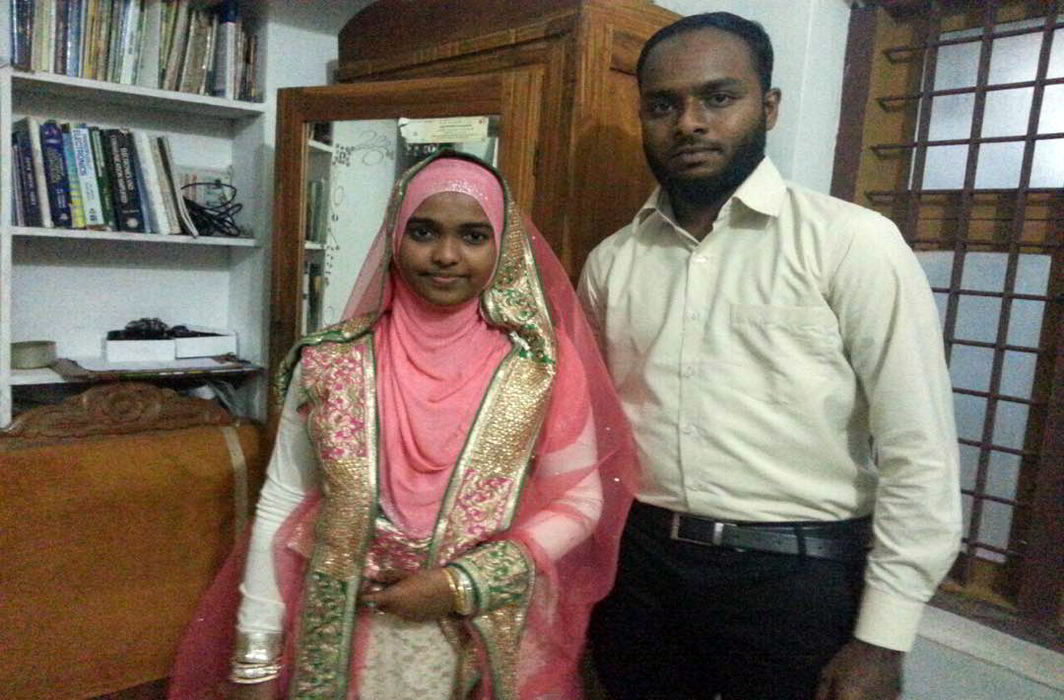
File photo of Hadiya alias Akhila with her husband Shafin Jahan. Photo credit: Agencies

Supreme Court expresses surprise over Asokan seeking his adult daughter’s custody, says consent is prime and no law prevents marriage with a criminal 

The Supreme Court, on Monday (October 30), made it clear that any decision on the Kerala ‘love jihad’ case will only be taken after Hadiya alias Akhila – the Hindu girl who had married a Muslim man Shafin Jahan, a marriage that had been annulled by the Kerala High Court – had expressed her opinion in open court for which the time and date has been set for 3 pm on November 27.

The order of the apex court bench of Chief Justice Dipak Misra and Justices AM Khanwilkar and DY Chandrachud, is a modification of an earlier directive issued by the same court in which it had said that the statements of 24-year-old Hadiya before the SC will be recorded ‘in camera’.

The proceedings in what has come to be called the Kerala love jihad caseon Monday, saw high voltage arguments being put forth by senior advocates Shyam Divan and Kapil Sibal and Additional Solicitor General Maninder Singh – each of them trying hard to pursue their respective stands in the matter. The arguments were countered by equally pointed, often curt, observations by the apex court bench.

The proceedings on Monday began with the Chief Justice asking ASG Maninder Singh – who is appearing in the case on behalf of the National Investigation Agency (NIA) – on how Hadiya’s marriage with Shafin Jahan could be annulled in a Habeas Corpus petition.

Singh submitted that this is a case in which the girl has been indoctrinated and hence “court can invoke parental authority” though she is a major.

The Additional Solicitor General submitted that Akhila doesn’t want to be in the custody of her father, Asokan. A new application had been filed in the high court.

He said that as far as marriage is concerned “it is her personal consent. Who can say there is no free consent? I know my Lakshman Rekha and I am following the law. But the previous order passed by this court said the court has the authority to set the time of investigation. She married a criminal.”

The CJI asked: “Is there any law by which a girl can never fall in love with a criminal? I am really very surprised that her father wants custody of a major (she is now 25, was 24 when she married) person who is married to another major person.”

The ASG said: “We have to decide it within two or three hearings and the high court must know the fact that she does not want to be with her father.”

This is a critical part that the court would want to pay heed to. In a recent video made by social activist Rahul Eashwar in Kochi, Hadiya had said that her father was ill-treating her and that there was a threat to her life.  She has been quoted as saying in the video: “You have to get me out. I am sure I will be killed tomorrow or the day after. My father is getting angry, I know. When I walk, he is pushing me and kicking me. If my head or any body part hits somewhere and I die…”

The bench said thereafter: “Unless we call the person we cannot decide if she can express herself or if she has given consent. Then we can take a call. Prima facie you have to satisfy our constitutional obligation of producing her in court.”

Senior advocate Shyam Divan, who is appearing on behalf of Haditya’s father Asokan, reiterated the call for constitutional obligation. “When you talk about unity and diversity we are not going by impulse of society, but we will go by the law,” he said.

Arguing that “there is an organizational apparatus” operating for getting inter-religious marriages between Hindu girls and Muslim men operating, Divan said that this apparatus “consists of PFI and such organisations… They have students, preachers, psychologists etc and they radicalize impressionable minds.The question is do courts respond to such radicalization or do they remain silent?”

Leveling serious allegations against Hadiya’s husband, Divan told the top court that Shafin Jahan also questioned the antecedents of Hadiya’s has contacts with a person who recruits people for global terror outfit Islamic State.

Divan went on to submit that “Kerala has a huge contingent of people who have joined ISIS,” a contention that evoked sharp objections from senior advocate Kapil Sibal, who is appearing for Hadiya’s husband.

Asserting that Divan’s allegations against his client were “false and baseless”, Sibal said: “He (Divan) is saying that entire Kerala has gone to ISIS…the antecedents of Shafin Jahan had been investigated by the Kerala Police.”

The CJI, after hearing the heated arguments, directed Hadiya’s father to produce her on the next date of hearing, set for November 27.

India News

Lok Sabha clears bill to levy cess on pan masala and similar goods for health, security funding

The Lok Sabha has passed a bill to impose a cess on pan masala manufacturing units, aiming to create a dedicated revenue source for public health and national security initiatives.

Published

on

Nirmala Sitharaman

The Lok Sabha has approved the Health Security se National Security Cess Bill, 2025, paving the way for a new cess on pan masala manufacturing units. The legislation aims to generate dedicated funds for strengthening national security and improving public health, both areas identified as critical national priorities.

Bill aims to create predictable funding stream

Finance Minister Nirmala Sitharaman, responding to the debate before the bill was passed by voice vote, said that the cess will be shared with states because public health falls under the state list.

The new cess will be applied over and above the GST, based on production capacity and machinery used in units manufacturing pan masala and similar goods. The minister clarified that this cess will not affect GST revenue, and that pan masala already attracts the maximum GST slab of 40 per cent.

According to the bill text, the objective is to build a “dedicated and predictable resource stream” to support expenditure related to health and national security.

Sitharaman also mentioned that cess collection as a percentage of gross total revenue currently stands at 6.1 per cent, lower than the 7 per cent average between 2010 and 2014.

Continue Reading

India News

Simone Tata passes away at 95: A look at the visionary who shaped Lakme and modern retail

Simone Tata, the pioneering business leader who built Lakme and helped shape India’s modern retail sector, passed away at 95. Here’s a look at her legacy.

Published

on

simone tata

Ratan Tata’s stepmother and celebrated business leader Simone Tata passed away on December 5, 2025, at the age of 95. Known for her pioneering role in building Lakme and transforming India’s retail landscape, she leaves behind a remarkable legacy that redefined Indian consumer culture.

A legacy that shaped Indian business

Simone Tata, born in Geneva in 1930, first came to India at the age of 23. Two years later, in 1955, she married Naval H. Tata and gradually became an integral part of the Tata family’s business vision. Her journey with the Tata Group began in the 1960s, when she was appointed to Lakme—then under Tata Oil Mills.

Under her leadership, Lakme quickly grew into one of India’s most trusted cosmetic brands. She rose to the position of managing director and later chairperson, introducing global formulations and modernising beauty products for the Indian market. Lakme’s rise was also rooted in a strong national vision—launched on former Prime Minister Jawaharlal Nehru’s suggestion to reduce foreign exchange spent on imported makeup.

Transforming retail through Trent and Westside

After Lakme was sold to Hindustan Lever Limited in 1966, Simone moved to Trent, where she helped build one of India’s earliest modern retail chains. This later gave birth to Westside, a brand that has become synonymous with contemporary Indian shopping culture.

She also played a key role in philanthropic initiatives, guiding organisations such as the Sir Ratan Tata Institute and supporting cultural and children-focused foundations.

Family, personal life and final farewell

Simone Tata is survived by her son Noel, daughter-in-law Aloo Mistry, and grandchildren Neville, Maya and Leah. She also drew public attention in recent years for being the only member of the Tata family to attend Cyrus Mistry’s funeral, despite the widely known strained ties between the families.

Her funeral will take place on Saturday morning at the Cathedral of the Holy Name Church in Colaba, Mumbai.

Continue Reading

India News

Centre orders probe into IndiGo crisis, expects normal flight operations in three days

Amid record cancellations by IndiGo, the Centre has ordered a high-level inquiry and expects flight schedules to stabilise by Saturday, with full normalcy in three days.

Published

on

indigo

The Centre has initiated a high-level inquiry into the massive disruption of IndiGo’s operations, with the government projecting that flight schedules will begin stabilising by Saturday and full normalisation is expected within three days. The announcement comes as cancellations by the airline crossed 500 for the second consecutive day, severely impacting passengers across major airports.

Civil Aviation Minister Ram Mohan Naidu said the government has directed urgent measures to ensure swift restoration of services. Within minutes of his statement, the aviation regulator DGCA announced the formation of a four-member committee to examine the circumstances leading to the delays and cancellations.

DGCA forms committee as cancellations spark scrutiny

The DGCA said IndiGo was given sufficient time to implement revised Flight Duty Time Limitations (FDTL), yet the airline recorded the highest number of cancellations in November. The regulator added that the pattern suggested gaps in the carrier’s internal oversight and preparedness, warranting an independent probe.

The committee will review the sequence of events that triggered disruptions and recommend measures to prevent a recurrence.

Flight duty rules relaxed; minister defends move

Amid criticism from the Opposition and experts, the DGCA temporarily suspended certain FDTL rules, increasing pilot duty limits from 12 to 14 hours. The changes were widely questioned, with allegations that the government was yielding to pressure from IndiGo.

Naidu defended the decision, stating the move was taken solely to safeguard passengers and that safety standards would not be compromised.
He reiterated that passenger care and convenience remain the top priority.

Assurance of refunds, real-time updates, and support

Highlighting steps taken to ease passenger distress, the minister said airlines must:

  • Provide accurate, real-time updates before travellers leave for airports
  • Initiate automatic refunds for cancelled flights without requiring follow-ups
  • Arrange hotel accommodation for passengers stranded for extended periods

Senior citizens and persons with disabilities have been accorded special priority, including access to lounges and additional assistance. Refreshments and essential services are to be provided to all affected travellers.

Inquiry to determine accountability

The government said the high-level probe will identify what went wrong at IndiGo, establish responsibility, and recommend systemic corrections to ensure such disruptions do not occur again.

Continue Reading

Trending

© Copyright 2022 APNLIVE.com