
India News
RSS chief Mohan Bhagwat’s statement a challenge to SC, say Muslim bodies and opposition


[vc_row][vc_column][vc_column_text]Before the final hearings in the Ram Janmabhoomi case start in the Supreme Court on December 5, a day before the anniversary of Babri Masjid demolition 25 years ago on Dec 6, 1992, RSS chief Mohan Bhagwat passed his own judgment on the issue, saying only Ram temple will be built at the disputed site in Ayodhya.
While ignoring the court case, Bhagwat also went ahead and rejected efforts for an out-of-court settlement of the issue being made by Art of Living founder Sri Sri Ravi Shankar and Shia Waqf Board.
As was to be expected, he managed to provoke a flurry of protests. The statement was criticised by Muslim organisations and opposition parties alike as an affront to the apex court and the Constitution of the land.
The timing of the statement and the dates related to the controversial issue also coincides with the Gujarat Assembly polls where the BJP is banking again on emotive issues for its campaign.
Bhagwat had made a similar statement in 2013, in the run-up to the 2014 Lok Sabha elections in which he described Ram Janmabhoomi as a question of “India’s identity”.
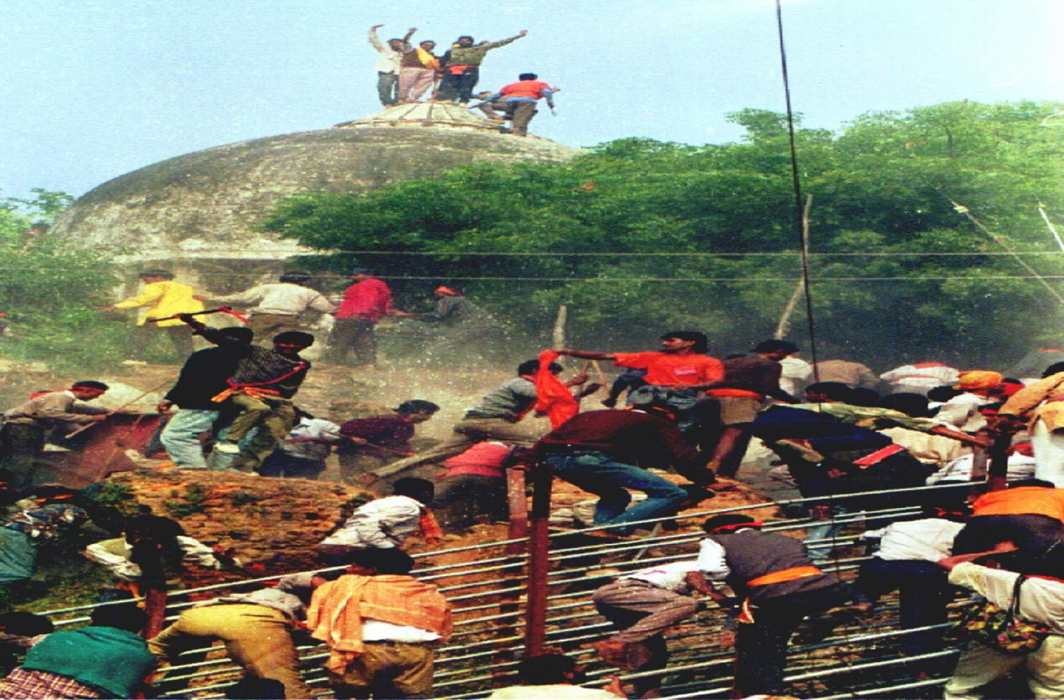
The RSS insists – unconvincingly – that it has nothing to do with politics or elections.
Bhagwat’s statement came on Friday at the Vishwa Hindu Parishad’s (VHP) ‘Dharma Sansad’ in Karnataka’s Udupi town. He said, “The Ram temple will be built at the Ram Janmabhoomi and nothing else will be constructed on that land. It will be built using the same stones and under the leadership of people who fought for it for the last 20-25 years.”
“We will construct it. It is not a populist declaration but a matter of our faith. It will not change,” he added, observing that after years of efforts and sacrifice, building the Ram temple seemed possible now. The RSS political wing BJP holds the reins of government at the Centre and, with NDA partners, in 18 states and is the dominant political party in the country. The 18 states include the crucial Uttar Pradesh, where the saffron party came to power with a thumping majority and the new Hindutva mascot Yogi Adityanath was anointed chief minister.
RSS chief Mohan Bhagwat also rejected any moves by AoL founder Sri Sri Ravi Shankar towards an out-of-court settlement in the Ayodhya Ram Temple issue. He mentioned how Ravi Shankar had approached him and VHP’s Acharya Dharmendra at a function and put forth his proposal, despite being warned not try it, and how it (the proposal) was dismissed outright.
Sri Sri Ravi Shankar had, earlier this month, traveled to Lucknow and Ayodhya to speak to all major stake holders to find an amicable solution to the issue. However, most of the concerned parties remained cold to the proposal espoused by the spiritual leader.
Bhagwat asserted that any decision on the issue has to be made by seers and saints who have led the movement. “If anyone wants to make an effort, let them do that. It is a democracy,” he added.
Bhagwat’s statement that only the temple will be built at the disputed site in Ayodhya came even as the Supreme Court is going to start final hearings in the Ram Janmabhoomi case from December 5. The court will hear appeals against the Allahabad High Court verdict dividing the 2.77 acre disputed land in Ayodhya between the main deity Ram Lalla, Sunni Wakf Board and Nirmohi Akhara.
The case had come up before a three-judge bench headed by Justice Dipak Misra on August 11 and was adjourned for three months to give time for translation of relevant documents into English: there are nearly 90,000 pages of oral evidence and 533 documentary exhibits in eight different languages, including Sanskrit and Persian.
As The Indian Express reported, while litigants await hearing in the Supreme Court, the change of government in Uttar Pradesh saw a new cast of characters jumping in. First, there was the Shia Wakf Board of Uttar Pradesh, its chairman proclaiming that a mosque at the disputed site made no sense. Then came a glittering Diwali celebration in Ayodhya in the presence of Uttar Pradesh Chief Minister Yogi Adityanath and, subsequently, the abrupt entry of spiritual guru Sri Sri Ravishankar as a mediator.
Bhagwat’s statement predictably drew strong reactions.
Muslim organisations said Bhagwat had challenged the Supreme Court court, and demanded action against him, PTI reported. The RSS chief, they said, was attempting to assist the Bharatiya Janata Party in the Gujarat Assembly elections by diverting voters’ attention from “real” matters.
“The All India Muslim Personal Law Board has faith in the judiciary and will try to implement its order. By issuing this statement, Mohan Bhagwat has taken [the] law into his hands,” the organisation’s spokesperson Maulana Khaild Saifullah Rehmani said.
“Despite the issue pending in the court, Mohan Bhagwat has given this statement only to divert the attention of voters in Gujarat from real issues,” All India Shia Personal Law Board Maulana Yasoob Abbas said.
Convenor of the Babri Masjid Action Committee and lawyer for the UP Sunni Wakf Board Zafaryab Jilani said Bhagwat’s statement was a “challenge” to the Supreme Court and the Constitution of India. “As per the Constitution, the Supreme Court is the highest authority and it is that authority which is adjudicating on whether there can be construction there or not. The country runs by rule of law and we are all awaiting the verdict of the SC. This statement amounts to a challenge to both the SC and Constitution,” he said.
Member of All India Muslim Personal Law Board (AIMPLB) executive committee Asaduddin Owaisi said: “This is obnoxious, a deliberate ploy to vitiate the atmosphere. How can such a statement be made when the matter is in the Supreme Court? This is a title suit and the RSS is saying it is a matter of faith. I hope the SC takes note of it. This is dangerous.”
The opposition parties criticised Bhagwat’s statement saying that the RSS chief is not above the Supreme Court and that the country is run by the Constitution and not faith.
“Mr Bhagwat is not above the Supreme Court and the country is run by the constitution and not by faith,” Nationalist Congress Party (NCP) leader Nawab Malik told ANI. “BJP Is losing public faith and that is why the Ram Mandir issue has been raised by BJP and Sangh parivar,” he added.
He further stated that the matter is before the Supreme Court and the verdict of the highest court should be binding on everybody.[/vc_column_text][/vc_column][/vc_row]









India News
Journalist files police complaint against Rahul Gandhi over push allegation
Journalist Richa Parashar has filed a criminal complaint against Rahul Gandhi and others, alleging that she was pushed while covering the Opposition’s march to the Supreme Court. The Congress has denied the allegation.

India News
Delhi court orders release of CJP founder Abhijeet Dipke
A Delhi court on Saturday ordered the conditional release of Cockroach Janta Party founder Abhijeet Dipke, who was detained and subsequently arrested ahead of a planned protest march at Connaught Place.
India News
Anirudh Ravichander to marry Kavya Maran in November, reception on November 21
Anirudh Ravichander and Kavya Maran are set to marry in November, with their Chennai wedding reception scheduled for November 21.


LK Advani, 98, hospitalised in Delhi with chest infection

ED summons Pinarayi Vijayan in money laundering case
Trump waives Russia-related sanctions, tariffs in relief for India

Anirudh Ravichander to marry Kavya Maran in November, reception on November 21

Delhi court orders release of CJP founder Abhijeet Dipke

Journalist files police complaint against Rahul Gandhi over push allegation
Delhi court orders release of CJP founder Abhijeet Dipke
Anirudh Ravichander to marry Kavya Maran in November, reception on November 21
ED summons Pinarayi Vijayan in money laundering case
LK Advani, 98, hospitalised in Delhi with chest infection

Afghan Men Try To Hang With The Jet Engine Of The Aircraft in Kabul- Afghanistan News – Kabul News
Trending Top 10 News: 10000 Crore Fine on Flipkart, Apple to Launch Unique Feature, Hdfc Bank Job Ad

Trending Top 10 News: Nokia 6310, Apple sales, Bachpan ka Pyar Video Kid, Dainik Bhaskar IT Raid

Trending Top 10 News: Canada bans Indian flights, Rain in Delhi NCR, AIMIM Twitter hacked, Raj Kundra case

Trending Top 10 News: Shein India, Apple New Service, Pocket Oxygen, Oppo Launched New Phone
-
 India News23 hours ago
LK Advani, 98, hospitalised in Delhi with chest infection
-
 India News22 hours ago
ED summons Pinarayi Vijayan in money laundering case
-
Latest world news24 hours ago
Trump waives Russia-related sanctions, tariffs in relief for India
-
 India News12 hours ago
Anirudh Ravichander to marry Kavya Maran in November, reception on November 21
-
 India News12 hours ago
Delhi court orders release of CJP founder Abhijeet Dipke
-
 India News11 hours ago
Journalist files police complaint against Rahul Gandhi over push allegation
