
Latest world news
US, Pakistan not to cut ties, work together in Afghanistan


US has reportedly assured Pakistan that it does not want to sever ties with Islamabad which has extended its “wholehearted support” to the US-backed Afghan offer of peace talks with the Taliban.
This has come at a time when Afghanistan President Ashraf Ghani has recently offered to recognise Taliban as a legitimate political group without any preconditions. On Wednesday, he was addressing Kabul Process conference in the presence of representatives of 25 countries.
Reacting to Afghan President’s offer of recognising Taliban as legitimate political group, Pakistan’s Foreign Minister Khawaja Asif has told that Pakistan “wholeheartedly supports Afghan President Ashraf Ghani’s latest offer of peace talks to the Taliban because “it’s a good move and a healthy move towards restoring peace in Afghanistan”.
According to Dawn report from Washington, the two statements supplement renewed efforts to improve relations between the US and Pakistan which were once close allies in the war against terror.
The move for improving ties between the two countries began last week when Washington sent a senior Trump aide Lisa Curtis to Islamabad for talks with Pakistani leaders.
Reports say that Curtis spoke of the need to build a new relationship with Pakistan after her talks with senior Pakistani officials. Curtis is the National Security Council’s senior director for South and Central Asia.
Dawn has also claimed of being informed by sources in Washington that Pakistan’s Foreign Secretary Tehmina Janjua will visit Washington next week for a series of meetings with senior American officials.
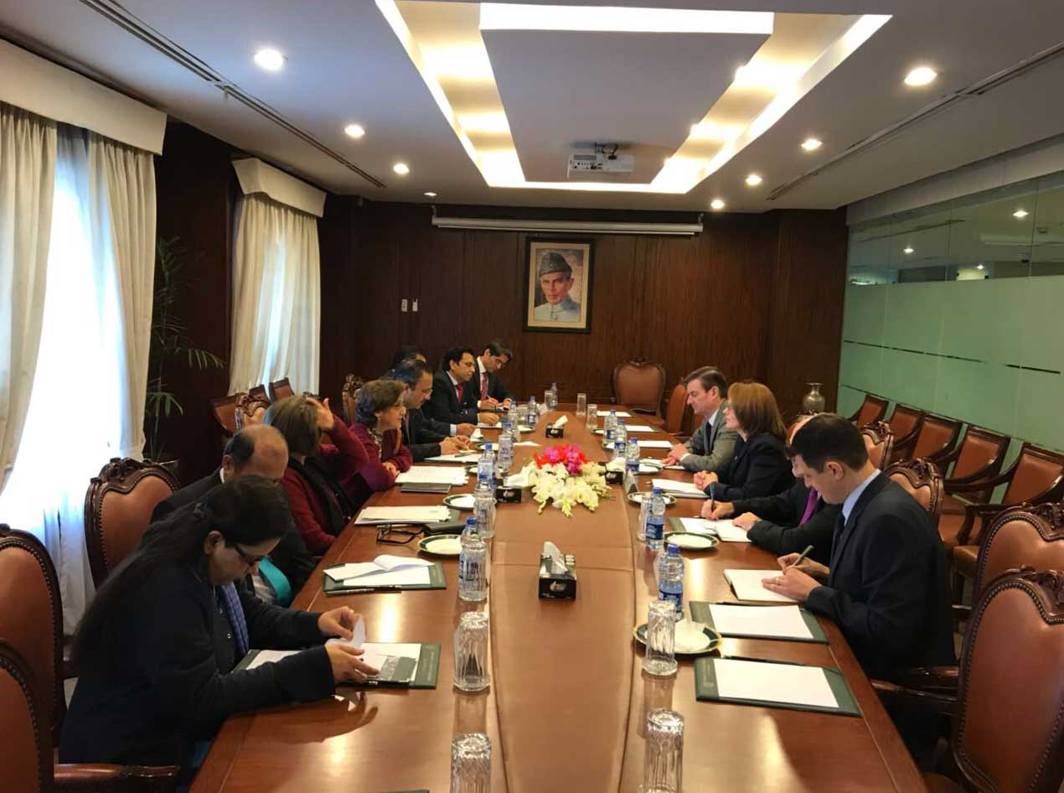
Earlier, Foreign Secretary was slated to visit Nepal next week with Prime Minister Shahid Khaqan Abbasi. But due to important bilateral talks in Washington she may skip that trip. During this visit Janjua may meet Ms Curtis once again.
There were some movements in the US-Pakistan ties for some time after a brief lull after Donald Trump’s “do more to destroy terror havens” comments in his new South Asia policy.
Recently, Alice Wells, Acting Assistant Secretary for South and Central Asia had reportedly told Voice of America (VOA) that US was not thinking of cutting ties with Pakistan. She also assured Islamabad that the US considered Pakistan essential for resolving the Afghan crisis.
Earlier, Gen Joseph Votel, head of the US Central Command, while speaking at a congressional panel in Washington this week, had dispelled impression that the US and Pakistan were on a collision course.
He was quoted saying, “We have preserved the valuable military-to-military relationship with Pakistan” while working to increase transparency and communication with military leaders.







Latest world news
Magnitude 7 earthquake strikes Russia’s Kamchatka Peninsula
A magnitude 7 earthquake struck Russia’s Kamchatka Peninsula region on Friday. The initial report placed the earthquake at a depth of 140 kilometres.


Latest world news
S Jaishankar says India is a natural option for Russia amid Europe tensions
External Affairs Minister S Jaishankar said India remained a natural option for Russia as Moscow increasingly turned towards Asia amid strained relations with Europe. He highlighted the continuity of India-Russia ties and their significance for the balance of power in Asia.

Latest world news
Putin praises PM Modi, says he has very good ideas on Ukraine war
Russian President Vladimir Putin has praised Prime Minister Narendra Modi for repeatedly raising the need to end the Ukraine war, describing his ideas for a settlement as “very good”.


Mallikarjun Kharge’s ‘Your Friends’ jab at Rahul Gandhi over congress exits

Magnitude 7 earthquake strikes Russia’s Kamchatka Peninsula

Delhi deploys 25,000 personnel, installs CCTV cameras ahead of CJP march

Abhijeet Dipke detained ahead of CJP’s national flag march in Delhi

Mallikarjun Kharge seeks all-party meeting with PM Modi on delimitation

Centre sends 3 letters to Punjab government after anti-drug activist’s killing
Mallikarjun Kharge seeks all-party meeting with PM Modi on delimitation
Abhijeet Dipke detained ahead of CJP’s national flag march in Delhi
Magnitude 7 earthquake strikes Russia’s Kamchatka Peninsula
Delhi deploys 25,000 personnel, installs CCTV cameras ahead of CJP march

Afghan Men Try To Hang With The Jet Engine Of The Aircraft in Kabul- Afghanistan News – Kabul News
Trending Top 10 News: 10000 Crore Fine on Flipkart, Apple to Launch Unique Feature, Hdfc Bank Job Ad

Trending Top 10 News: Nokia 6310, Apple sales, Bachpan ka Pyar Video Kid, Dainik Bhaskar IT Raid

Trending Top 10 News: Canada bans Indian flights, Rain in Delhi NCR, AIMIM Twitter hacked, Raj Kundra case

Trending Top 10 News: Shein India, Apple New Service, Pocket Oxygen, Oppo Launched New Phone
-
 India News19 hours ago
Mallikarjun Kharge’s ‘Your Friends’ jab at Rahul Gandhi over congress exits
-
 Latest world news18 hours ago
Magnitude 7 earthquake strikes Russia’s Kamchatka Peninsula
-
 India News19 hours ago
Delhi deploys 25,000 personnel, installs CCTV cameras ahead of CJP march
-
 India News9 hours ago
Abhijeet Dipke detained ahead of CJP’s national flag march in Delhi
-
 India News8 hours ago
Mallikarjun Kharge seeks all-party meeting with PM Modi on delimitation
-
 India News7 hours ago
Centre sends 3 letters to Punjab government after anti-drug activist’s killing
