Latest world news
Syria: Turkish forces and anti Assad group capture Afrin


In a major development in the Middle East, Turkish forces and anti- Bashar al-Assad regime group Free Syrian Army (FSA) have captured the centre of Afrin in northwest Syria after Kurdish fighters evacuated the city.
According to Aljazeera, Turkey’s military said in a tweet on Sunday that troops were searching for landmines and other explosive devices in the area.
Turkish President Recep Tayyip Erdogan, while addressing in western Trukey on Sunday said, “Many of the terrorists had turned tail and run away already.” He further said that Turkey-backed forces took complete control of the city centre at 8:30am local time. He said that since the beginning of the Afrin operation on 20 January, 3,603 “terrorists had been neutralised”.
Erdogan said the Turkish flag and the flag of the Syrian opposition fighters were raised in the city, previously controlled by the Kurdish militia known as the People’s Protection Units, or YPG, a separatist group supporting their Turkish counterparts PKK.
Describing the developments after capturing the city, Erdogan said, “Our special forces and members of the Free Syrian Army are cleaning the remains and the traps they left behind. In the centre of Afrin, symbols of trust and stability are waving instead of rags of terrorists.”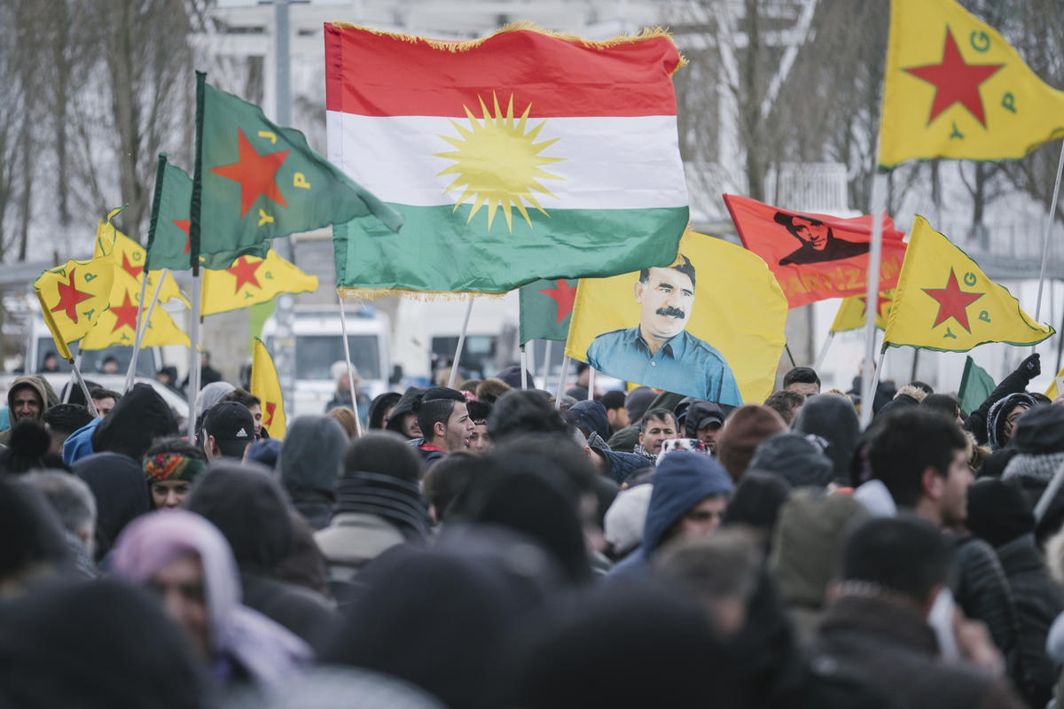
Meanwhile, Trukish army spread the video footage showing their soldiers taking control of the administrative building in the centre of the city. Dogan news agency showed Syrian fighters shooting in the air in celebration. In another Dogan video, a Syrian fighter is seen shooting at a statue of Kurdish hero Kawa, a symbol of resistance against oppressors, before a bulldozer pulled it down.
The Turkish army and Free Syrian Army had launched their joint operation to vanquish the US-backed YPG fighters near its border.
Syrian official news agency SANA, reported on Sunday that Turkish forces and their “terrorist mercenaries” invaded the city of Afrin on Sunday after fierce continuous bombardment on the city since January 20.
The agency quoted local and media sources saying that Turkish forces and terrorist groups affiliated to them have stormed the residential neighbourhood of Afrin city following heavy shelling carried during the past few days on the city, which targeted the city’s only hospital, in addition to cutting off water and communications.
The Syrian news agency claimed that more than 1,100 civilians were “martyred” or injured since the beginning of the Turkish assault on Afrin, in addition to the destruction of the city’s infrastructure and the displacement of thousands of civilians.
Meanwhile Free Syrian Army spokesman Mohammad al-Hamadeen has claimed that the Kurdish forces have pulled back to Syrian government-controlled areas around Aleppo, or east of the Euphrates River.
On the other hand, anti-Assad London based Syrian Observatory for Human Rights (SOHR) had previously said at least 150,000 civilians fled the city since last Wednesday.
Bekir Bozdag, the spokesman of Turkish government has said that the military campaign would continue to secure areas around Afrin and make sure food and medicine were available.
Observers believe that capturing of Afrin by Trukish forces and anti-Asad group indicate that US administration has given its consent to the Trukish move against separatist Kurdish group YPG. However, details are still not clear about the deal.




Latest world news
Trump waives Russia-related sanctions, tariffs in relief for India
Donald Trump has waived several Russia-related sanctions, restrictions and duties under a new US law, potentially easing tariff pressure on India and China, two major buyers of Russian energy.

Latest world news
Magnitude 7 earthquake strikes Russia’s Kamchatka Peninsula
A magnitude 7 earthquake struck Russia’s Kamchatka Peninsula region on Friday. The initial report placed the earthquake at a depth of 140 kilometres.

Latest world news
S Jaishankar says India is a natural option for Russia amid Europe tensions
External Affairs Minister S Jaishankar said India remained a natural option for Russia as Moscow increasingly turned towards Asia amid strained relations with Europe. He highlighted the continuity of India-Russia ties and their significance for the balance of power in Asia.


Anirudh Ravichander to marry Kavya Maran in November, reception on November 21

Journalist files police complaint against Rahul Gandhi over push allegation

Delhi court orders release of CJP founder Abhijeet Dipke
Journalist files police complaint against Rahul Gandhi over push allegation
Delhi court orders release of CJP founder Abhijeet Dipke
Anirudh Ravichander to marry Kavya Maran in November, reception on November 21

ED summons Pinarayi Vijayan in money laundering case

LK Advani, 98, hospitalised in Delhi with chest infection

Afghan Men Try To Hang With The Jet Engine Of The Aircraft in Kabul- Afghanistan News – Kabul News
Trending Top 10 News: 10000 Crore Fine on Flipkart, Apple to Launch Unique Feature, Hdfc Bank Job Ad

Trending Top 10 News: Nokia 6310, Apple sales, Bachpan ka Pyar Video Kid, Dainik Bhaskar IT Raid

Trending Top 10 News: Canada bans Indian flights, Rain in Delhi NCR, AIMIM Twitter hacked, Raj Kundra case