English हिन्दी
Connect with us

India News

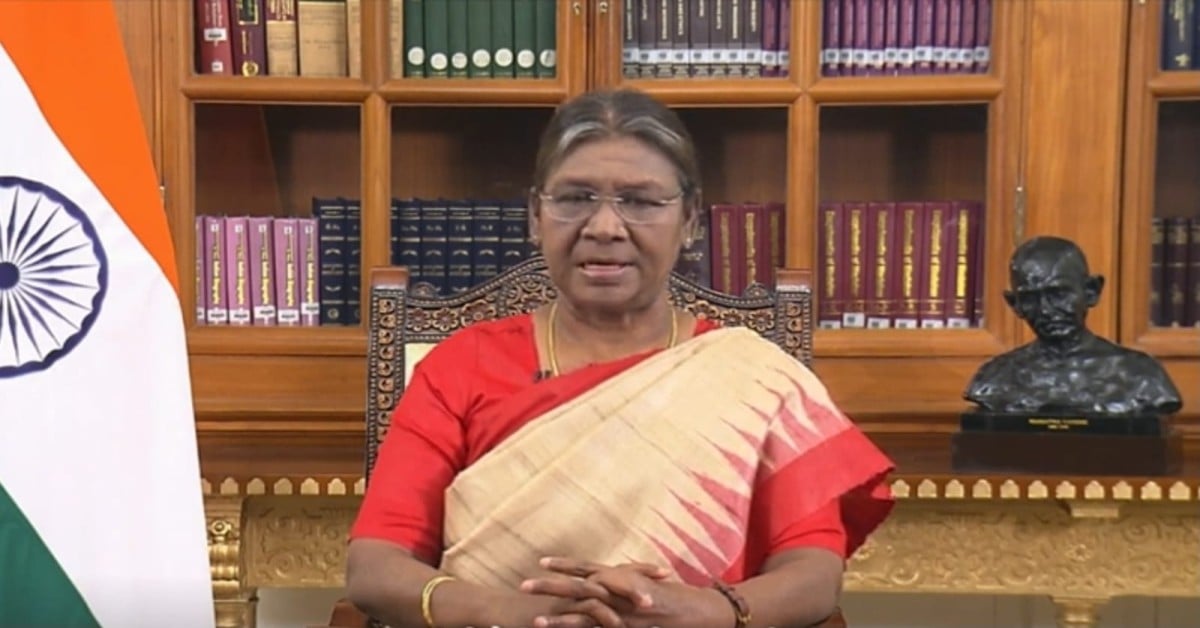
President Droupadi Murmu addresses the country on the eve of Republic Day | WATCH

The National Education Policy (NEP) prepares the learners for the challenges of the 21st century and makes the knowledge based on our civilisation relevant to contemporary life, she said in her speech

Published

on

President Draupadi Murmu

As India is set to enter the 74th year of becoming a Republic on January 26, 2023, President Droupadi Murmu gave a speech addressing the country on the Republic Day’s eve.

In her message to the nation, President Murmu said that she extends her hearty greetings to all the Indias living in the country and abroad. When we celebrate Republic Day, we celebrate what we have achieved together as a nation.

Watch the President’s address here:

She said that we are all one, and we are all Indians. So many creeds and so many languages have not divided us but united us. That’s why we have succeeded as a democratic republic. This is the essence of India.

India has moved from being a poor and illiterate nation to a confident nation on the world platform. This progress would not have been possible without the guidance from the collective wisdom of the framers of the Constitution, the President said in her speech.

India became fifth largest economy in World

Last year India became the fifth largest economy in the world. This achievement despite a a global backdrop of economic uncertainty. With the help of able leadership and effective struggle, we soon came out of the recession, and resumed our journey of development.

President praises NEP

The National Education Policy (NEP) prepares the learners for the challenges of the 21st century and makes the knowledge based on our civilisation relevant to contemporary life. We can feel proud of our achievements in the field of science and technology. In the field of space technology, India has been one of the few leading countries, she said.

Women empowerment is no longer just a slogan

President Murmu continued her speech, saying that women empowerment and equality between women and men are no longer mere slogans. She said that there was no doubt in her mind that women will make the maximum contribution to shape the India of tomorrow. This vision of empowerment guides the working of the government for the weaker sections, including the Scheduled Castes and the Scheduled Tribes .

People of tribal community teaching ways of protecting environment

In her speech, Murmu, who is first tribal President of India, gave a special mention to the members of tribal community. She said that the government’s aim was not only to remove obstacles in the lives of tribal people and help them grow, but also to learn from those communities. Tribal communities have many lessons to offer in many areas, from protecting the environment to making society more cohesive.

India is presiding over the G-20 this year.

This year India is presiding over the group of G-20 countries. In line with our ideal of universal brotherhood, we stand for peace and prosperity for all. The chairmanship of the G-20 gives India a very important role in contributing to building a better world.

Global warming big challenge

In the President’s view, global warming and climate change are challenges that need to be addressed urgently. Global temperatures are rising and extreme forms of climate change are visible.

India News

Delhi air quality improves slightly but stays in poor category

Delhi’s air quality improved slightly on Friday with the AQI falling to the poor category, though many areas continue to record very poor pollution levels.

Published

on

Delhi's air quality

Delhi witnessed a marginal improvement in air quality on Friday, with the overall Air Quality Index (AQI) slipping into the ‘poor’ category. Official data showed the city’s average AQI at 292, offering limited relief after pollution levels had touched the ‘severe’ mark earlier this week.

The improvement comes days after Delhi recorded an AQI of 412 on December 23, placing air quality firmly in the ‘severe’ category. Over the last two days, pollution levels have shown a gradual decline across multiple monitoring stations in the national capital.

Some stations record moderate air quality

According to data from the Central Pollution Control Board’s Sameer mobile application, three locations reported ‘moderate’ air quality as of early morning. Lodhi Road-IITM recorded an AQI of 160, Lodhi Road-IMD stood at 194, while Najafgarh reported 188.

Several other parts of the city remained in the ‘poor’ category. Areas including Aya Nagar, CRRI Mathura Road, Dr Karni Singh Shooting Range, Dwarka Sector 8, IGI Airport Terminal 3, IIT Delhi, Jawaharlal Nehru Stadium and Mandir Marg recorded AQI values ranging between the low 200s and high 200s.

Very poor air persists in pollution hotspots

Despite the overall improvement, many parts of Delhi continued to struggle with ‘very poor’ air quality. Anand Vihar, Bawana, Jahangirpuri, Narela, Nehru Nagar, Sonia Vihar and Vivek Vihar reported some of the highest AQI readings, with values crossing 350 at several locations.

In view of the easing pollution levels, the Commission for Air Quality Management lifted Graded Response Action Plan (GRAP) Stage-IV restrictions across the Delhi-National Capital Region on December 24. Officials indicated that further relaxations could be considered if the downward trend in pollution continues.

Mixed air quality across NCR

Air quality in neighbouring NCR regions showed mixed trends. In Haryana, Bahadurgarh recorded a ‘very poor’ AQI of 301, while Gurugram’s overall AQI stood at 270, falling in the ‘poor’ category. One monitoring station in Gurugram’s Sector 51 reported ‘very poor’ air quality with an AQI of 375. Dharuhera also remained in the ‘poor’ range.

In Uttar Pradesh, pollution levels stayed elevated. Ghaziabad recorded an overall AQI of 344, with all monitoring stations reporting ‘very poor’ air quality. Greater Noida’s AQI stood at 362, while Knowledge Park-V and Knowledge Park-III recorded AQI levels of 386 and 337 respectively. Noida also remained in the ‘very poor’ category with an AQI of 334.

Authorities have restricted the entry of non-BS 6 vehicles into Delhi, a move that has blocked around 1.2 million older vehicles registered outside the city. Vehicular emissions remain a key contributor to winter pollution, with experts estimating that vehicles account for up to 40 per cent of particulate matter pollution in the NCR.

Continue Reading

India News

Train fares increased from December 26: check revised ticket prices across classes

Indian Railways has increased long-distance train fares from December 26, with higher ticket prices for mail, express, sleeper and select ordinary classes.

Published

on

Train fair

Long-distance train travel has become costlier from Friday as the Ministry of Railways implemented a revision in passenger fares. This is the second fare hike in the last six months, with the ministry stating that the decision aims to balance passenger affordability with the sustainability of railway operations.

What has changed in train ticket prices

According to the revised structure, the fare hike applies only to tickets booked on or after December 26. Passengers who booked tickets before this date will not have to pay any additional amount, even if their journey takes place later.

There is no increase in fares for suburban train services and season tickets, covering both suburban and non-suburban routes.

Revised fares for second class ordinary travel

For passengers travelling in Second Class Ordinary coaches, the fare increase depends on the distance:

  • Journeys up to 215 km: no change
  • 216 km to 750 km: increase of Rs 5
  • 751 km to 1,250 km: increase of Rs 10
  • 1,251 km to 1,750 km: increase of Rs 15
  • 1,751 km to 2,250 km: increase of Rs 20

Sleeper and first class ordinary fares

For Sleeper Class Ordinary and First Class Ordinary, fares have been increased by 1 paisa per kilometre.

Mail and express train fare hike

Mail and Express trains have seen a uniform increase of 2 paise per kilometre across all non-AC and AC classes. This includes Sleeper Class, First Class, AC Chair Car, AC 3-Tier, AC 2-Tier and AC First Class. As a result, a passenger travelling around 500 km in a non-AC Mail or Express coach will pay approximately Rs 10 extra.

The revised fares are also applicable to premium and special services such as Rajdhani, Shatabdi, Duronto, Vande Bharat, Tejas, Garib Rath, Jan Shatabdi, Humsafar, Amrit Bharat, Antyodaya, Gatimaan, Mahamana, Yuva Express and Namo Bharat Rapid Rail.

No change in reservation and other charges

The ministry has clarified that there is no change in reservation fees, superfast surcharges or other ancillary charges. GST rules remain unchanged, and fares will continue to be rounded off as per existing norms.

The Railways said the updated fare structure follows a balanced approach to ensure passenger convenience while supporting operational requirements.

Continue Reading

India News

PM Modi pays tribute to Atal Bihari Vajpayee at Sadaiv Atal, says leadership is defined by conduct

PM Modi paid tribute to Atal Bihari Vajpayee at Sadaiv Atal, saying true leadership is defined by conduct and values, not by position.

Published

on

PM Modi pays tribute to Atal Bihari Vajpayee at Sadaiv Atal, says leadership is defined by conduct

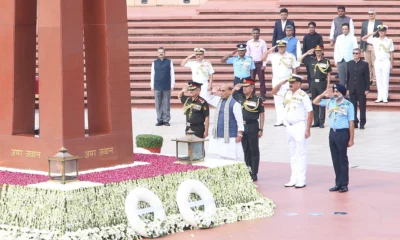
Prime Minister Narendra Modi on Thursday paid floral tributes to former Prime Minister Atal Bihari Vajpayee at the ‘Sadaiv Atal’ memorial in New Delhi on the occasion of his 101st birth anniversary. Remembering Vajpayee’s legacy, the Prime Minister said that true leadership is not established by position, but by conduct.

Several dignitaries were present at the memorial to pay homage to the former Prime Minister, who remains one of the most respected figures in Indian politics.

PM Modi remembers Vajpayee’s conduct and values

In a message shared on social media platform X, Prime Minister Modi described Atal Bihari Vajpayee as a statesman whose behaviour, dignity and unwavering commitment to national interest set a benchmark for Indian politics. He said Vajpayee’s life continues to inspire the nation and highlights that leadership is determined by character rather than authority.

The Prime Minister also shared a Sanskrit verse, noting that the actions of great leaders guide society, and said this principle was clearly reflected throughout Vajpayee’s public life.

‘Nation always came first for Atal ji’

Prime Minister Modi further said that Vajpayee’s birth anniversary is an opportunity for everyone to draw inspiration from his life. He highlighted Vajpayee’s conduct, grace, ideological firmness and resolve to place the nation’s interest above all else as an ideal standard for public life.

Through his life and work, Vajpayee demonstrated that excellence and greatness are shaped by values and conduct, not merely by holding office, the Prime Minister said. The remarks were shared with inputs from media.

Continue Reading

Trending

© Copyright 2022 APNLIVE.com