English हिन्दी
Connect with us

India News

India marks 77th Republic Day with grand parade at Kartavya Path

India marked its 77th Republic Day with a grand parade at Kartavya Path, highlighting military strength, cultural unity and international participation.

Published

on

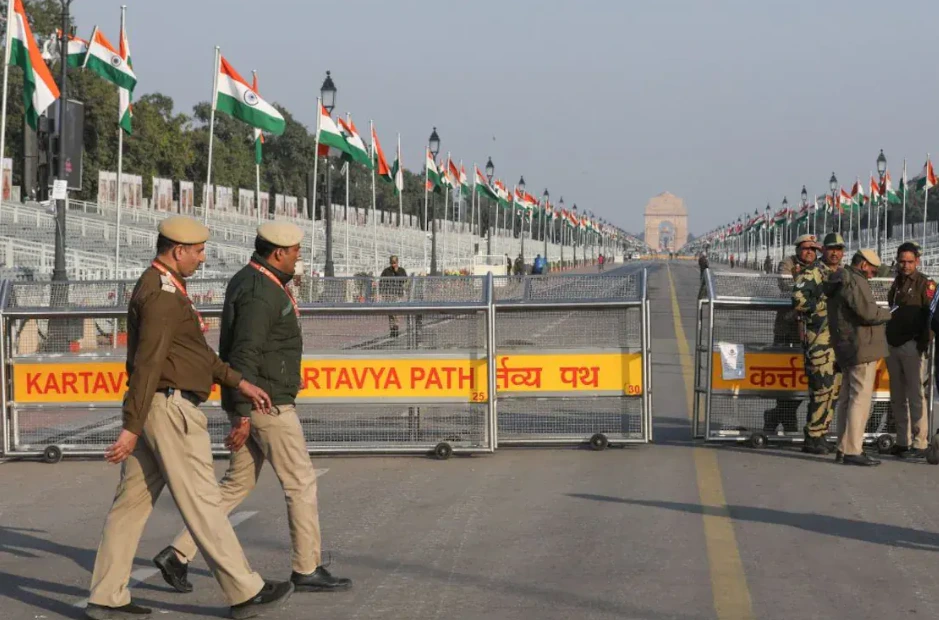
Kartavya Path on Republic Day 2026

India is celebrating its 77th Republic Day today with a ceremonial parade at Kartavya Path in New Delhi, presided over by President Droupadi Murmu. European Council President Antonio Costa and European Commission President Ursula von der Leyen are attending the celebrations as chief guests.

Kartavya Path, stretching from Rashtrapati Bhavan to the National War Memorial, has been extensively decorated to reflect India’s journey as a republic. This year’s celebrations also mark the 150-year legacy of the national song Vande Mataram, blending historical symbolism with contemporary national achievements.

According to the Defence Ministry, the parade highlights India’s developmental progress, military capabilities, cultural diversity, and participation from citizens across the country.

Parade begins with tribute at National War Memorial

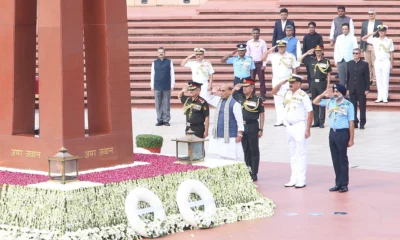
The Republic Day parade began at 10:30 am and is scheduled to run for around 90 minutes. Prime Minister Narendra Modi first visited the National War Memorial, where he laid a wreath to honour fallen soldiers. He then proceeded to the saluting dais at Kartavya Path along with other dignitaries.

President Murmu arrived at the venue in the traditional buggy, accompanied by the two chief guests and escorted by the President’s Bodyguard, the senior-most regiment of the Indian Army.

Following the unfurling of the national flag, the national anthem was played along with a 21-gun salute using indigenously developed 105 mm light field guns. The salute was presented by the 1721 Ceremonial Battery of the 172 Field Regiment.

Cultural performances and parade leadership

More than 100 cultural artists are participating in the parade, performing on the theme ‘Vividata Mein Ekta – Unity in Diversity’. The musical presentation reflects India’s cultural richness and national unity.

The parade is being commanded by Lieutenant General Bhavnish Kumar, General Officer Commanding, Delhi. Major General Navraj Dhillon, Chief of Staff at Headquarters Delhi, is serving as the Parade Second-in-Command.

Gallantry award winners and EU participation

Recipients of India’s highest gallantry awards are also part of the parade. These include Param Vir Chakra awardees Subedar Major (Honorary Captain) Yogendra Singh Yadav (retired) and Subedar Major Sanjay Kumar, along with Ashoka Chakra awardees Major General CA Pithawalia (retired) and Colonel D Sreeram Kumar.

An European Union contingent is participating with four flag bearers on three gypsies. The group is carrying the flags of the European Union, the European Union Military Staff, EU Naval Force Atalanta, and EU Naval Force Aspides.

First-ever phased battle array display

For the first time, the Indian Army is showcasing a phased battle array format during the parade, including aerial elements. The reconnaissance component includes the 61 Cavalry in combat uniform, followed by the high mobility reconnaissance vehicle — India’s first indigenously designed armoured light specialist vehicle.

Aerial support is being provided by the indigenous Dhruv advanced light helicopter and its armed variant, Rudra, underlining India’s growing defence self-reliance.

India News

Voting underway in West Bengal phase 1 and Tamil Nadu as turnout crosses 50% by afternoon

Voter turnout crosses 50% in West Bengal phase 1 and Tamil Nadu as polling continues across key constituencies.

Published

on

voting percentage Bengal and Tamilnadu

Voting is underway in West Bengal and Tamil Nadu as the 2026 assembly elections see active participation from voters across both states. In West Bengal, the first phase of polling is being held across 152 constituencies in 16 districts, marking the beginning of a multi-phase election process.

Tamil Nadu, on the other hand, is witnessing single-phase polling across all 234 assembly seats, making it a crucial electoral day for the state.

Polling began in the morning with voters arriving at booths early, and arrangements were in place to ensure smooth voting.

Turnout figures show steady participation

As voting progressed, turnout figures indicated moderate to strong participation in both states.

  • West Bengal recorded around 62.2% voter turnout by 1 pm
  • Tamil Nadu saw approximately 56.8% turnout by the same time

Earlier in the day, initial turnout trends showed gradual momentum as queues built up at polling stations.

High-stakes contest in both states

The elections are significant for major political parties in both regions.

In West Bengal, the contest remains largely between the ruling Trinamool Congress and the Bharatiya Janata Party, with several key constituencies drawing attention. Around 3.6 crore voters are eligible to vote in this phase, highlighting the scale of the exercise.

Tamil Nadu’s election features a traditional contest between the DMK and AIADMK alliances, with the outcome expected to shape the state’s political direction.

Security and arrangements in place

Authorities have deployed security personnel and made logistical arrangements to ensure peaceful polling. Reports indicate that voting is largely proceeding smoothly, with monitoring systems in place across sensitive areas.

The election process in West Bengal will continue with the second phase scheduled for April 29, while Tamil Nadu will conclude voting in a single day.

Continue Reading

India News

Early voter turnout steady in Tamil Nadu and Bengal as polling gains pace

Tamil Nadu and West Bengal recorded steady voter turnout till 9 am as polling began across constituencies, with numbers expected to rise through the day.

Published

on

Elections

Morning polling sees moderate participation as voters head to booths across key states

Polling in the ongoing Assembly elections showed steady participation in the early hours on Thursday, with both Tamil Nadu and West Bengal recording moderate voter turnout by 9 am.

According to initial data released by election authorities, Tamil Nadu registered a turnout of around 17.7%, while West Bengal slightly edged ahead with approximately 18.8% in the same period.

Voting began at 7 am across polling stations, and officials expect the turnout to rise significantly as the day progresses, a pattern typically seen in Indian elections.

Tamil Nadu votes in single phase

Tamil Nadu is conducting polling across all 234 Assembly constituencies in a single phase. Early trends indicate a gradual but steady flow of voters, with participation likely to increase during the later hours of the day.

Several prominent personalities were among early voters, encouraging public participation and highlighting the importance of the democratic process.

Bengal phase 1 polling underway

West Bengal is witnessing polling across multiple constituencies in the first phase of its Assembly elections. The early turnout suggests an active start, with voters turning up in noticeable numbers despite the morning hours.

Turnout expected to rise through the day

Election officials have indicated that turnout figures in the morning are usually conservative, with a sharper increase expected in the afternoon and evening. Weather conditions, local factors, and voter mobilisation efforts often influence the final turnout percentage.

The elections are being closely watched due to the high political stakes in both states, with major parties competing intensely for control.

Continue Reading

India News

West Bengal election battle begins as phase 1 voting covers 152 seats

Phase 1 of the Bengal assembly elections begins with voting across 152 constituencies, setting the stage for a high-stakes TMC vs BJP contest.

Published

on

West bengal elections

Voting for the first phase of the West Bengal assembly elections 2026 began on April 23, marking the start of a crucial political contest in the state.

In this phase, polling is being held across 152 constituencies, making it one of the most significant stages of the election process. The voting spans multiple districts across both North and South Bengal, setting the tone for the rest of the electoral battle.

The election is largely being seen as a direct contest between the ruling Trinamool Congress (TMC) and the Bharatiya Janata Party (BJP). While the TMC is seeking to retain power after over a decade in office, the BJP is aiming to expand its presence and challenge the incumbent government.

A large number of candidates are in the fray for this phase, reflecting the scale and intensity of the contest. Several prominent leaders are contesting from key constituencies, adding to the political significance of the opening phase.

The elections are being conducted in two phases, with the second round of polling scheduled for April 29. The counting of votes is expected in early May, after which the composition of the 294-member assembly will be decided.

Key issues shaping voter sentiment include employment concerns, welfare schemes, governance, and identity politics. The outcome of this phase is expected to provide early indications of the broader electoral trend in the state.

With high voter turnout expected and tight security arrangements in place, the first phase is being closely watched as it could influence momentum for the remaining constituencies.

Continue Reading

Trending

© Copyright 2022 APNLIVE.com